
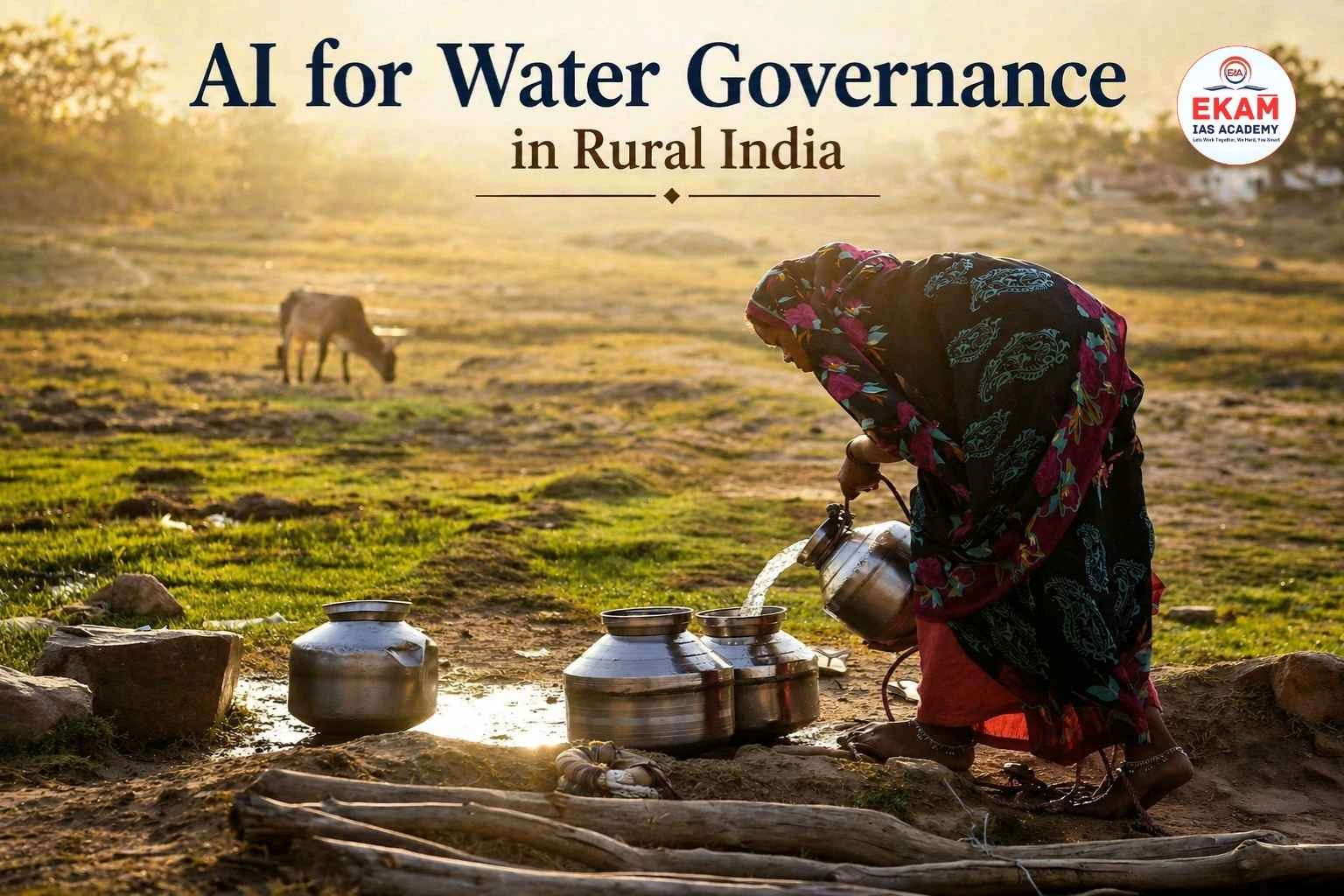
Recently, a pilot project called AI4WaterPolicy in Rajasthan’s Sirohi and Pali districts showed how AI can strengthen water resilience and last mile governance by listening to communities and improving responsiveness. This topic is important for aspirants preparing through IAS coaching in Hyderabad, UPSC coaching in Hyderabad, and UPSC online coaching.
Background
• India is in an AI adoption phase across agriculture, health, finance, and governance.
• Most AI tools assume information gaps, but rural challenges often stem from institutional gaps — delays, lack of coordination, and social barriers.
• The pilot used AI to listen to communities, not just push information.
Such governance and technology intersections are widely discussed in Hyderabad IAS coaching.
The Pilot Project – AI4WaterPolicy
• Conducted in 50 villages over 6 months, with 352 interviews.
• AI chatbot held 20-minute WhatsApp conversations in Hindi/local dialects with:
• Pani Mitras (community water volunteers)
• Panchayat leaders
• CmF frontline staff
• Conversations captured local realities: pride in water gains, women’s double burden, and delays in Panchayat approvals.
• Findings were validated in “Pause and Reflect” workshops, leading to mid-cycle redesign of training programmes.
Key Insights
• Community Pride: Villagers reported visible water table improvements.
• Gender Burden: Women faced dual responsibilities — community work plus household duties.
• Institutional Delays: Panchayat approvals slowed project execution.
• Behavioural Barriers: Limited knowledge of Panchayat procedures reduced participation.
These insights are relevant for GS3 preparation under IAS coaching and civils coaching in Hyderabad.
Challenges
• Digital Divide: Access gaps due to caste, class, gender, and smartphone availability.
• Fragmented Responsibility: Health, labour, disaster, and platform governance act separately.
• Dependence on Human Intermediaries: AI worked only because CmF had built trust with communities.
Way Forward
• Treat AI as Listening Tool: Use AI to capture qualitative insights at scale, not just push advisories.
• Integrate with Governance: Link findings to Panchayati Raj training, Jal Jeevan Mission, and rural development schemes.
• Platform Responsibility: Encourage digital platforms to adopt climate-responsive and community-responsive design.
• Inclusive Design: Ensure women and marginalised groups have access to devices and safe spaces for participation.
• Institutional Coordination: Strengthen collaboration between local bodies, state departments, and NGOs.
Strategic Significance
• Demonstrates how AI can empower, not replace, human intermediaries like Pani Mitras.
• Provides a model for last-mile responsiveness in programmes such as Jal Jeevan Mission, VB GRAM, and rural extension systems.
• Shows that community-led development becomes more effective when AI enables active listening and rapid feedback loops.
Conclusion
Rajasthan pilot shows that AI can strengthen community-led development by enabling active listening and rapid feedback loops. This approach makes programmes more inclusive, responsive, and resilient, ensuring local voices shape real policy action. For aspirants using UPSC online coaching and IAS coaching in Hyderabad, this topic is highly relevant for GS3 Science & Technology.
This topic is available in detail on our main website.