


A recent growing role of AI companies in the U.S. defence industry, shifting military innovation from traditional weapons raises questions about defence costs, cybersecurity and the future of warfare, particularly for India. This highlights the growing importance of Artificial Intelligence in Modern Warfare, Artificial Intelligence in Defence and AI in India’s Defence Sector.
What is the Military-Industrial Complex?
- The Military-Industrial Complex (MIC) refers to the relationship between armed forces, defence manufacturers, technology companies and government institutions.
- Traditionally, it focused on expensive aircraft, warships, missiles and armoured vehicles.
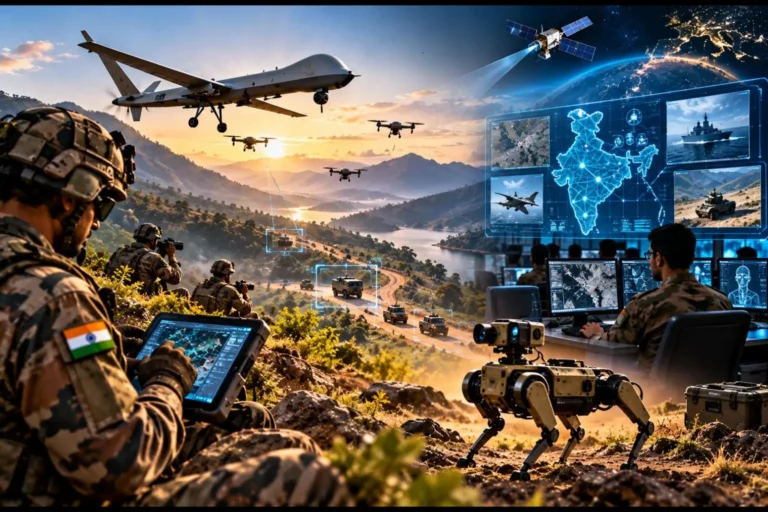
- Increasingly, AI, cloud computing, advanced chips and autonomous systems are becoming essential components of military capability, including Military Applications of Artificial Intelligence.
- This shift is often described as software-defined warfare, where digital systems influence the performance of physical weapons and contribute to Future of Warfare Technology.
Why is AI Transforming Defence?
- Changing war economics: Low-cost drones can force opponents to use expensive defensive missiles.
- Faster innovation: Software upgrades can improve military systems without replacing entire platforms.
- Private investment: Technology startups can develop specialised solutions through commercial research.
- Procurement reforms: Flexible contracts may reduce delays in acquiring new capabilities.
- Data advantage: AI can process satellite images, intelligence reports and battlefield information rapidly.
- These developments are driving AI Warfare Technology and transforming modern defence capabilities.
Major Applications of Military AI
- Intelligence: Analyses surveillance footage and identifies unusual activities.
- Autonomous systems: Supports navigation and coordination of unmanned vehicles and contributes to the development of Autonomous Weapons Systems.
- Cybersecurity: Detects suspicious network behaviour and potential attacks, strengthening Artificial Intelligence and Cyber Warfare capabilities.
- Logistics: Predicts equipment failures and improves supply management.
- Decision support: Helps commanders compare operational information.
- Training: AI-enabled simulations support realistic military exercises.
- These applications demonstrate the growing role of AI-Powered Weapons Systems and AI-enabled military technologies.
Strategic and Economic Significance
- Defence efficiency: Affordable unmanned systems can complement costly conventional platforms.
- Industrial transformation: Software firms, chip manufacturers and cloud providers gain strategic importance.
- Technological competition: Control over computing infrastructure and advanced semiconductors becomes critical.
- Deterrence: Faster information processing may improve situational awareness.
- Global supply chains: Countries face pressure to secure trusted technology and domestic production capabilities.
- For India, these developments are closely linked to India’s Military Modernisation, Defence Technology in India and AI and National Security.
Challenges
- Cyber vulnerabilities: Hacked software may disrupt critical military operations.
- Algorithmic errors: Incorrect data can produce unreliable assessments.
- Accountability: Autonomous weapons raise questions about human control and international humanitarian law.
- Corporate dependence: Reliance on a few private technology providers creates strategic vulnerabilities.
- Verification gaps: Frequent software updates make safety testing more difficult.
- Escalation risks: Faster automated responses may reduce time for human judgement.
Way Forward
- Indigenous innovation: Strengthen defence AI research through DRDO, iDEX and domestic startups.
- Defence modernisation: Integrate AI with surveillance, logistics and unmanned systems.
- Cyber resilience: Secure military networks, data and communication infrastructure.
- Human oversight: Retain meaningful human control over critical decisions.
- Skill development: Train personnel in AI, robotics and electronic warfare.
- Institutional reform: Improve procurement, testing standards and cooperation between academia and industry.
- These measures are important for Defence Current Affairs UPSC, AI in Modern Warfare UPSC and Internal Security UPSC preparation.
Conclusion
India must combine indigenous AI innovation, secure digital infrastructure and responsible human oversight to remain strategically prepared for the next generation of warfare. The evolution of Artificial Intelligence in Modern Warfare, AI in India’s Defence Sector, AI Warfare Technology, AI and National Security and Future of Warfare Technology makes responsible technological adoption central to India’s strategic preparedness.