

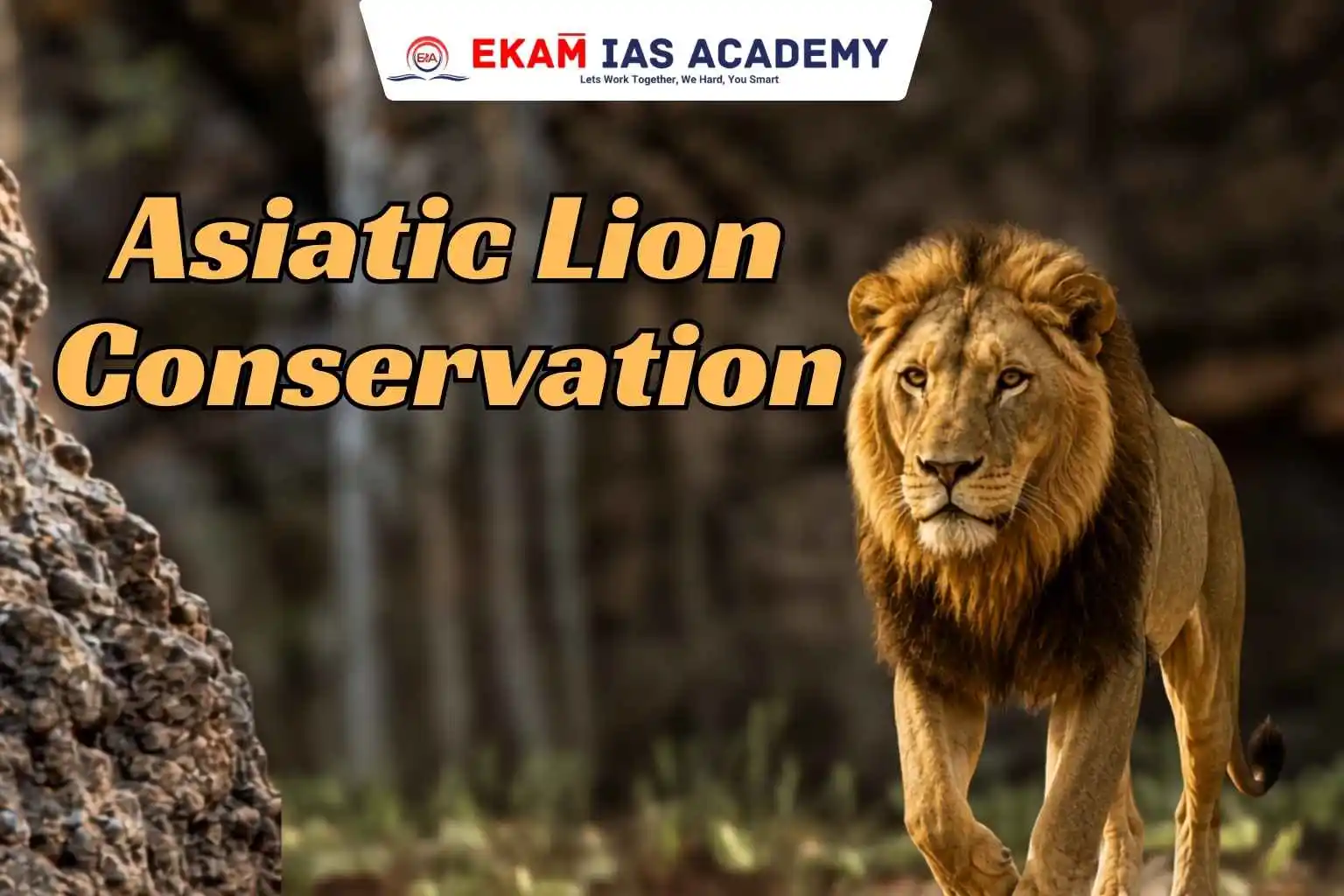
The Asiatic Lion (Panthera leo persica) population crossing 1,000 marks represents a major milestone in India’s wildlife conservation journey. However, conservation success cannot be measured only through increasing numbers; long-term survival requires habitat protection, disease management, wildlife corridor conservation, and ecological planning. This topic is important for aspirants preparing for GS3 Environment through IAS Coaching in Hyderabad.
Introduction
- The Asiatic Lion (Panthera leo persica) is India’s only wild lion species and an important symbol of the country’s biodiversity.
- Once distributed across West Asia and northern India, it is now naturally found only in the Gir landscape of Gujarat.
- Although India has achieved remarkable success in increasing its population, ensuring the species’ future requires moving beyond population growth to habitat security, disease management, and long-term ecological planning.
About the Asiatic Lion
- Scientific Name: Panthera leo persica
- Natural Habitat: Gir landscape, Gujarat
- IUCN Red List: Vulnerable
- Wildlife (Protection) Act, 1972: Schedule I
- CITES: Appendix I
- It is slightly smaller than the African lion and is identified by a distinct fold of skin along its abdomen.
Conservation Achievements
- The population has increased from around 100–150 lions in the 1960s to over 1,000 today.
- Nearly half of the lions now live outside protected areas, indicating healthy natural dispersal.
- The species has expanded beyond Gir National Park into Girnar Hills, Mitiyala forests, Savarkundla-Liliya region, coastal areas, agricultural fields, grasslands, and riverbeds.
- Improved forest protection, prey availability, and community participation have played a major role in this recovery.
Factors Behind the Success
- Strong political commitment towards wildlife conservation.
- Efficient forest administration and regular monitoring.
- Continuous financial support for habitat management and protection.
- Cooperation of local communities, who have largely accepted the presence of lions and supported coexistence.
Challenges
- Concentration in a Single Region: The entire wild population is still confined to the Gir landscape. A single catastrophic event such as a disease outbreak, wildfire, or natural disaster could severely affect the entire species.
- Disease Threats: The 2018 Canine Distemper Virus (CDV) outbreak caused the death of more than 20 lions. It highlighted the need for continuous disease surveillance and veterinary care.
- Habitat Fragmentation: Expansion of roads, industries, railways, and urban settlements can break wildlife corridors. Fragmented habitats reduce lion movement and increase human-lion conflicts.
Way Forward
- Strengthen landscape-based conservation by protecting habitats beyond Gir.
- Preserve and restore wildlife corridors connecting lion habitats.
- Enhance disease monitoring, veterinary infrastructure, and scientific research.
- Promote community-based conservation through awareness and compensation mechanisms.
Conclusion
A balanced approach combining scientific management, habitat connectivity, and geographical diversification will ensure that the Asiatic lion continues to thrive for future generations.