

India’s southwest monsoon reportedly recorded a rainfall deficit of nearly 13% in 2026, alongside strong El Niño conditions. This highlights the El Nino Effect on Indian Monsoon, Impact of El Niño on Rainfall in India and broader Monsoon Variability in India.
Understanding El Niño
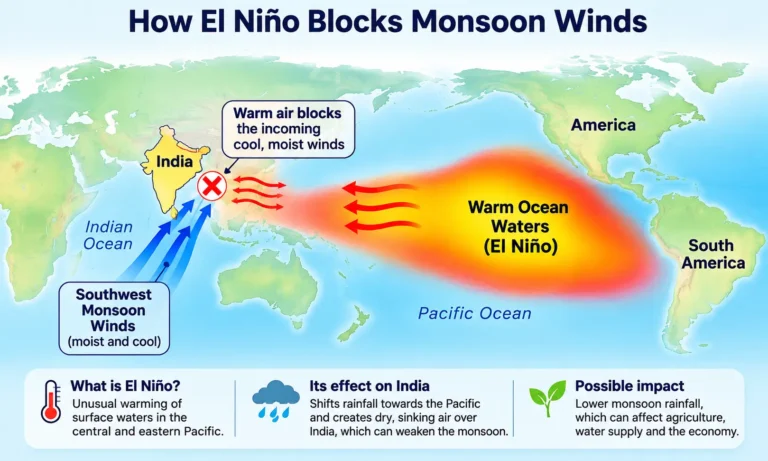
- El Niño is the abnormal warming of surface waters in the central and eastern equatorial Pacific Ocean. It is an important El Nino Weather Phenomenon in global climate studies.
- It is the warm phase of the El Nino–Southern Oscillation (ENSO), making ENSO and Indian Monsoon linkages important for understanding monsoon behaviour.
- Normally, trade winds push warm Pacific waters towards Indonesia, encouraging cloud formation and rainfall.
- During El Niño, these winds weaken, shifting rainfall towards the eastern Pacific.
- This can increase sinking, dry air over India and weaken the southwest monsoon, contributing to the El Nino Effect on Indian Monsoon.
Why El Niño Does Not Always Cause Drought
- Indian Ocean Dipole (IOD): A positive IOD, with warmer western Indian Ocean waters, can support monsoon rainfall and modify the impact of El Niño. This relationship is often studied as Indian Ocean Dipole and El Niño.
- 1997 example: A favourable IOD helped India receive near-normal rainfall despite a strong El Niño.
- 2015 example: A weak IOD response failed to offset El Niño, contributing to deficient rainfall.
- El Niño location: Warming concentrated in the central Pacific may affect India differently from warming near South America.
- Regional circulation: Atmospheric pressure patterns over West Asia and moisture transport from the Arabian Sea can modify rainfall.
- Southern Ocean influence: Changes in winds around Antarctica can affect IOD development.
- Therefore, El Niño La Niña Explained requires understanding the interaction of multiple oceanic and atmospheric processes rather than treating El Niño alone as a direct cause of drought.
Role of Other Climate Factors
- Madden–Julian Oscillation (MJO): An eastward-moving tropical rainfall system that influences active and weak monsoon phases.
- Monsoon depressions: Low-pressure systems over the Bay of Bengal distribute rainfall across India.
- Himalayan and land–sea heating: Temperature differences influence monsoon circulation.
- Climate change: Rising temperatures can intensify rainfall extremes and increase uncertainty, highlighting the relationship between Indian Monsoon and Climate Change and Climate Change and Monsoon Patterns.
Improvements in Monsoon Forecasting
- India Meteorological Department (IMD) issues seasonal forecasts and updates them as new observations become available.
- Since 2021, IMD has used a multi-model ensemble approach, combining several climate models.
- Ocean temperatures, atmospheric circulation and regional weather patterns are considered together.
- However, accurate all-India seasonal forecasts do not guarantee accurate regional or monthly predictions.
- Improved forecasting is particularly important for El Nino UPSC, Southwest Monsoon UPSC and Geography and Environment UPSC preparation.
Significance for India
- Agriculture: Rainfall uncertainty affects sowing, crop yields and farmers’ incomes, making the El Nino and Indian Agriculture relationship particularly important.
- Food inflation: Poor harvests can increase food prices.
- Water security: Weak rainfall reduces reservoir storage and groundwater recharge.
- Energy: Hydropower generation and electricity demand are affected.
- Disaster management: Uneven rainfall can cause droughts and floods within the same season.
- These impacts demonstrate the wider Impact of El Niño on Rainfall in India and its implications for India’s economy and society.
Way Forward
- Improve district-level forecasts and early-warning systems.
- Expand irrigation, rainwater harvesting and watershed management.
- Promote drought-resistant crops and climate-resilient farming.
- Strengthen crop insurance and weather-based agricultural advisories.
- Invest in ocean observations, climate research and forecasting technology.
Conclusion
India’s monsoon depends on several interacting oceanic and atmospheric forces; therefore, climate resilience requires better forecasting, scientific planning and reduced dependence on rainfall. Understanding El Niño and the Indian Monsoon, El Niño Southern Oscillation (ENSO), Indian Ocean Dipole and El Niño, Monsoon Variability in India and Climate Change and Monsoon Patterns is essential for building resilient agriculture and water-security strategies.