
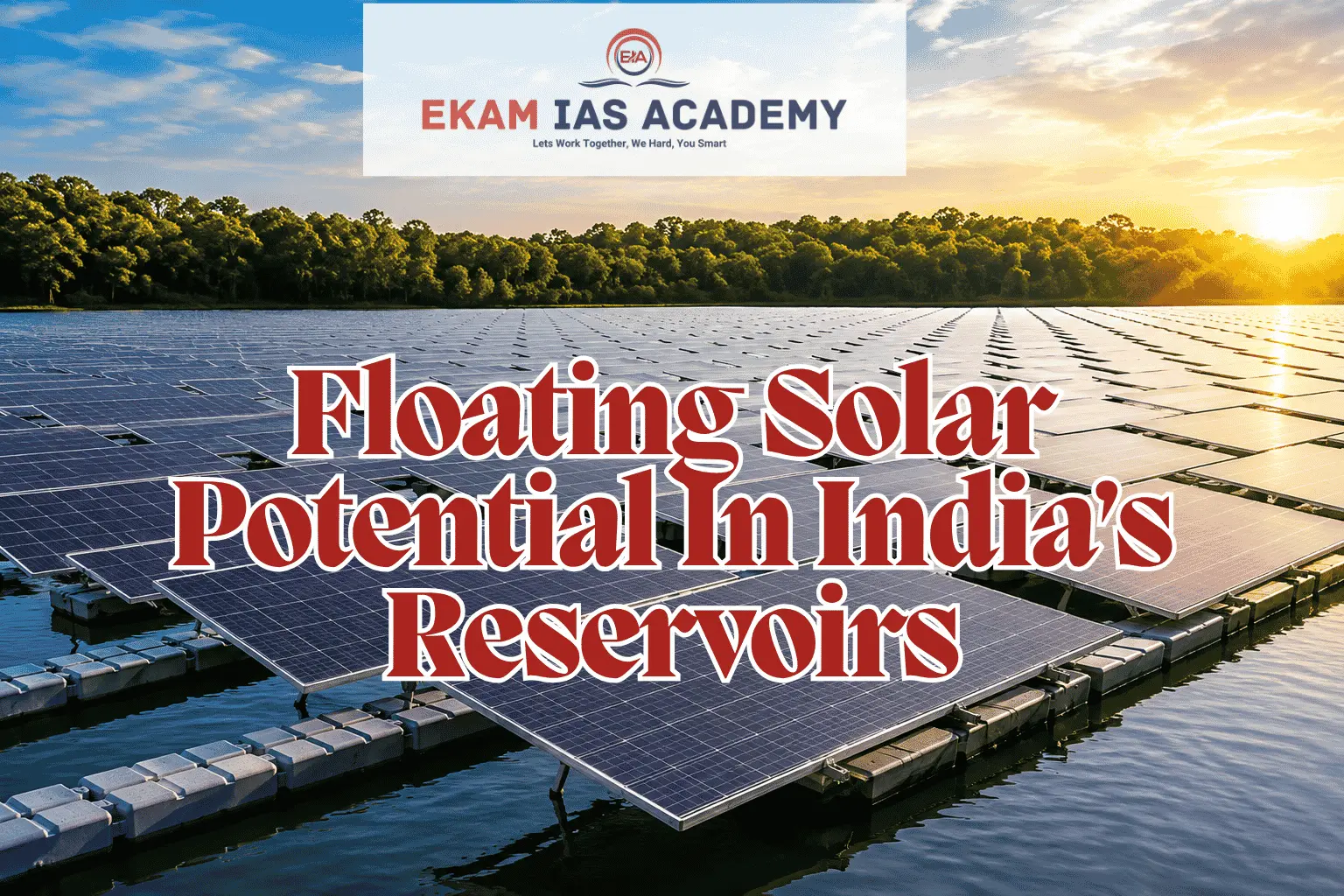
A report by the National Institute of Solar Energy (NISE), under the Ministry of New and Renewable Energy, has estimated that Indian reservoirs can host about 102 GW of floating solar capacity, highlighting a major opportunity for renewable energy expansion. This topic is important for aspirants preparing for GS3 Environment and renewable energy-related issues through civils coaching in Hyderabad.
What is Floating Solar?
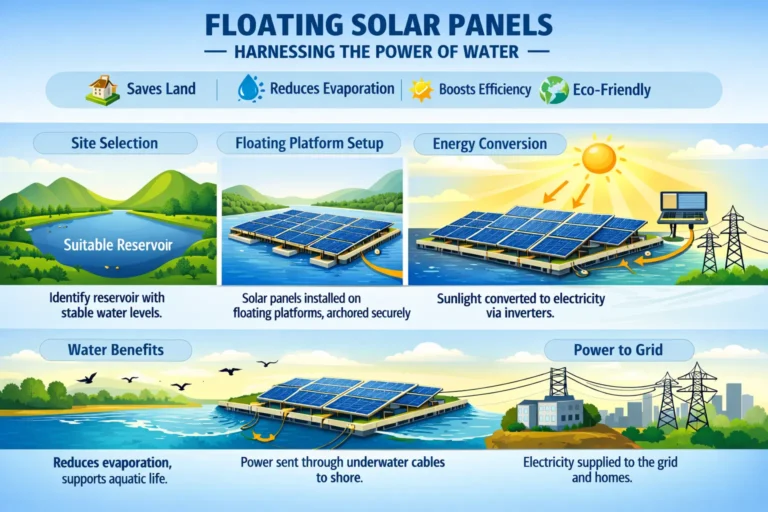
• Floating solar refers to solar photovoltaic panels installed on reservoirs, lakes, or other water bodies instead of land.
• It helps reduce land use conflicts, especially in a country like India where land is needed for agriculture, housing, industry, and infrastructure.
• It combines renewable energy generation with water conservation, making it an important solution for sustainable development.
Solar Panels on Water Surfaces
• Concept: Panels are installed on reservoirs, lakes, or other water bodies instead of land, helping reduce land use conflicts.
• Land Efficiency: Saves valuable agricultural and urban land, making renewable energy expansion more sustainable.
• Water Conservation: Limits evaporation losses from reservoirs, supporting irrigation and drinking water supply.
• Performance Boost: Cooler water surfaces improve panel efficiency, generating higher output compared to land based systems.
Key Findings of the Report
• Potential Capacity: India’s reservoirs can generate about 102 GW of floating solar power.
• State Contributions: Maharashtra, Madhya Pradesh, Karnataka, Odisha, and Telangana account for the bulk of this potential.
• Flagship Project: The Omkareshwar floating solar park in Madhya Pradesh aims for 600 MW capacity, making it one of the largest floating solar projects globally.
Implications
• Energy Security: Helps India diversify renewable energy sources beyond land based solar and wind.
• Climate Goals: Supports India’s target of 500 GW renewable capacity by 2030 under its climate commitments.
• Water Energy Nexus: Reduces evaporation losses, aiding irrigation and drinking water supply.
• Economic Impact: Creates jobs in installation, maintenance, and local supply chains.
Challenges
• High Costs: Floating solar projects are costlier than land based solar projects.
• Technical Risks: They require durable anchoring systems to withstand winds, waves, and water level fluctuations.
• Environmental Concerns: Poorly designed projects may affect aquatic ecosystems, water quality, and local biodiversity.
SOLAR ENERGY IN INDIA
- Installed Solar Capacity: As of May 2026, India has 157 GW of solar power capacity, including 118.79 GW ground‑mounted, 27.88 GW rooftop, and 6.31 GW off‑grid systems.
- Largest Solar Plant: The Bhadla Solar Park in Rajasthan is the largest in India and one of the biggest globally, with 2,245 MW capacity spread over 14,000 acres.
- Global Ranking: India ranks 3rd worldwide in renewable energy installed capacity, after China and the USA.
- State Leaders: Rajasthan, Gujarat, Maharashtra, Karnataka, and Madhya Pradesh together account for over 70% of India’s renewable potential.
India’s Energy Mix (2025–26)
- Coal Dominance: Coal remains the largest source, supplying ~60% of electricity.
- Renewable Share: Renewables contributed 29.2% of total electricity generation in 2025–26, with solar being the largest component.
- Milestone Achievement: India achieved 50% of its installed capacity from non‑fossil sources in June 2025, five years ahead of its Paris Agreement target.
Future Target: India aims for 500 GW of non‑fossil capacity by 2030, aligning with COP26 commitments.
Conclusion
Floating solar offers India a game changing renewable pathway by combining clean energy generation with water conservation. It can reduce land pressure, support climate goals, and strengthen India’s transition toward sustainable development.