
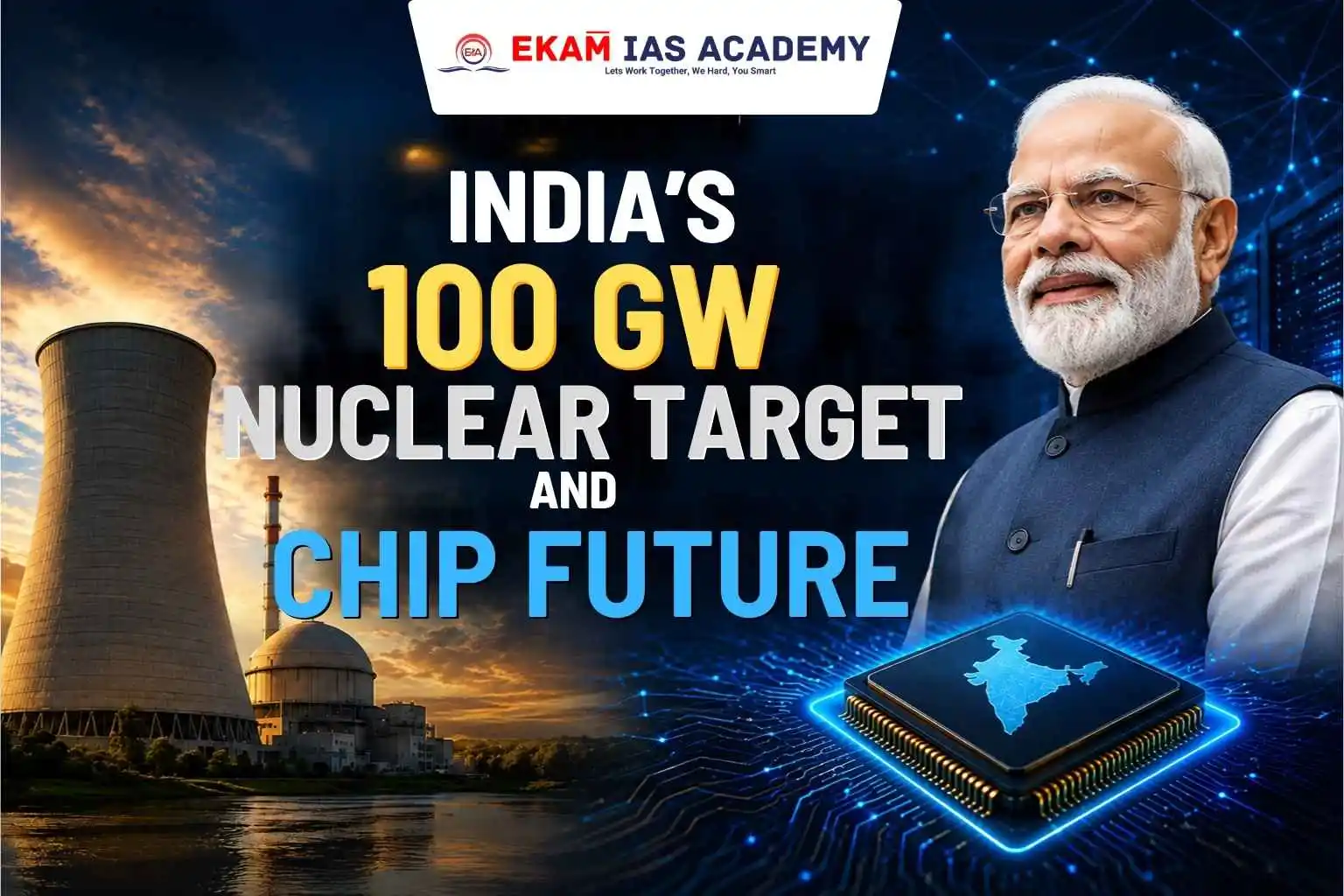
India’s growing digital economy, driven by Artificial Intelligence (AI), semiconductor manufacturing, and data centres, is creating unprecedented demand for reliable electricity. In this context, the announcement of a 100 GW nuclear power capacity target by 2047 highlights India’s strategy to combine clean energy expansion, technological growth, and energy security. This topic is important for aspirants preparing for GS3 Economy and Science & Technology through UPSC Preparation.
Background
- SHANTI Act 2025: Replaced older nuclear laws, enabled private participation, and gave statutory backing to the Atomic Energy Regulatory Board (AERB).
- Draft Rules (DAE): Cover licensing, safety, liability, and captive generation for private players.
- Global Interest: Russia, US, and France have shown interest in supplying nuclear technology.
Why Nuclear Expansion is Needed
- Digital Economy Demand: AI, semiconductor fabs, and data centres require continuous, high‑density electricity.
- Carbon Neutrality: Nuclear provides baseload clean energy, complementing renewables.
- Land & Storage Limits: Unlike solar/wind, nuclear requires less land and avoids large battery storage costs.
- Energy Security: Reduces dependence on coal imports and volatile fossil fuel markets.
Two-Pronged Strategy
- Large Reactors: Expansion of Pressurised Heavy Water Reactors (PHWRs) and imported Light Water Reactors (LWRs).
- Small Modular Reactors (SMRs): Flexible, quicker to deploy, suited for industrial decarbonisation and repurposing old thermal sites.
Current Nuclear Status
- Operational: 25 reactors, ~8.7 GWe.
- Under Construction: 10 reactors, ~8 GWe.
- Pre‑Project Stage: 10 units, ~6.6 GWe.
India’s Three-Stage Nuclear Programme
- Stage 1: PHWRs using natural uranium.
- Stage 2: Fast Breeder Reactors (FBRs) — convert thorium into fissile Uranium‑233.
- Stage 3: Thorium‑based advanced reactors for long‑term self‑reliance.
- Recent Milestone: Kalpakkam FBR achieved criticality in April 2026, marking progress toward thorium utilisation.
Significance
- Economic: Supports semiconductor & AI industries, reduces import bills.
- Strategic: Enhances energy independence, strengthens global nuclear partnerships.
- Environmental: Aligns with India’s Net Zero 2070 pledge.
- Social: Repurposing old thermal sites avoids displacement, ensures community acceptance.
- International Relations: Nuclear cooperation with Australia, Canada, Russia, Central Asia ensures uranium supply security.
Conclusion
India’s nuclear roadmap combining thorium self‑reliance, SMR innovation, and private participation is set to become the backbone of its AI‑driven, carbon‑neutral future.