

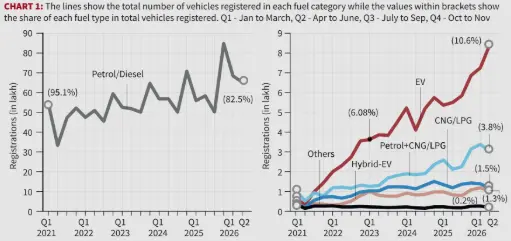
August 2026 marked a significant shift in India’s automobile market, as India Alternative Fuel Vehicles collectively crossed petrol vehicles in new registrations. This reflects the growing Alternative Fuel Vehicles in India transition towards cleaner and more sustainable mobility solutions.
Changing Automobile Fuel Pattern
- India is gradually moving from exclusive dependence on petrol and diesel towards Electric Vehicles in India, CNG Vehicles in India, hybrid vehicles, Hydrogen Fuel Cell Vehicles India, Ethanol Fuel Vehicles India, Biofuel Vehicles India and other alternatives.
- The shift is important because road transport contributes to urban air pollution, oil-import dependence and greenhouse-gas emissions.
- The transition towards India Alternative Fuel Vehicle Transition is a major step towards Clean Mobility in India and reducing environmental challenges.
- However, grouping EVs, hybrids and CNG together can hide differences in the pace of actual electrification and adoption of different Alternative Fuels and Transport India solutions.
Segment-wise EV Adoption
- Two-wheelers: EV adoption is gaining momentum because of relatively lower purchase prices, lower running costs and suitability for short-distance urban travel.
- Three-wheelers: This is the strongest electrification segment. Electric three-wheelers are particularly suitable for commercial passenger and goods transport because of high daily utilisation.
- Passenger cars: EV penetration remains comparatively slower. Consumers continue to consider CNG and hybrid vehicles because of concerns over charging access, purchase price and long-distance travel.
- Recent FADA data reported EV retail penetration of 12.3% across categories in August 2026, while passenger EVs accounted for 7.6%.
- The growth of Alternative Fuel Vehicles India 2026 highlights the gradual expansion of Vehicle Electrification India across different transport segments.
Why the Transition Matters
- Energy security: Reduces dependence on imported crude oil over the long term.
- Environment: EVs have no tailpipe emissions and can contribute more to decarbonisation as electricity generation becomes cleaner.
- Urban health: Lower vehicle emissions can help reduce local air pollution.
- Manufacturing: Battery, electronics, powertrain and charging industries can create new industrial capabilities and employment.
- Technology: Promotes innovation in batteries, energy storage, software and smart mobility.
- Sustainable mobility solutions under Green Mobility India can support India’s long-term climate and economic objectives.
Government Support
- PM E-DRIVE supports electric two-wheelers, three-wheelers, buses, trucks and other emerging EV categories, besides charging infrastructure. The scheme has been extended for relevant segments up to March 2028.
- The scheme provides ₹2,000 crore for public EV charging infrastructure.
- The 2024 EV charging guidelines seek interoperable, reliable and accessible charging networks and provide measures relating to electricity connections, land and tariffs.
- Government initiatives aim to strengthen Sustainable Transportation India by improving EV adoption and alternative mobility infrastructure.
Challenges
- High upfront cost of some EVs and batteries.
- Uneven charging infrastructure, particularly beyond major cities.
- Battery recycling and critical-mineral dependence.
- Consumer concerns regarding range, charging time and battery life.
- Need for cleaner electricity to maximise climate benefits.
- Scaling Alternative Fuel Vehicles in India requires addressing technological, economic and infrastructure barriers.
Way Forward
- Expand fast-charging infrastructure along highways and in residential areas.
- Strengthen domestic battery and critical-mineral supply chains.
- Promote battery recycling and second-life applications.
- Continue targeted incentives while gradually improving market competitiveness.
- Encourage public transport electrification, where high vehicle utilisation can generate larger fuel savings.
- Promote research and adoption of emerging technologies including Hydrogen Fuel Cell Vehicles India, biofuels and advanced clean-energy transport systems.
Conclusion
India’s fuel transition is progressing, but sustained electrification requires affordable EVs, reliable charging, domestic technology and cleaner electricity working together. The development of India Alternative Fuel Vehicles and Alternative Fuel Vehicles UPSC topics highlights the importance of balancing energy security, environmental sustainability and technological innovation in India’s transport future.