
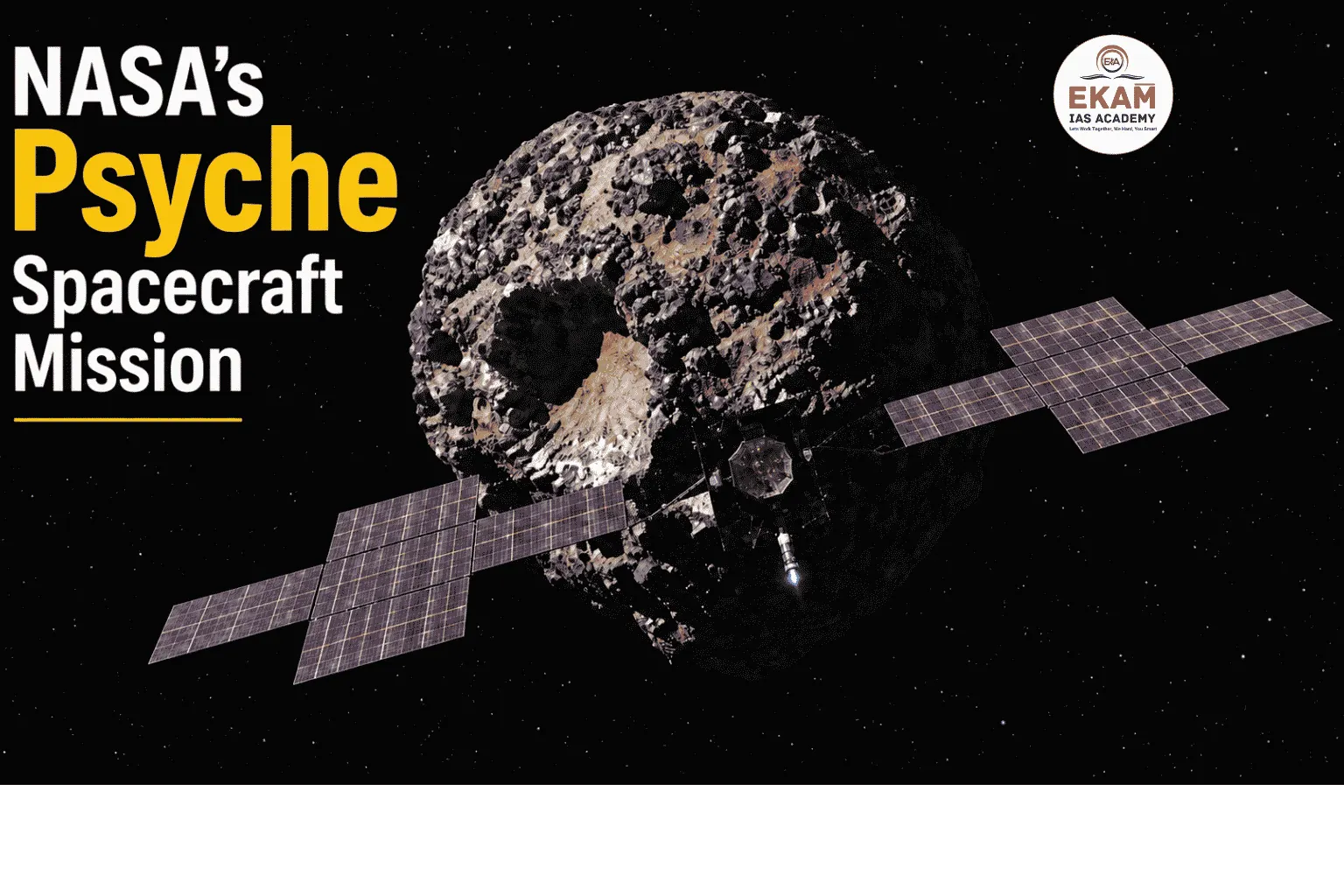
NASA’s Psyche spacecraft recently captured a crescent image of Mars from nearly 5 million km away, highlighting its progress in deep space exploration. This topic is important for aspirants preparing through IAS coaching in Hyderabad, UPSC coaching in Hyderabad, and UPSC online coaching.
Psyche Mission
• Launched on October 13, 2023 by NASA.
• Target: Asteroid Psyche, believed to be composed largely of nickel and iron.
• Timeline:
• Asteroid’s gravity will capture the spacecraft in July 2029.
• Prime mission begins in August 2029.
• Duration: Around two years of orbiting, imaging, and mapping.
Features of the Spacecraft
• Size: Comparable to a small van.
• Propulsion: Solar-electric system using xenon gas, gradually increasing speed.
• Design: Built for long-duration deep space travel with efficient energy use.
Scientific Instruments
• Magnetometer: Detects traces of ancient magnetic fields.
• Gamma-ray and neutron spectrometer: Determines surface chemical composition.
• Multispectral imager: Equipped with telescopic lenses and filters to capture images in multiple wavelengths.
Significance of the Mission
• Planetary science: Offers insights into how rocky planets’ cores may have formed.
• Asteroid composition: Psyche may represent the remnants of a protoplanet’s core.
• Space resources: Understanding metallic asteroids could inform future space mining.
• Technological innovation: Demonstrates solar-electric propulsion for deep space missions.
Importance for Future Space Exploration
• Helps scientists understand the early evolution of the solar system.
• Strengthens research into asteroid mining and rare metal extraction.
• Demonstrates advanced propulsion systems for future interplanetary missions.
• Contributes to global competition in deep space exploration and resource utilisation.
Conclusion
The Psyche mission findings could reshape our understanding of solar system evolution and open pathways for space resource utilisation. For aspirants preparing through IAS coaching and civils coaching in Hyderabad, it exemplifies the intersection of science, technology, planetary exploration, and strategic innovation in GS3 Science & Technology.
This topic is available in detail on our main website.