
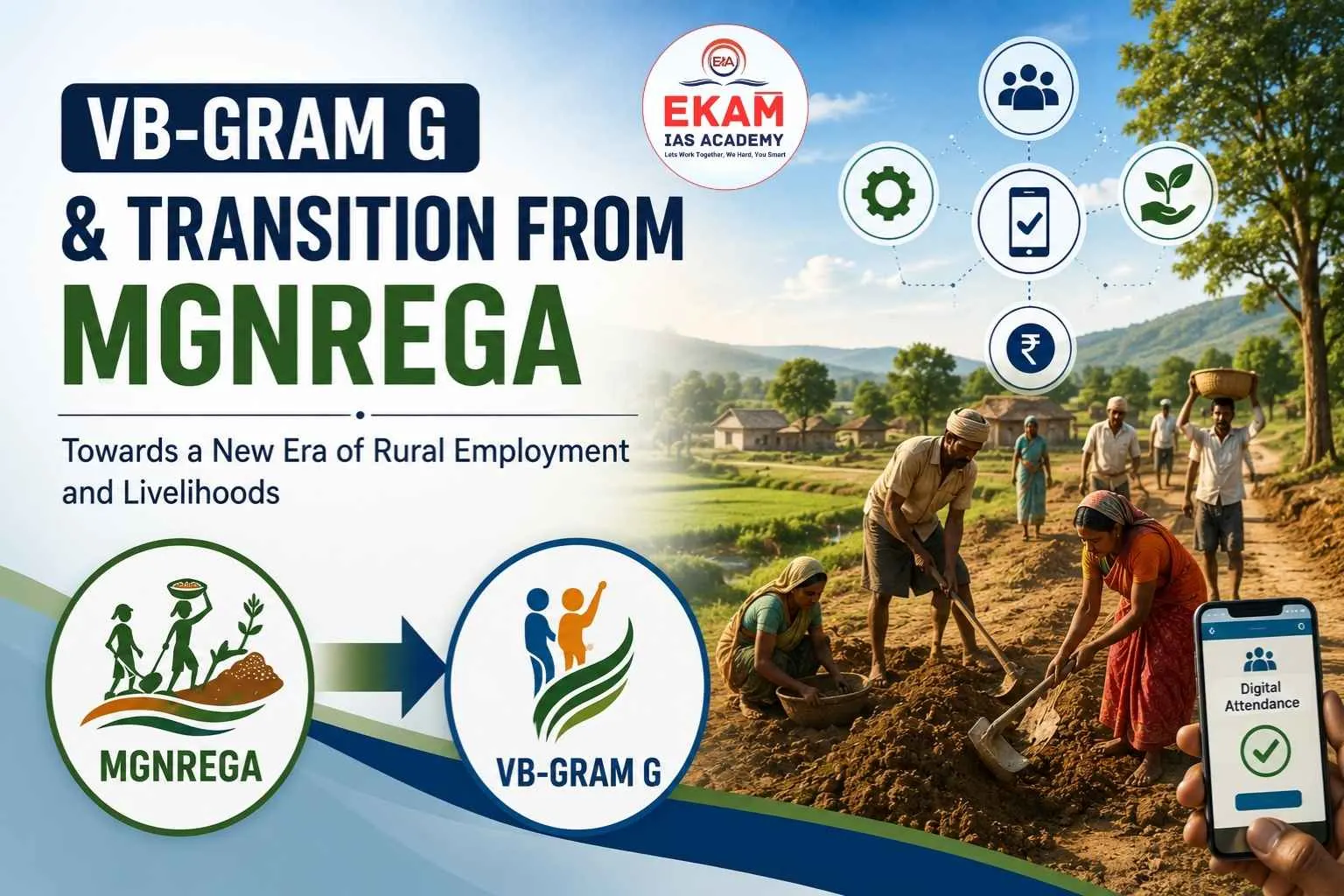
The Government of India has announced the Viksit Bharat Guarantee for Rozgar and Ajeevika Mission (Gramin) [VB-GRAM G], which will replace MGNREGA from July 1, 2026. This topic is important for aspirants preparing through IAS coaching in Hyderabad, UPSC coaching in Hyderabad, and UPSC online coaching.
Background
• MGNREGA, launched in 2005, guaranteed 100 days of wage employment to rural households.
• Over time, issues such as delayed payments, misuse of funds, and lack of asset creation were highlighted.
• The new scheme seeks to modernize rural employment guarantees and integrate them with digital monitoring and livelihood diversification.
Features of VB-GRAM G
• Employment Guarantee: Continues to provide assured work opportunities in rural areas.
• Integrated Livelihoods: Expands scope beyond manual labour to include skill-based and productive activities.
• Digital Attendance: Mandatory use of digital systems for transparency and accountability.
• Repeal of MGNREGA Rules: All earlier guidelines, notifications, and schemes under MGNREGA will stand repealed.
• Funding Mechanism: Normative budget and state shares yet to be clarified, raising concerns about implementation.
Concerns and Challenges
• Lack of clarity: No clear formula for budget allocation and state contributions.
• Transition issues: Risk of confusion during the shift from MGNREGA to VB-GRAM G.
• Social impact: Protests by workers’ groups highlight fears of reduced employment security.
• Implementation capacity: States may face difficulties in adapting to new digital systems.
Significance
• Aligns rural employment with national development goals.
• Promotes productive asset creation and skill development.
• Enhances transparency through digital monitoring.
• Supports the vision of inclusive growth under Viksit Bharat 2047.
Comparison: MGNREGA vs VB-GRAM G
• MGNREGA focused mainly on wage employment through manual labour.
• VB-GRAM G aims to integrate livelihoods, digital governance, and skill development.
• MGNREGA relied heavily on physical attendance and local execution, whereas VB-GRAM G introduces technology-driven monitoring systems.
• The transition reflects a shift from welfare-oriented employment generation to productivity-linked rural development.
Conclusion
The VB-GRAM G scheme promises modernization and efficiency, but its success will depend on clarity in rules, adequate funding, and a smooth transition from MGNREGA. Aspirants preparing through IAS coaching and civils coaching in Hyderabad should focus on its implications for rural development, governance reforms, and welfare policy in GS2.
This topic is available in detail on our main website.