
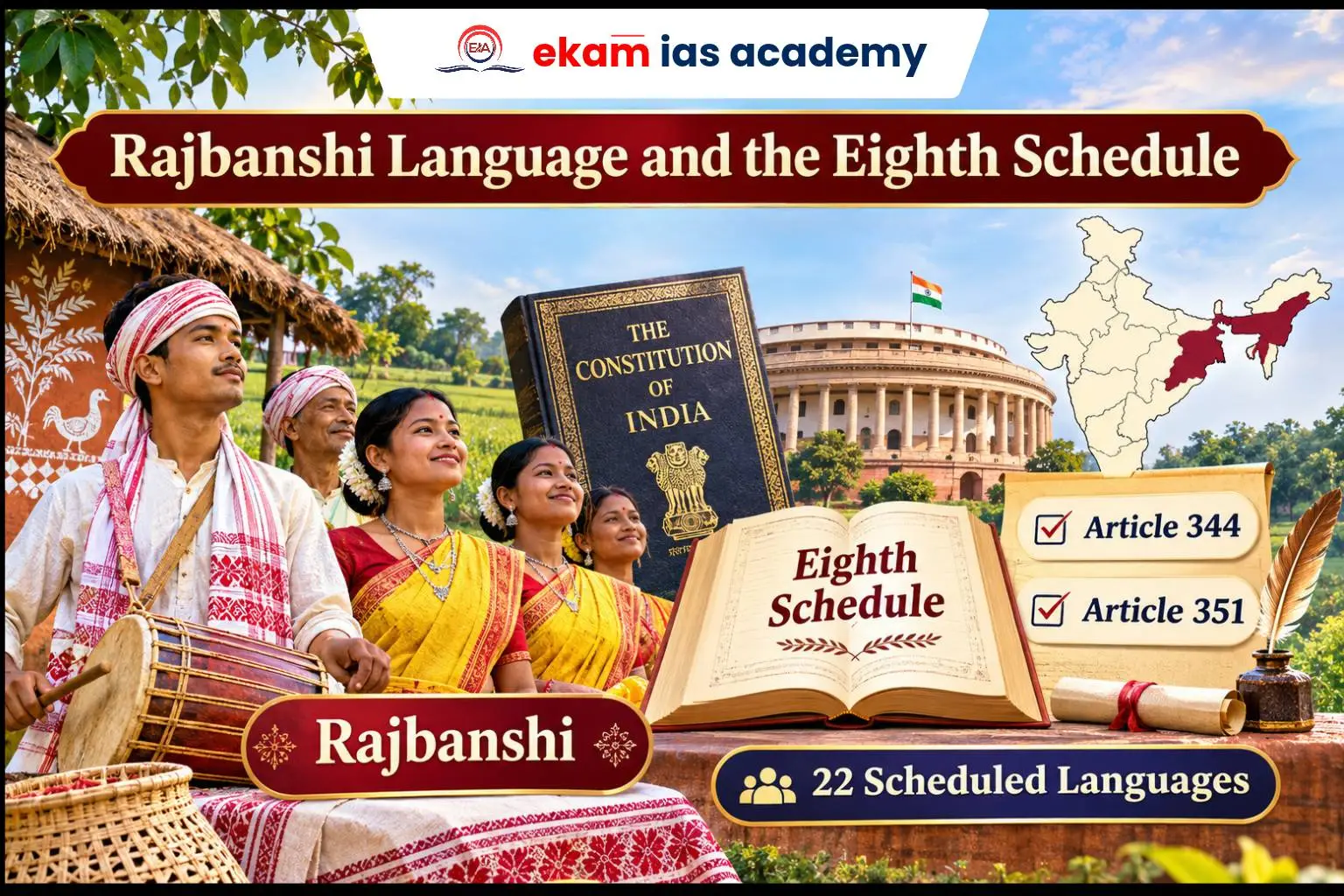
The West Bengal government announced efforts to include the Rajbanshi language in the Eighth Schedule of the Constitution, highlighting linguistic identity and cultural preservation. The Demand for Rajbanshi Language Recognition raises broader questions about Constitutional Recognition of Languages, regional identity and India’s linguistic diversity.
About Rajbanshi
- Belongs to the Eastern Indo-Aryan language family.
- Spoken across northern West Bengal, Assam, Bihar, Nepal and Bangladesh.
- Closely related linguistic varieties are known as Rangpuri and Kamtapuri.
- Census 2011 recorded Rajbangsi as a mother tongue under Bengali rather than a separate language.
- Associated with the cultural identity of the Rajbanshi community.
- The issue is relevant to Rajbanshi Language in India, Rajbanshi Language and Eighth Schedule and Linguistic Diversity in India.
Eighth Schedule – Constitutional Provisions
- Originally contained 14 languages, currently contains 22 languages.
- Article 344(1): Provides for an Official Language Commission with representation from scheduled languages.
- Article 351: Directs the Union to promote and develop Hindi while drawing upon India’s linguistic heritage.
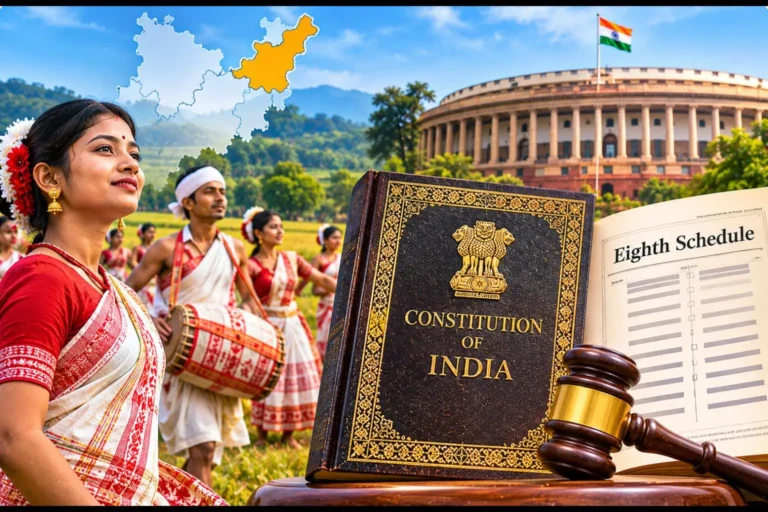
- The Eighth Schedule of Indian Constitution provides constitutional recognition to Scheduled Languages of India and is central to debates on linguistic recognition. Article 344 Indian Constitution and Article 351 Indian Constitution provide important constitutional dimensions.
Amendments to the Eighth Schedule
| Amendment | Languages added |
|---|---|
| 21st (1967) | Sindhi |
| 71st (1992) | Konkani, Manipuri, Nepali |
| 92nd (2003) | Bodo, Dogri, Maithili, Santhali |
| 96th (2011) | Renamed Oriya as Odia |
Criteria for Inclusion
- No formally prescribed constitutional criteria exist.
- Pahwa Committee (1996) and Sitakant Mohapatra Committee (2003) attempted to formulate objective criteria without an accepted outcome.
- Inclusion requires a constitutional amendment under Article 368.
- The absence of formally prescribed criteria remains significant for the Demand for Rajbanshi Language Recognition and other demands concerning the Constitutional Recognition of Languages.
Significance
- Promotes linguistic preservation and cultural recognition.
- Encourages literary development and institutional support.
- Reinforces Article 29(1), protecting distinct languages, scripts and cultures.
- Recognition can strengthen Protection of Regional Languages, address concerns of Linguistic Minorities in India and contribute to India’s broader Linguistic Diversity in India.
Conclusion
Recognition of regional languages strengthens India’s linguistic diversity and cultural inclusiveness while reinforcing the principle of unity in diversity. The debate over Rajbanshi Language, its inclusion in the Eighth Schedule of Indian Constitution and Constitutional Recognition of Languages is relevant to Rajbanshi Language UPSC and Indian Society and Culture UPSC.