
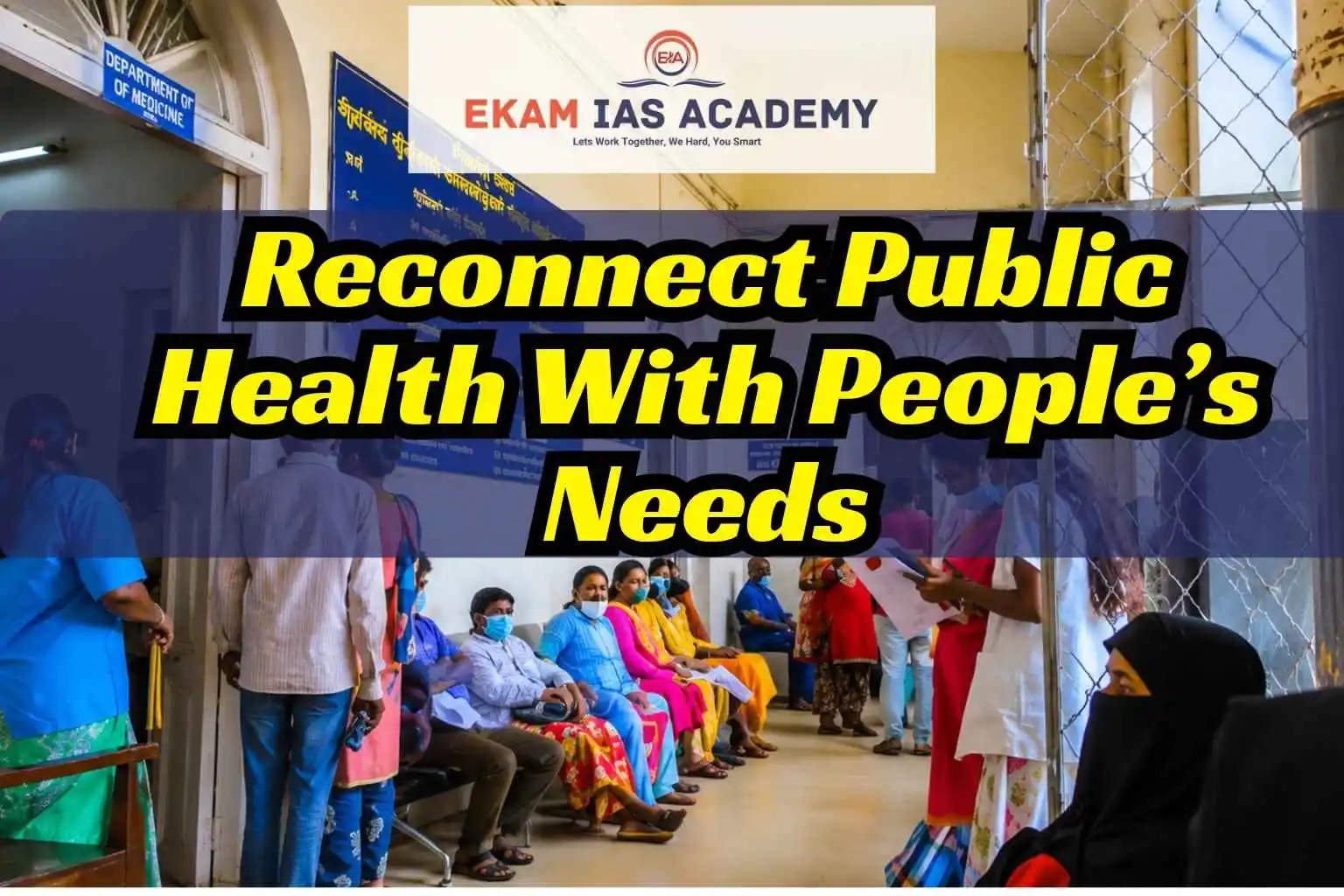
Recently, concerns have been raised that Ayushman Bharat Health & Wellness Centres and the Digital Health Mission are not adequately addressing people’s real health needs. This topic is important for aspirants preparing for GS2 Polity and public health governance issues through upsc online coaching.
Ayushman Bharat Initiative
Launch & Objective
• Introduced in 2018 by the Government of India.
• Aim: Provide comprehensive healthcare services (preventive, promotive, curative, rehabilitative, palliative) and financial protection against high medical costs.
• Goal: Reduce Out of Pocket Expenditure (OOPE), which still accounts for ~48% of total health spending in India.
Two Major Components
Health & Wellness Centres (HWCs):
- Transform existing Sub Centres, PHCs, CHCs into HWCs.
- Provide primary care services: maternal & child health, NCD screening, essential drugs, diagnostics, and health promotion.
- Target: 1.5 lakh HWCs across India.
Pradhan Mantri Jan Arogya Yojana (PM JAY):
- World’s largest government-funded health insurance scheme.
- Coverage: ₹5 lakh per family per year for secondary and tertiary care.
- Beneficiaries: ~50 crore people.
- Cashless treatment at empanelled hospitals nationwide.
Recent Expansions & Achievements
• In 2024, coverage extended to all senior citizens aged 70+, irrespective of income.
• As of 2026, PM JAY is operational in all 28 states and 8 UTs.
• PM Modi highlighted savings of ₹2.25 lakh crore in medical expenses for poor and middle-class families through Ayushman Cards and Jan Aushadhi Kendras.
Digital Integration – ABHA Card
• Under the Ayushman Bharat Digital Mission (ABDM), citizens receive a unique 14-digit Ayushman Bharat Health Account (ABHA) number.
• Enables digital health records, linking lab reports, prescriptions, and hospital visits.
• Strengthens India’s move towards a digital health ecosystem.
Challenges in India’s Public Health Policy
• Universal Health Coverage vs Reality: Hospitalisation rates remain lower than 2014 levels despite PM JAY coverage.
• OOPE: India’s Out of Pocket Expenditure is 48% of total health spending (NHA 2023).
• HWCs (2018): Ambiguity in mandate; shift from population health outcomes to individual well-being, which is subjective.
• Digital Health Mission: Focuses on data generation; budget ~₹300 crore annually.
• Health Infrastructure: India spends only 2.1% of GDP on health (2024–25), below WHO recommended 5%. Doctor-to-population ratio ~1:1,500 (WHO norm 1:1,000).
Broader Dimensions
• Equity: Policies must address social determinants like poverty, caste, and gender.
• Global Lessons: Countries like Thailand achieved UHC by strengthening primary care institutions, not just insurance.
• Fiscal Priority: Health budget allocation <1.5% of total expenditure, limiting systemic reforms.
Strong Conclusion
India’s public health must reconnect with people’s felt needs by strengthening grassroots institutions and focusing on measurable population outcomes, rather than wellness narratives or digital records.