
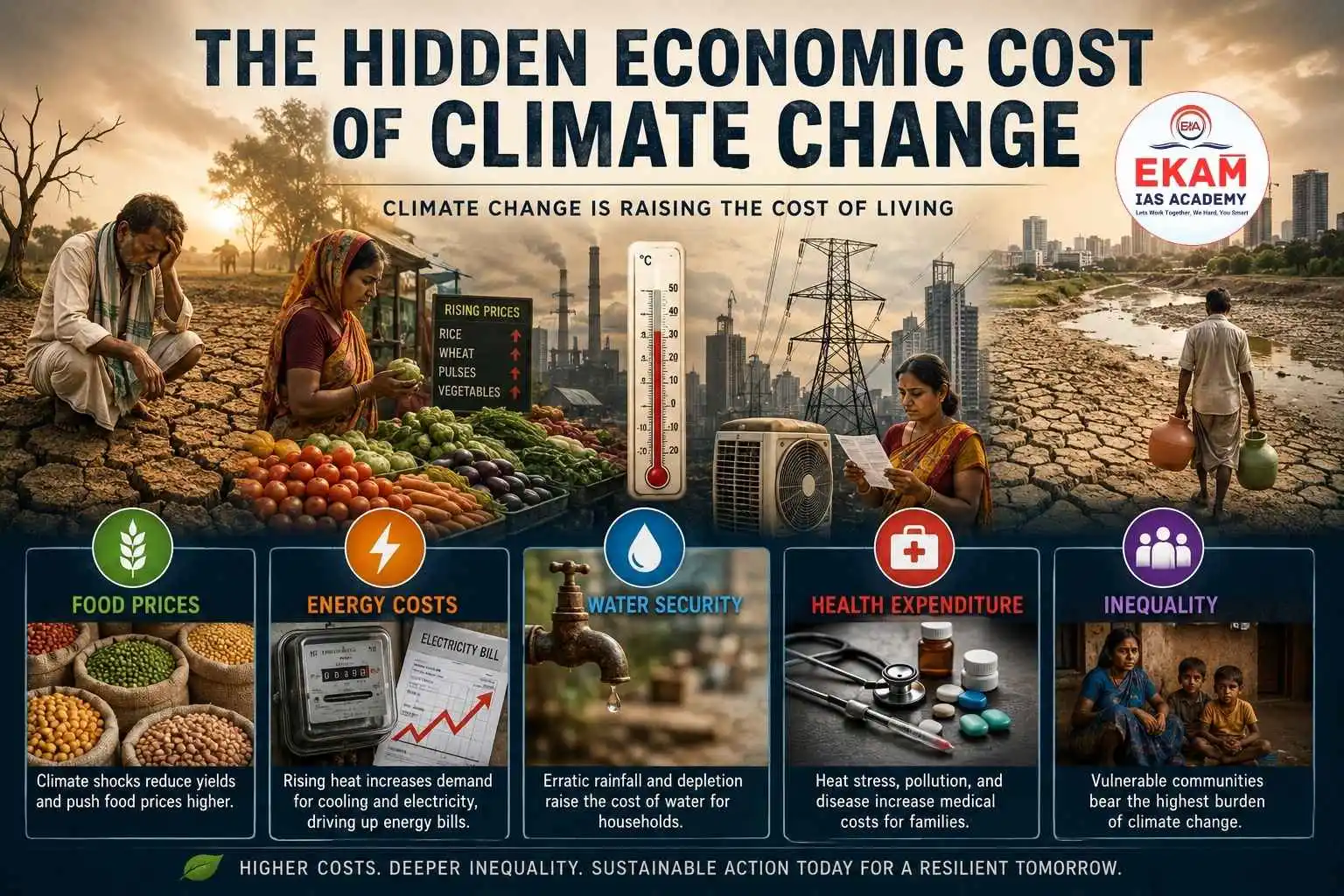
Recent World Bank projections and national analyses highlight how climate change is no longer just an environmental issue but is directly raising household living costs in India through food, energy, water, and healthcare expenses. This topic is important for aspirants preparing for GS3 Environment and climate economics-related issues through upsc online coaching.
Climate Change as a Cost-of-Living Issue
• Rising temperatures, erratic monsoons, and extreme weather are already impacting daily essentials.
• World Bank warns India’s GDP could shrink by 2.8% by 2050, affecting nearly half the population’s living standards.
• Climate change represents both an economic and social challenge, not only an ecological one.
Impact on Food Prices
• Agriculture is highly climate-sensitive; weak monsoons or heatwaves reduce yields.
• Example: In 2023, a 6% rainfall deficit lowered sowing of pulses and oilseeds, pushing retail prices of rice, wheat, and pulses up by 6–15%.
• Since food and beverages form 45.86% of CPI basket, climate shocks quickly translate into food inflation.
• Repeated floods and heatwaves create supply bottlenecks, worsening household budgets.
Impact on Energy Costs
• Rising heat increases demand for cooling appliances, straining power grids.
• During May 2026 heatwave, electricity demand hit a record 270.8 GW.
• Utilities rely on costly coal and imported fuels, leading to higher tariffs.
• Poor households often cut spending on food or education to pay electricity bills.
Impact on Water Security
• Erratic rainfall and groundwater depletion dry up local sources.
• Rural families spend more time and money fetching water.
• In cities, rise of a “tanker economy” forces households to buy water from private vendors, raising monthly expenses.
• Vulnerable communities in water-stressed regions face the heaviest burden.
Impact on Health Expenditure
• Heat stress, poor air quality, and shifting disease patterns increase medical costs.
• Rural women are disproportionately affected due to water collection, outdoor work, and caregiving.
• Even small increases in health spending destabilize households near the poverty line.
Climate Change and Inequality
• Marginalised groups lack irrigation and resilient farming; only 18% of India’s gross cropped area is under assured irrigation (MoA&FW).
• High risk states like Chhattisgarh, Madhya Pradesh, Rajasthan, Uttar Pradesh, and Maharashtra face steep declines in living standards, accounting for over 40% of India’s rural poor (NITI Aayog SDG Index).
• Climate change acts as a regressive burden; food inflation disproportionately hurts low-income households.
Economic Implications for India
• Higher inflation: CPI food inflation touched 10.95% in July 2023 during erratic monsoon (MOSPI).
• Reduced farm productivity: 6% rainfall deficit in 2023 cut sowing of pulses/oilseeds, lowering yields.
• Rising health costs: Heatwaves doubled from 21 days (2010) to 42 days (2023) (IMD), increasing heat-related illnesses.
• Greater rural distress: Over 280 million internal displacements (2008–2023) linked to weather disasters (IDMC).
• Slower growth: World Bank projects India’s GDP could shrink by 2.8% by 2050 due to climate shocks.
Way Forward
• Climate-resilient agriculture: Andhra Pradesh’s Community Natural Farming (APCNF) covers 6.3 lakh farmers, showing scalable models.
• Urban heat action plans: Ahmedabad’s plan reduced heatwave mortality by 30% (2010–2015); similar models should expand nationwide.
• Water conservation: India’s groundwater depletion rate is 61% in critical blocks (CGWB); urgent recharge and watershed management needed.
• Affordable healthcare & social protection: Expand Ayushman Bharat, currently covering 55 crore beneficiaries, to include climate-sensitive illnesses.
• Resilient infrastructure: Invest in renewable grids; India’s peak demand hit 270.8 GW in May 2026, showing the need for sustainable energy.
Conclusion
Climate change is silently eroding household stability in India. It is not just an environmental crisis but a hidden economic emergency.