
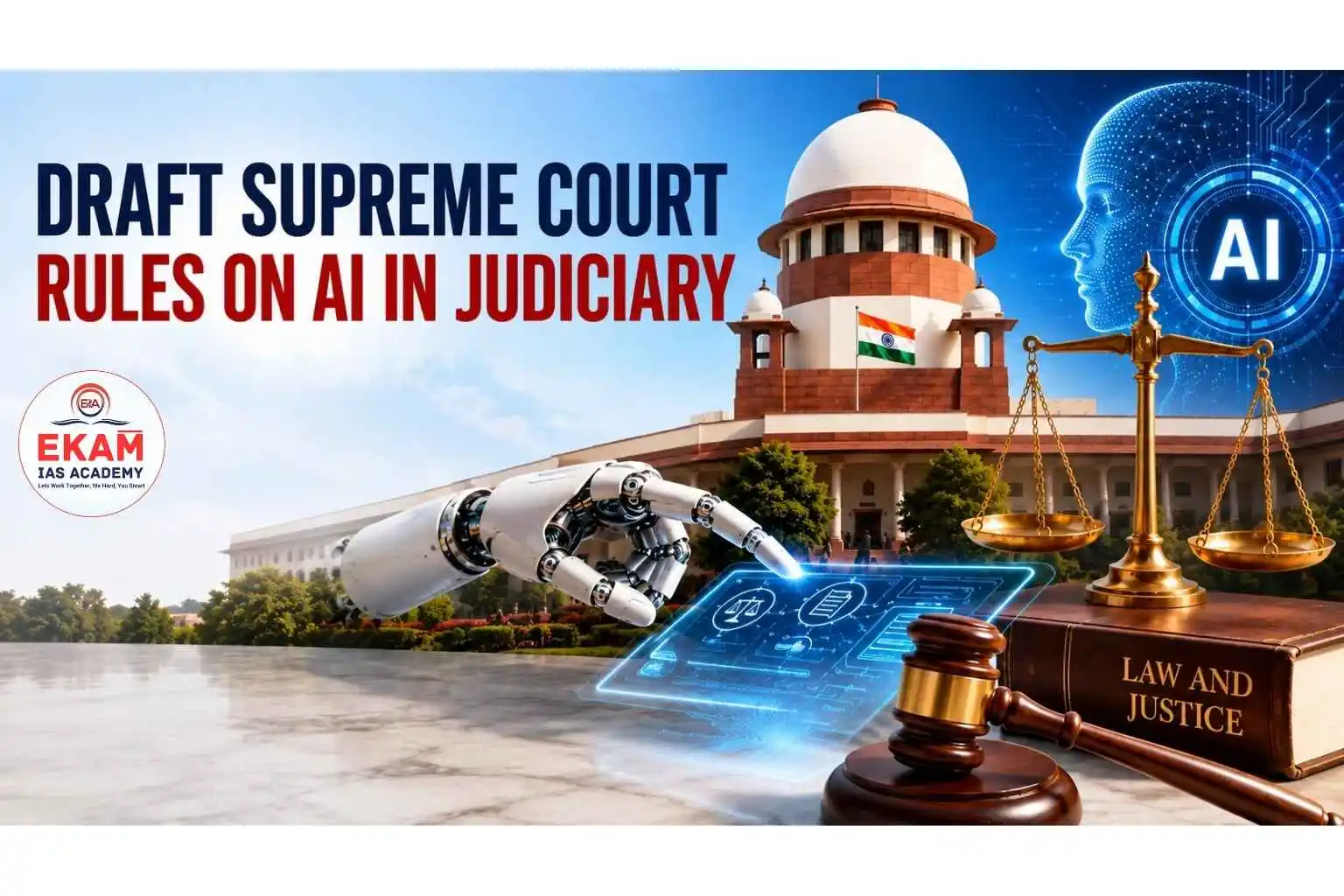
The Supreme Court AI Committee has released draft rules in June 2026 prohibiting the use of AI for judicial outcomes and witness profiling. This topic is important for aspirants preparing for GS2 Polity, governance, and technology-related issues through IAS coaching in Hyderabad.
AI and Judicial Integrity
• Artificial Intelligence is increasingly used in governance and law.
• However, in the judiciary, concerns arise about bias, transparency, and accountability.
• The draft rules aim to ensure that AI remains assistive, not authoritative, thereby safeguarding judicial independence and fairness.
Provisions of Draft Rules
• Assistive Role Only: AI tools can support research, documentation, and case management but must remain subservient to human judges.
• Ban on AI Sentencing: AI cannot decide punishments or judicial outcomes without mandatory human oversight.
• No Witness Profiling: AI systems are barred from profiling parties or witnesses, preventing algorithmic bias in credibility assessments.
• Transparency Requirement: Only explainable AI models can be used; opaque or “black box” systems are prohibited.
• Human-in-the-Loop: Every AI application must have human oversight to ensure accountability.
Significance of the Rules
• Judicial Independence: Protects courts from undue reliance on machines.
• Ethical Safeguards: Prevents discrimination and bias in judicial processes.
• Public Trust: Ensures citizens retain confidence in human led justice.
• Global Benchmark: Positions India alongside EU and US debates on ethical AI in law.
Challenges
• Capacity Building Deficit: Judges, clerks, and registry staff lack structured training in AI ethics, bias detection, and digital case management.
• A 2025 NITI Aayog survey found over 70% of district courts had no formal exposure to AI tools.
• Dependence on Imported Technology: Current AI solutions are largely sourced from foreign vendors, raising risks of data sovereignty and hidden algorithmic bias.
• India spends nearly ₹1,200 crore annually on imported judicial software, limiting self reliance.
• Data Privacy Vulnerabilities: Sensitive case files and witness records risk misuse if stored on cloud servers without end to end encryption.
• CERT-In reported a 28% rise in cyberattacks on government portals in 2025, many targeting legal databases.
• Balancing Innovation with Fairness: Courts must adopt AI for efficiency but avoid automated bias in sentencing or profiling.
• The challenge lies in integrating AI for speed while ensuring human led justice remains paramount.
Way Forward
• Indigenous AI Development: Encourage collaboration between IITs, NLU research centres, and NIC for judicial AI prototypes.
• Secure Digital Infrastructure: Establish dedicated judicial data centres with blockchain based audit trails to prevent tampering.
• Mandate ISO certified cybersecurity protocols across all e-courts.
• Legal Tech Ecosystem Growth: Provide seed funding and incubation for startups working on AI driven case management, e-filing, and translation tools.
• Dynamic Ethical Oversight: Create a National Judicial AI Ethics Board to periodically review algorithms.
Conclusion
India’s judiciary must embrace AI cautiously, ensuring human oversight and ethical safeguards remain central. The draft rules mark an important step towards balancing technological efficiency with constitutional values, judicial independence, transparency, and public trust.