
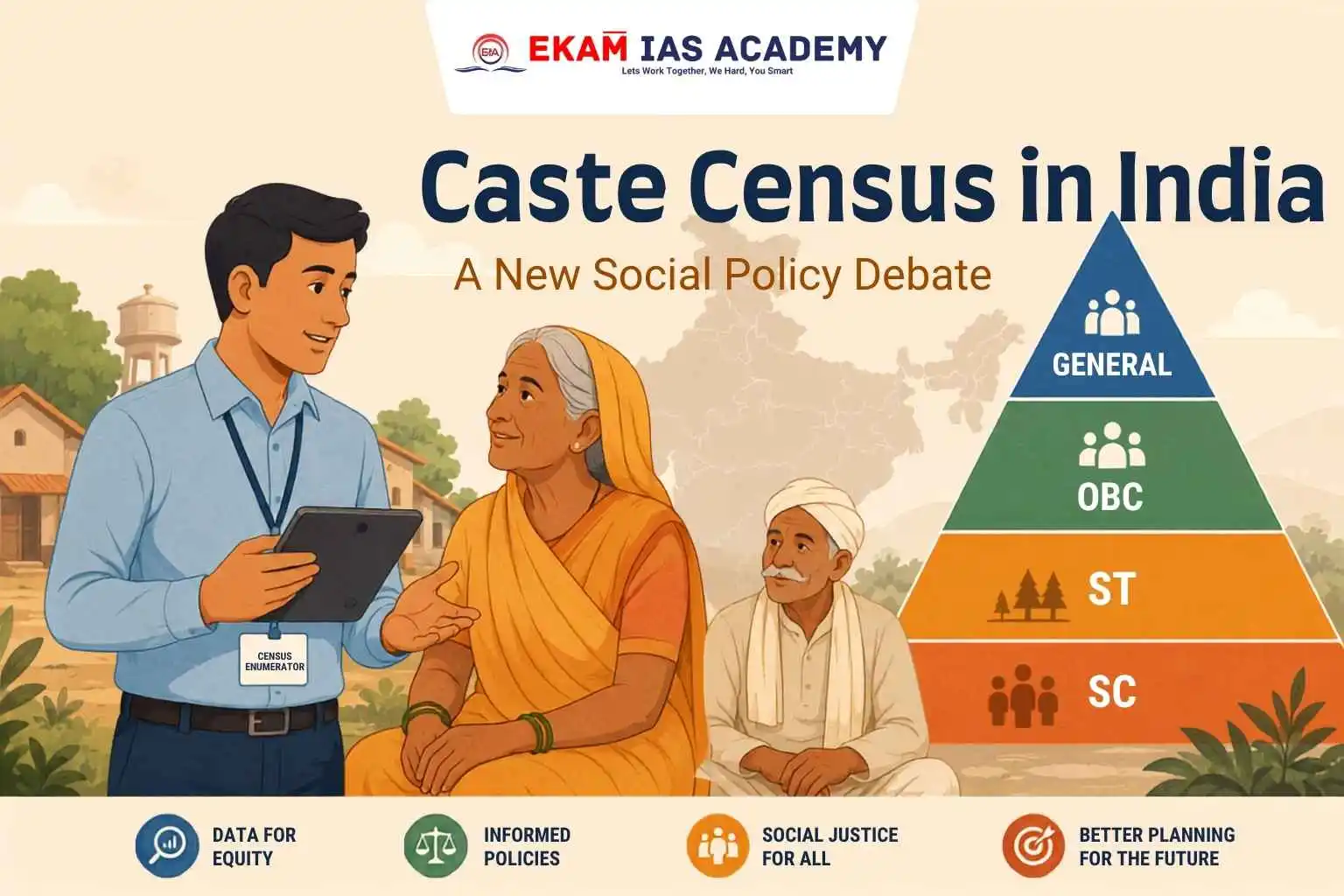
The Government of India is conducting caste enumeration along with Census 2027, marking the first official nationwide caste count since 1931. This topic is important for aspirants preparing for GS2 Polity and governance through ias coaching in Hyderabad.
What is a Caste Census?
• Systematic collection of caste-wise population data during the national Census.
• Records social identity along with demographic information.
• Helps determine the size and distribution of different caste groups.
Background
• 1881: First synchronous Census conducted in British India.
• 1931 Census: Last Census to publish detailed data for all castes.
• Post-Independence: Census records only Scheduled Castes (SCs) and Scheduled Tribes (STs).
• SECC 2011 collected socio-economic and caste information but caste figures were not officially released due to inconsistencies.
Need for a Caste Census
- Evidence-Based Policy Making: Accurate demographic data for welfare programmes and resource allocation.
- Effective Reservation Policy: Assesses whether reservation benefits reach deserving communities.
- Social Justice: Identifies disadvantaged communities, reducing exclusion.
- Better Targeting of Welfare Schemes: Minimises inclusion/exclusion errors.
- Academic and Administrative Planning: Supports research, planning, and governance.
- Transparent Governance: Encourages data-driven public decision-making.
Challenges of Conducting a Caste Census
• Data Standardisation: Thousands of castes/sub-castes with regional variations.
• Classification Issues: Merging multiple spellings and local names into standard categories.
• Political Sensitivity: Caste figures may influence electoral politics.
• Administrative Complexity: Enumerator training and data verification is time-consuming.
• Risk of Social Polarisation: Public debate over numbers may intensify social divisions.
• Privacy & Data Security: Sensitive personal data must be protected.
Recent Developments
- The Government of India has decided to include caste enumeration in Census 2027.
- The Census will be conducted in two phases.
- It will be India’s first fully digital Census, using mobile applications, digital data collection, geo-referenced mapping, and self-enumeration facilities.
The government is exploring methods such as self-declaration in an open field or standardised caste lists to improve data quality.
Conclusion
A credible, transparent, and scientifically conducted Caste Census can strengthen inclusive governance, social justice, and evidence-based policymaking while preserving social harmony.