
The Supreme Court has ruled that homemakers’ unpaid domestic labour must be valued in compensation claims. This topic is important for aspirants preparing for GS2 Polity and gender policy-related issues through IAS coaching in Hyderabad.
Recognition of Homemakers’ Economic Contribution
• Traditional Exclusion: For decades, homemakers’ unpaid domestic labour was excluded from economic valuation in legal compensation cases. The NSSO (2019) estimated that women spend 5–6 hours daily on unpaid household work, contributing indirectly to national productivity.
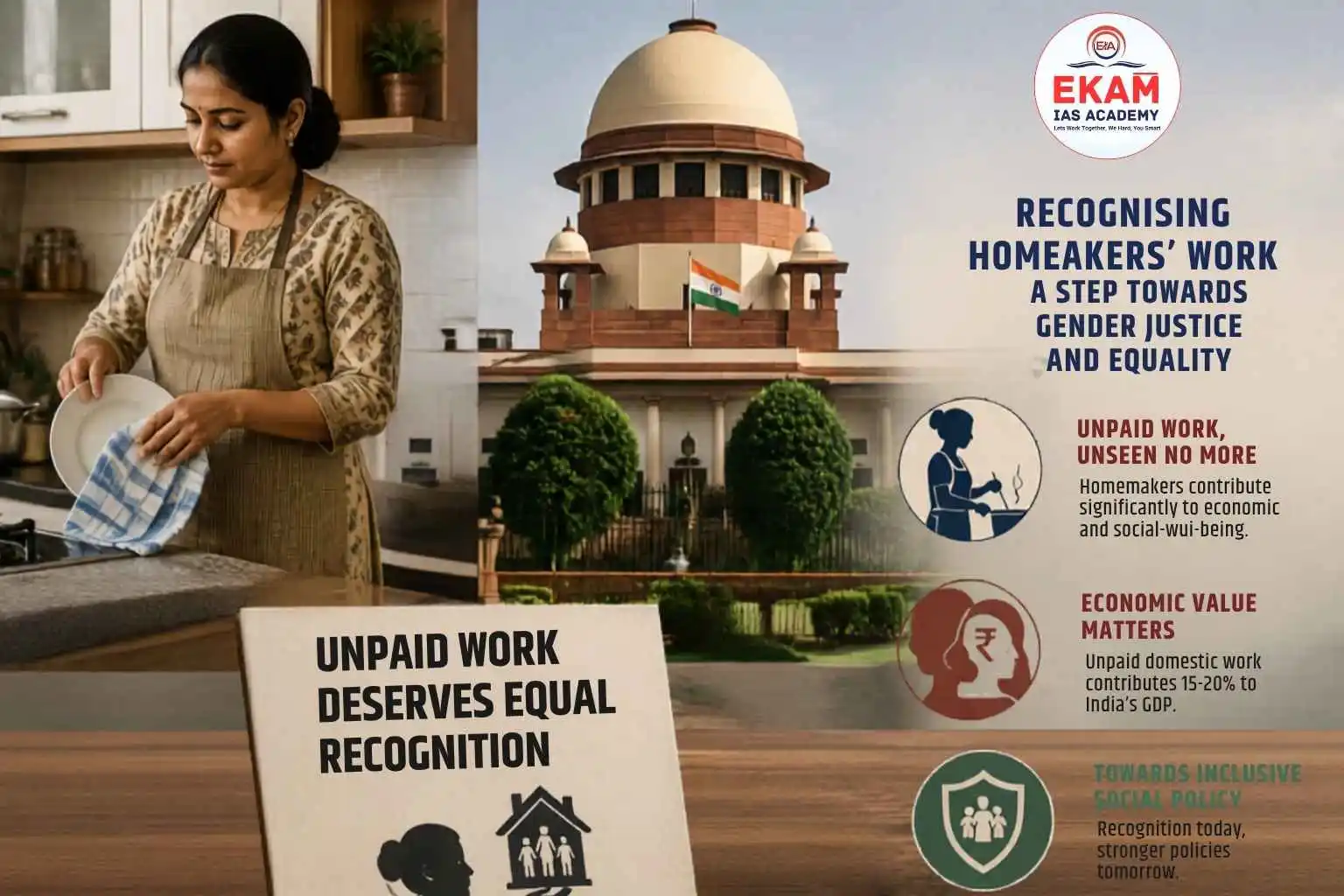
• Judicial Shift in Terminology: The Supreme Court replaced the term “housewife” with “homemaker”, emphasizing dignity and economic value. This reflects recognition of women’s non-market labour as a form of social and economic contribution.
• Motor Accident Claims Tribunal (MACT): The Court directed MACTs to include domestic care as a compensable head in accident cases. It fixed a base value of ₹30,000 per month for homemakers’ work, with a 10% increment every three years, accounting for inflation and rising living costs.
• Economic Context: According to NITI Aayog (2022), unpaid domestic work by women contributes an estimated 15–20% of India’s GDP if monetized. This aligns with SDG 5 (Gender Equality) and global efforts to value unpaid care work.
Implications
• Gender Equality: Acknowledges women’s invisible labour in household management.
• Economic Valuation: Brings unpaid domestic work into formal economic recognition.
• Policy Impact: May influence future welfare schemes and social security measures.
• Social Change: Strengthens discourse on dignity of women’s work in Indian society.
Empirical Evidence of Homemakers’ Economic Role
• Census & NSSO Findings: The Census 2011 recorded over 160 million women engaged primarily in unpaid household work. The NSSO 2019 Time Use Survey found women spend 5.7 hours daily on domestic tasks versus 1.6 hours for men, revealing a major gender gap.
• NITI Aayog Reports: Estimate that unpaid domestic work could contribute 15–20% of India’s GDP if monetized, urging inclusion in national accounts to reflect women’s invisible economic participation.
• Global Commitments – SDG 5: Recognition of homemakers aligns with Sustainable Development Goal 5, which calls for valuing unpaid care and domestic work through public services and social protection policies.
• Comparative Perspective: Countries like Australia and Canada include unpaid household labour in satellite national accounts, valuing it at 30–40% of GDP, setting a benchmark India can emulate.
Conclusion
By valuing homemakers’ labour, the Supreme Court has advanced gender justice and economic recognition of unpaid work, marking a step towards inclusive social policy.