
Five new judges have been appointed to the Supreme Court through the Supreme Court (Number of Judges) Amendment Ordinance, 2026, raising concerns about judicial independence and constitutional propriety. This topic is important for aspirants preparing for GS2 Polity and constitutional governance-related issues through IAS coaching in Hyderabad.
Constitutional Mandate
• Article 124(1): Parliament alone can prescribe the number of Supreme Court judges by law.
• Past Amendments: The strength of Supreme Court judges was increased through Acts in 2009 to 31 judges and in 2019 to 34 judges.
• Legislative Process: Generally, the Chief Justice of India proposes expansion, the Law Ministry drafts the amendment, Parliament passes the Bill, and finally Presidential assent is given.
• Article 123: The President may promulgate Ordinances when Parliament is not in session, but they lapse within six weeks unless approved by Parliament.
Judicial Pronouncements on Ordinances
• R.C. Cooper Case, 1970: Presidential satisfaction under Article 123 is subject to judicial review.
• D.C. Wadhwa Case, 1986: Repeated re promulgation of Ordinances is unconstitutional.
• Gokaraju Rangaraju Case, 1981: The De Facto Doctrine protects judgments delivered by judges even if their appointment is later invalidated.
• Krishna Kumar Singh Case, 2017: Ordinance making power is exceptional and cannot be used as a parallel law making route.
Concerns
• Judicial Independence: Ordinance based posts are temporary, making judges dependent on executive or legislative approval.
• Conflict of Interest: The Union Government, being the largest litigant, may indirectly influence judicial strength.
• NJAC Judgment Contradiction: Collegium’s acceptance of Ordinance created posts may appear inconsistent with its earlier stand against executive interference.
• Legal Anomaly: If the Ordinance lapses, sanctioned strength may revert to 34, creating uncertainty for sitting judges.
• Pendency Argument: Adding judges has historically not solved backlog issues, as the root cause also lies in excessive admission of Special Leave Petitions under Article 136.
Safeguards Suggested
• Clarify De Facto Doctrine: Limit its use to past judgments and not allow it to cure structural irregularities.
• Swearing in Protocols: Collegium may delay swearing in until the Ordinance is ratified by Parliament.
• Recusal: Judges appointed against Ordinance created posts could recuse themselves from sensitive cases involving the Union Government.
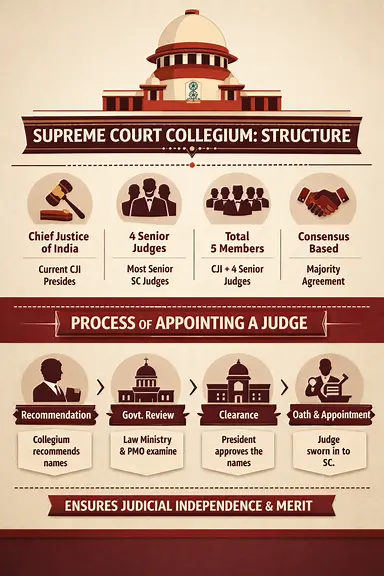
Collegium vs Ordinance Created Posts
• Role of Collegium: The Collegium system, consisting of the Chief Justice of India and senior judges, recommends names for appointment to the Supreme Court and High Courts. It decides who becomes a judge, but not how many posts exist.
• Creation of Posts: The sanctioned strength of the Supreme Court is determined by Parliament through law under the Supreme Court (Number of Judges) Act, 1956. An Ordinance under Article 123 can temporarily expand this strength when Parliament is not in session.
• Collegium’s Limitation: If posts are created through an Ordinance, the Collegium may still recommend judges to fill them. However, the existence of those seats depends on executive action and later parliamentary ratification.
• Institutional Concern: This creates a situation where the Collegium participates in appointments, but has no control over the legality or permanence of the posts themselves.
Conclusion
Judicial independence, a pillar of the Basic Structure, demands that the Supreme Court’s strength be determined by Parliamentary law and not by executive Ordinances. This ensures that the judiciary remains fully insulated from political timelines and executive influence.