
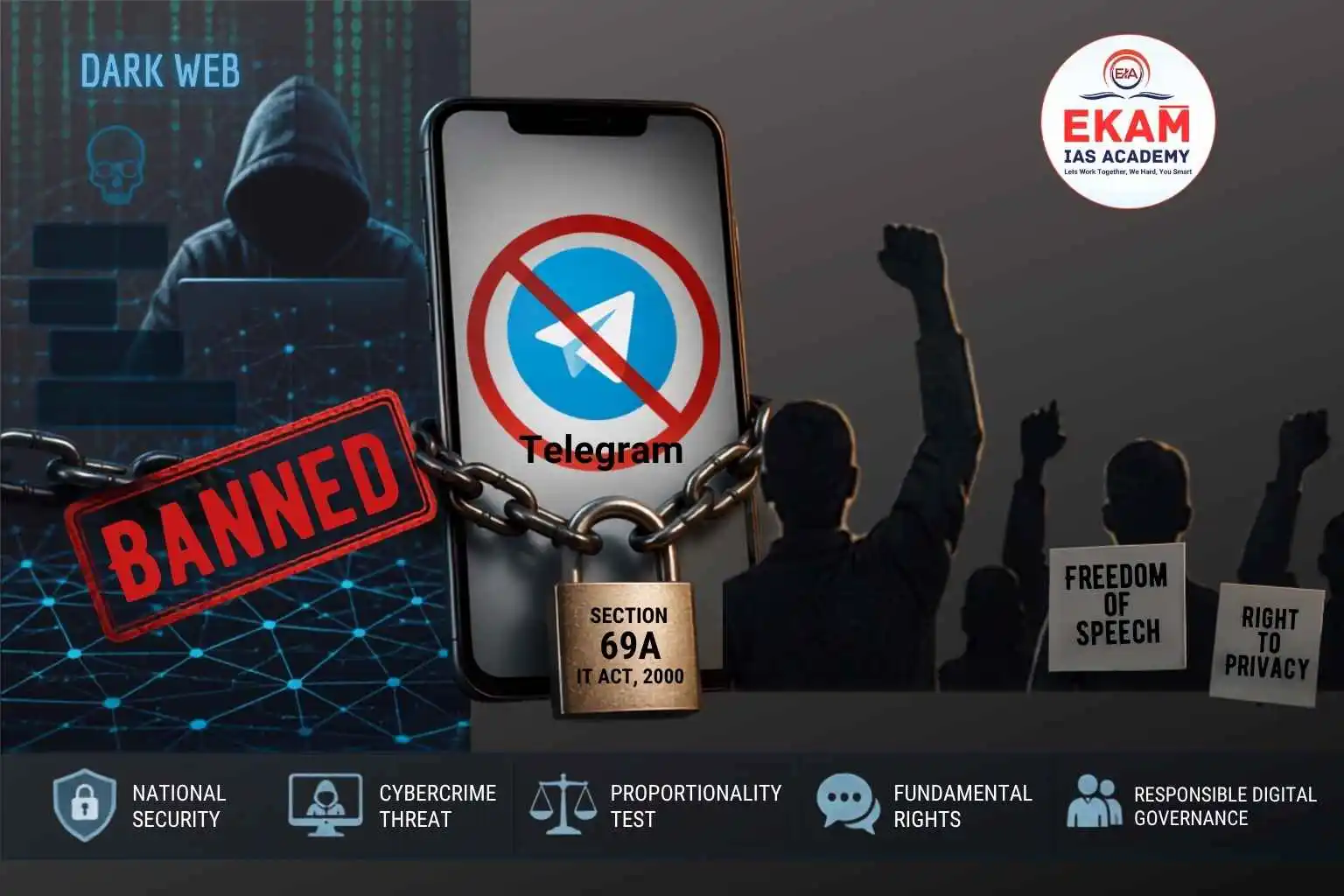
The temporary ban under Section 69A of the IT Act, 2000 has been challenged by Telegram, and judgment is currently reserved. This topic is important for aspirants preparing for GS2 Polity and digital rights-related issues through IAS coaching in Hyderabad.
Section 69A of IT Act
• Government Position: The Union government informed the Delhi High Court that Telegram has evolved into a “new dark web,” citing its misuse for cybercrime and exam paper leaks.
• Legal Provision: Empowers the Centre to block public access to information if necessary for sovereignty, integrity, defence, security, public order, or preventing cognizable offences.
• Safeguards: Orders must follow the IT (Procedure and Safeguards for Blocking Access) Rules, 2009.
• Judicial Precedent: In Anuradha Bhasin v Union of India, the Supreme Court held that restrictions must pass the proportionality test (least restrictive, necessary, and subject to review).
Government’s Position on Telegram Ban
• Cybercrime Concerns: I4C identified Telegram as a preferred platform for fraud networks, extremist groups, and exam paper leak operators.
• Data Evidence: Complaints linked to Telegram rose sharply from 75,688 in 2023 to 2.75 lakh in 2025, with financial frauds exceeding ₹3,000 crore.
• Operational Misuse: Channels allegedly hosted marketplaces for mule accounts, UPI handles, and crypto conversions.
• Exam Integrity: Ban imposed ahead of NEET re-test to prevent malpractice.
Telegram’s Argument
• Overreach of Powers: Government failed to justify why specific channels couldn’t be blocked instead of banning the entire platform.
• Impact on Users: Blanket ban affects 150 million Indian users, disrupting educators, entrepreneurs, and creators.
• Fundamental Rights: Interferes with Article 19(1)(a) (freedom of speech) and Article 19(1)(g) (freedom to trade/profession).
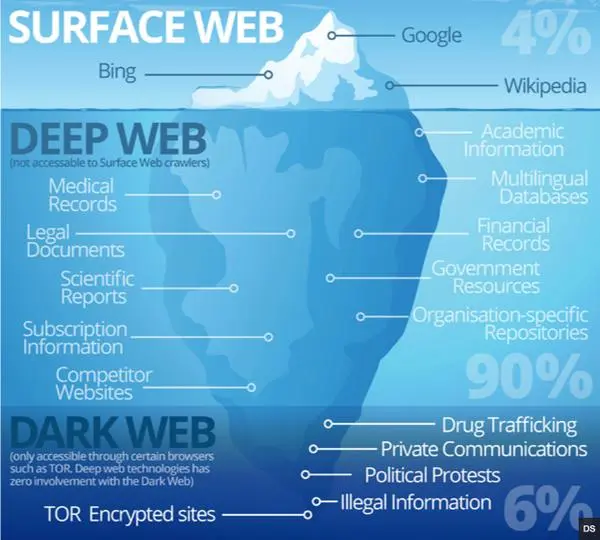
Dark Web Overview
• Hidden part of the internet accessible only via special browsers (e.g., Tor), providing online anonymity.
• Positive uses: Protect privacy and free speech. Negative uses: Cybercrime, illicit marketplaces.
• Examples: Silk Road (drug marketplace), ransomware forums, arms trade networks using cryptocurrency.
• Telegram acts as a gateway linking users to dark web forums.
Way Forward
• Cybersecurity Oversight: Strengthen I4C with AI-based tracking to detect suspicious groups quickly.
• Digital Governance: Targeted enforcement avoids collateral damage to legitimate businesses and protects Article 19(1)(g).
• Biometric & AI Surveillance: Deploy biometric verification for exam staff and AI monitoring of flagged online groups.
• Strict Accountability & Penalties: Amend Public Examinations (Prevention of Unfair Means) Act, 2024 to impose minimum 10-year jail terms for organised leaks.
ARTICLE 19 FUNDAMENTAL RIGHTS
- Freedom of Speech & Expression: Citizens can express opinions freely through speech, writing, or any medium.
- Freedom of Assembly: Right to peaceful meetings without arms.
- Freedom of Association: Citizens can form unions or groups.
- Freedom of Movement: Free movement across India.
- Freedom of Residence: Right to live anywhere in India.
- Freedom of Profession: Right to practice any trade, business, or occupation.
Relation to Telegram Ban
- Speech & Expression hampered: Blanket ban restricts 150 million users from communicating, violating Article 19(1)(a).
- Right to Profession affected: Educators, entrepreneurs, and digital creators lose livelihood opportunities, violating Article 19(1)(g).
- Assembly & Association curtailed: Groups and communities using Telegram for collective action are disrupted.
How It Hampers Rights
- Over‑breadth: Instead of targeting illegal channels, the entire platform is blocked.
- Disproportionate restriction: SC in Anuradha Bhasin (2020) held that restrictions must be proportional and least intrusive.
Economic disruption: Blanket bans affect legitimate businesses and innovation.
Conclusion
Balancing national security and cybercrime prevention with constitutional freedoms is a key challenge in India’s digital governance, requiring proportionate measures, transparency, and protection of citizen rights.