

The Centre’s proposal to direct States to establish exclusive NDPS (Narcotic Drugs and Psychotropic Substances) courts aims to fast-track narcotics trials, reduce judicial pendency, and strengthen India’s response against drug trafficking and substance abuse. This topic is important for aspirants preparing for GS2 Governance and Internal Security through upsc coaching in hyderabad.
Why Drug Issues Are Increasing in India
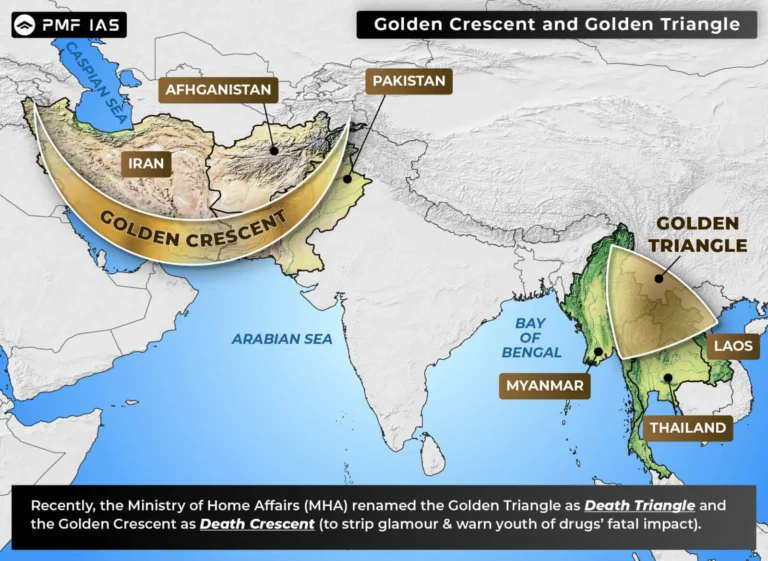
- Geopolitical location: India lies between the Golden Crescent (Afghanistan–Pakistan–Iran) and the Golden Triangle (Myanmar–Laos–Thailand), two major global drug hubs.
- Transit routes: Porous borders in Punjab, Northeast, and Kerala’s coastline make India a natural corridor for smuggling.
- Urban demand: Rising youth addiction due to stress, unemployment, peer pressure, and lifestyle changes.
- Weak enforcement: Delays in trials, corruption, and lack of specialized courts reduce deterrence.
- Economic incentives: Drug trafficking linked to organized crime, terrorism financing, and black money circulation.
Current Situation
- Punjab: 60,000 pending cases, no special courts, 5 proposed.
- Kerala: 50,000 pending cases, 2 special courts, 9 proposed.
- Odisha: 17,000 pending cases, 5 special courts, 6 proposed.
- Tamil Nadu: 15,000 pending cases, 5 special courts, 6 proposed.
- Karnataka: 15,000 pending cases, 3 special courts, 8 proposed.
- National total: 3.9 lakh pending NDPS cases, highlighting the scale of judicial burden.
Why Some States Are More Affected
- Punjab: Border state, heroin inflow from Afghanistan via Pakistan.
- Kerala: Coastal smuggling routes; high youth addiction rates.
- Odisha & Tamil Nadu: Ports exploited for trafficking.
- Northeast states: Proximity to Golden Triangle; porous borders facilitate inflow.
Role of Special NDPS Courts
- Enable fast‑track trials, reducing pendency.
- Judges trained in specialized narcotics law ensure better handling of complex cases.
- Dedicated infrastructure prevents overburdening of regular courts.
- Speedy convictions act as deterrence against trafficking and abuse.
Government Measures Against Drug Menace
- Narcotics Control Bureau (NCB): Established in 1986 under the NDPS Act, to conduct raids, seizures, and arrests, while also handling international cooperation.
- National Action Plan for Drug Demand Reduction (NAPDDR): A Ministry of Social Justice & Empowerment initiative focusing on awareness, counseling, rehabilitation, de‑addiction centers, and livelihood support for youth.
- Border Fencing & Surveillance: Intensive fencing and patrols along Punjab and Rajasthan borders, deployment of drones and night‑vision equipment, and coastal monitoring in Kerala, Tamil Nadu, and Odisha to prevent smuggling.
- Awareness Campaigns: Nationwide initiatives in schools, colleges, and communities, supported by media and cultural programs, with the Prime Minister’s call for youth to pledge against substance abuse.
Way Forward
- Strengthen governance: Expand special NDPS courts, improve forensic labs, enhance coordination between police, judiciary, and NCB.
- Community & behaviour change: School and college awareness programs, family monitoring, rehabilitation centers, de‑addiction services.
- Policy reforms: Strict border control using drones and sensors, crackdown on drug money laundering, integrate health and law enforcement approaches.
- Youth engagement: Promote sports, skill development, and employment opportunities to reduce vulnerability.
SPECIAL COURTS IN INDIA
Special courts are statutorily established courts under Article 247 of the Constitution or specific Acts (e.g., NDPS Act, PMLA, NIA Act).
- They are designed to speed up trials in sensitive or high‑volume categories of offences.
Difference from Normal Courts
- Jurisdiction: Special courts deal with specific offences only (e.g., narcotics, terrorism, money laundering), while normal courts handle a broad spectrum.
- Speed: Special courts are mandated for fast‑track trials, unlike normal courts which face heavy pendency.
- Judges: Often designated from existing courts but given exclusive authority under the relevant Act.
- Procedure: Similar to regular courts but with limited scope and priority listing of cases.
- Impact: Helps reduce backlog and ensures specialized handling of complex cases.
Conclusion
The establishment of special NDPS courts, coupled with stronger enforcement, rehabilitation, and awareness, is essential to reduce pendency, and protect youth. A balanced approach combining judicial efficiency, and behavioural change will be the key to tackling this growing menace.