

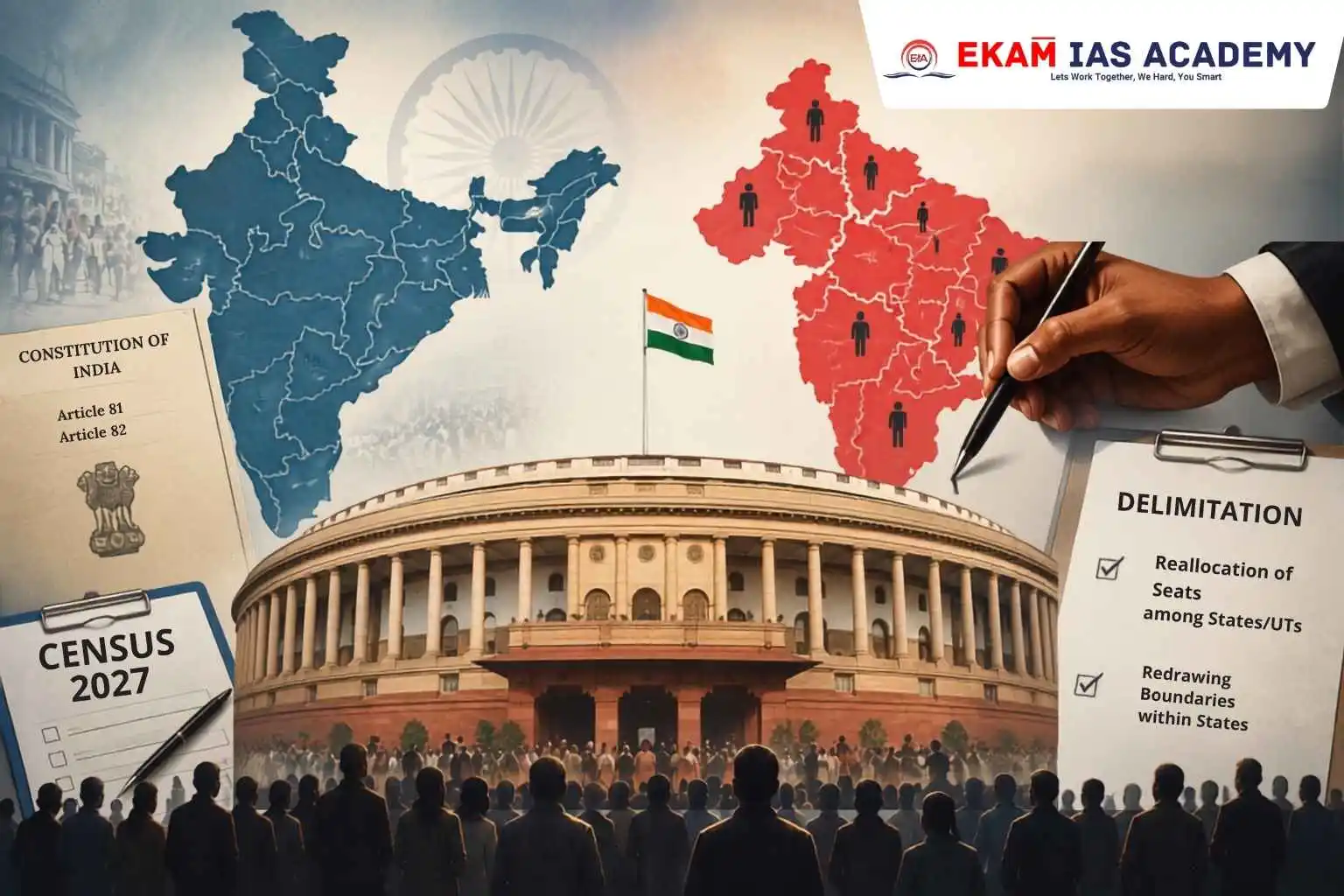
The Union Government’s proposed delimitation exercise after the 2027 Census has triggered a major debate over the future structure of parliamentary representation in India. The exercise may involve reallocation of Lok Sabha seats among States, expansion of the House, and implementation of women’s reservation, raising questions about balancing democratic equality and federal fairness. This topic is important for aspirants preparing for GS2 Polity through UPSC Coaching in Hyderabad.
What is Delimitation
- It is the process of fixing seat numbers and redrawing constituency boundaries based on Census data.
- Two parts:
- Reallocation of seats among States/UTs.
- Redrawing boundaries within States.
- Conducted by an independent Delimitation Commission, whose orders carry the force of law.
Constitutional Provisions
- Article 81: Lok Sabha composition; seats allocated on national average population per seat.
- Article 82: Readjustment after every Census.
- Ceiling: Maximum Lok Sabha seats capped at 550 (currently 543 elected).
Freeze on Seat Reallocation
- Last reallocation: 1973 (1971 Census).
- 42nd Amendment (1976) and 84th Amendment (2001) froze seat reallocation until after the 2026 Census.
- The 2002 Delimitation Commission only redrew boundaries within States, implemented in 2008 elections.
Current Proposals
- Expand Lok Sabha to 850 seats.
- Use 2011 Census for reallocation (requires amendment).
- Implement women’s reservation alongside delimitation.
Likely Gains and Losses
- Northern States (UP, Bihar, Rajasthan): Likely to gain seats due to higher population growth.
- Southern States (Kerala, Tamil Nadu, Andhra Pradesh, Karnataka): May lose relative share as they stabilised population earlier.
- Creates tension between federal fairness and democratic equality.
Federalism vs Democracy
- Federalism: States should not be penalised for successful population control.
- Democracy: Principle of “one person, one vote, one value” demands equal weight for every vote.
- Balancing these principles is the core challenge.
Gerrymandering Concerns
- Manipulation of boundaries can distort representation even with equal population per seat.
- Cracking and Packing examples show how constituency design can alter electoral outcomes.
- Independent oversight and transparency are essential safeguards.
Way Forward
- Build broad political consensus before amendments.
- Ensure transparent criteria for seat allocation and boundary drawing.
- Provide compensatory mechanisms (e.g., Rajya Sabha seats, fiscal transfers) for States with stabilised populations.
- Public awareness campaigns to explain implications for representation.
Conclusion:
The upcoming delimitation will be a defining test of India’s ability to balance democratic equality with federal fairness, shaping the future of parliamentary representation.



One thought on “Delimitation Debate And The 2027 Census”