

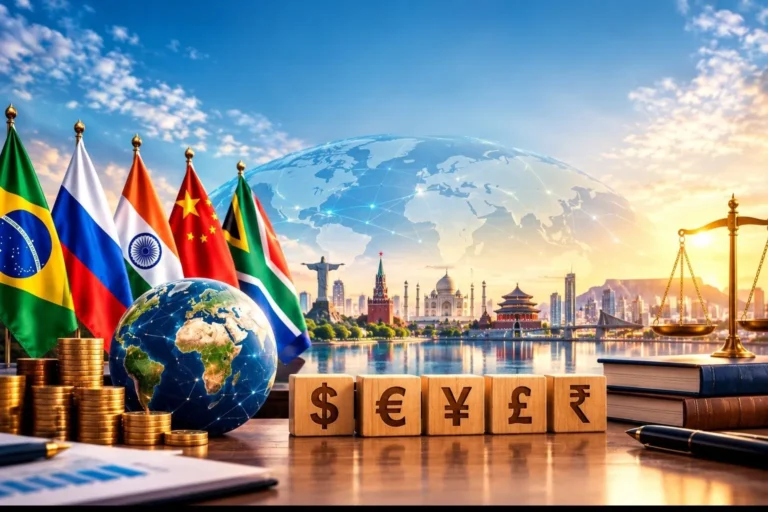
India is hosting the 18th BRICS Summit in New Delhi on September 12–13, 2026, under the theme “Humanity First.” The summit focuses on reforms in the Western-dominated global financial system and explores the possibility of a BRICS New Global Financial Architecture through alternative institutions and mechanisms.
BRICS Alternative Financial Architecture
New Development Bank (NDB)
- Established in 2015, the BRICS New Development Bank was created to finance infrastructure and sustainable development projects in BRICS countries and other emerging economies.
- It aims to provide developing countries with greater access to development finance and promote BRICS Financial Cooperation through increased use of local currencies.
- The NDB represents an important step towards a BRICS Alternative Financial System, but its scale remains smaller than institutions such as the World Bank.
- The bank continues to operate within the existing international financial framework and has relied on international credit-rating agencies.
- It has also undertaken cooperation and co-financing arrangements with existing multilateral institutions.
Contingent Reserve Arrangement (CRA)
- BRICS established a $100-billion Contingent Reserve Arrangement in 2015 to provide liquidity support to members facing balance-of-payments pressures.
- It was designed as a mechanism to reduce excessive dependence on IMF assistance and strengthen BRICS Economic Cooperation.
- However, the CRA has not been activated so far, limiting its role as an independent financial safety mechanism.
De-dollarisation
- BRICS has promoted greater use of local currencies in cross-border trade and finance, known as BRICS De-dollarisation efforts.
- BRICS Local Currency Trade aims to reduce dependence on the US dollar and strengthen financial autonomy among member countries.
- However, replacing the dollar remains difficult due to the dollar’s dominant role in global trade, financial markets and foreign exchange reserves.
- Differences among BRICS members make initiatives such as a BRICS Common Currency or rapid de-dollarisation challenging.
Why Has BRICS Struggled to Create a Genuine Alternative?
- Divergent national interests: China, India, Russia, Brazil and other members have different economic and geopolitical priorities, affecting collective decision-making.
- Dependence on existing institutions: BRICS economies remain deeply integrated with Western financial markets and the dollar-based system.
- Limited institutional capacity: BRICS financial mechanisms are smaller and less developed compared to the IMF and World Bank.
- Geopolitical divisions: Sanctions, conflicts and strategic competition create challenges for deeper financial integration.
- Risk of financial fragmentation: Rapid movement away from the dollar could increase transaction costs and create instability in global markets.
Significance for India
- Global representation: India supports greater representation of developing countries in institutions like the IMF and World Bank through BRICS and IMF Reform initiatives.
- Financial cooperation: BRICS promotes alternative development financing, local currency settlements and stronger economic partnerships.
- Global South: Strengthening BRICS supports India’s interests in promoting a more inclusive global financial order.
- India views BRICS as a platform to advance reforms in global institutions and support BRICS Global South cooperation.
Way Forward
- Strengthen institutions: Enhance the capacity of the NDB and make the Contingent Reserve Arrangement more effective.
- Payment systems: Develop interoperable cross-border payment mechanisms and expand BRICS Local Currency Trade.
- Global reforms: Coordinate BRICS positions on BRICS and World Bank Reform and IMF reforms for a balanced international financial system.
- Promote practical financial cooperation rather than immediate replacement of existing institutions.
Conclusion
BRICS may not immediately replace the existing financial order, but it can contribute towards a more representative and inclusive global governance system. The development of alternative mechanisms such as the BRICS New Development Bank, CRA and local currency settlements reflects the group’s efforts to reshape the BRICS and Global Financial Architecture.
For UPSC aspirants, BRICS UPSC remains an important topic under international economic institutions, global governance, India’s foreign policy and the changing world financial order.