
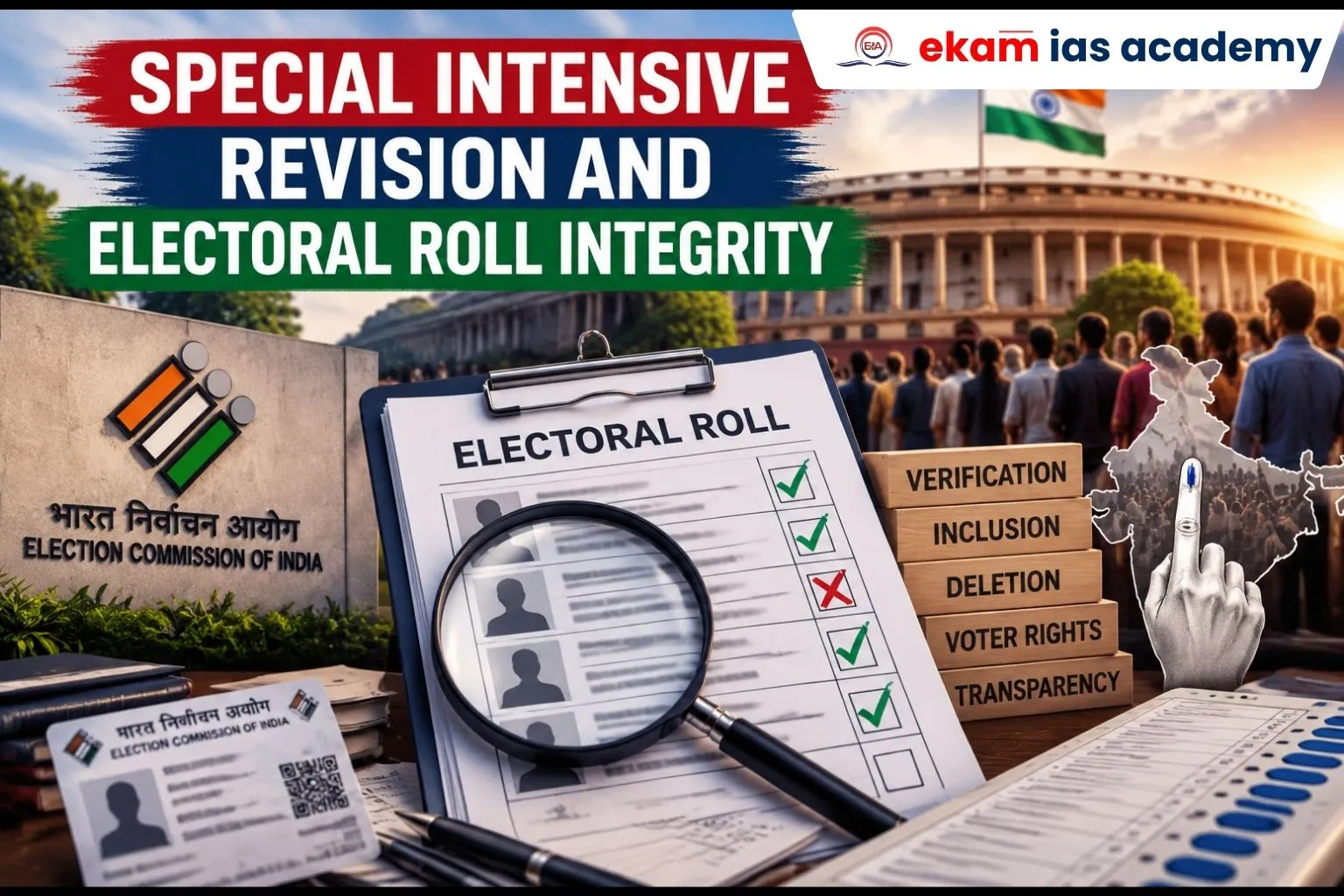
The Special Intensive Revision (SIR) of electoral rolls has raised concerns over verification procedures, deletions and transparency of the revision process. The Special Intensive Revision Electoral Rolls exercise highlights the importance of maintaining Electoral Roll Integrity India and accurate voter databases.
What is Special Intensive Revision?
- Special Intensive Revision (SIR) is a detailed exercise to verify and update electoral rolls, including identification of eligible voters and correction or removal of ineligible entries.
- SIR Electoral Roll Revision aims to improve voter databases by ensuring accurate, updated and credible electoral rolls.
- Section 21(3) of the Representation of the People Act, 1950 empowers the Election Commission to order a special revision, with reasons recorded.
- The objective of Electoral Roll Revision India is to maintain reliable voter lists and strengthen the credibility of the electoral process.
Constitutional Importance
- Article 324: Entrusts the Election Commission with superintendence, direction and control of elections and electoral rolls.
- Article 325: Provides for one general electoral roll and prohibits exclusion on grounds only of religion, race, caste or sex.
- Article 326: Establishes elections to Lok Sabha and State Assemblies on the basis of adult suffrage.
- Therefore, Special Intensive Revision SIR must ensure both electoral integrity and inclusion while supporting democratic participation.
Issues Raised During SIR
- Reports have highlighted concerns regarding software-generated discrepancies, deletion of names and the burden of documentary verification during the Electoral Roll Verification process.
- Questions have also been raised about coordination between centralised databases and local Electoral Registration Officers.
- Critics have argued that large-scale deletion before adequate verification could affect genuine electors and create concerns regarding Electoral Roll Deletion and Inclusion.
- The ECI maintains that Election Commission SIR is intended to identify eligible electors and improve voter list accuracy.
Supreme Court’s Role
- In May 2026, the Supreme Court upheld the ECI’s authority to conduct the West Bengal SIR, recognising its statutory power under Section 21(3).
- Subsequent proceedings addressed acceptable documents and verification procedures, including Aadhaar and specified educational records.
- This highlights judicial oversight in balancing administrative efficiency with voter inclusion under SIR Electoral Rolls UPSC related topics.
Key Challenges
- Exclusion risk: Genuine voters may face difficulties proving eligibility during Electoral Roll Revision India exercises.
- Digital dependence: Database errors can affect large numbers of records simultaneously and impact Voter List Revision India.
- Documentation gap: Poor and migrant households may lack easily available documents required for Voter Registration India.
- Public trust: Electoral processes require transparency and confidence across political and social groups to maintain Electoral Roll Integrity India.
Way Forward
- Ensure notice, hearing and appeal opportunities before final deletion of voter names.
- Conduct independent database audits and sample-based verification of automated discrepancies.
- Strengthen the capacity of Electoral Registration Officers and Booth Level Officers.
- Publish clear methodologies and data on deletions, restorations and appeals under the Special Intensive Revision Electoral Rolls process.
- Use technology as a verification aid while retaining accountable human oversight.
Conclusion
- Electoral-roll purification through Special Intensive Revision must strengthen election integrity without creating unnecessary barriers to universal adult participation.
- A transparent SIR Electoral Roll Revision process is essential for protecting voter rights, improving Voter List Accuracy India and strengthening democratic institutions.