
Recent protests in Delhi over the Special Intensive Revision (SIR) of electoral rolls have raised concerns about restrictions on public demonstrations and the Right to Peaceful Assembly in India.
Constitutional Basis of the Right to Protest
- Article 19(1)(a): Guarantees freedom of speech and expression, including peaceful political dissent.
- Article 19(1)(b): Guarantees citizens the Article 19(1)(b) Indian Constitution right to assemble peacefully without weapons, forming the constitutional basis of the Freedom of Assembly in India.
- Article 19(3): Permits reasonable restrictions on assembly in the interests of public order and India’s sovereignty and integrity, subject to Reasonable Restrictions on Assembly.
- Article 21: Protects life and personal liberty, including safeguards against arbitrary detention.
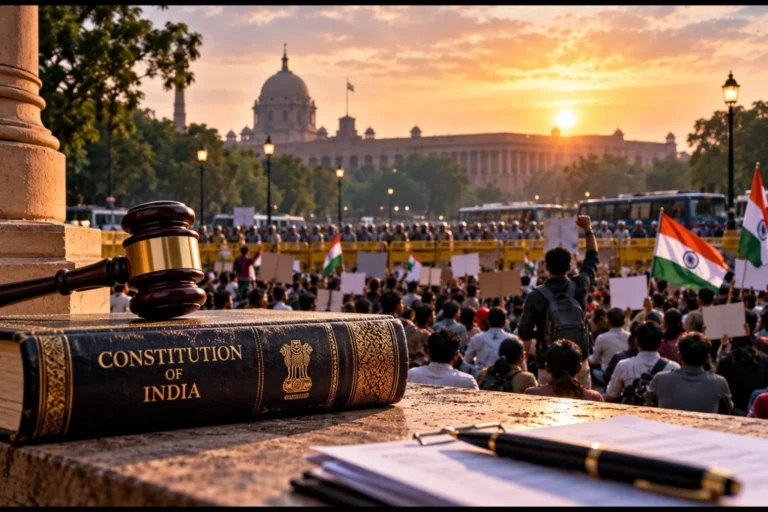
- The Constitution protects peaceful protest, but not violence or unrestricted occupation of public spaces. The Right to Protest in India must therefore be balanced with Public Order and Fundamental Rights.
Importance of Peaceful Assembly
- Democratic participation: Allows citizens to express concerns between elections.
- Government accountability: Encourages public scrutiny of policies and decisions.
- Protection of minorities: Gives marginalised communities opportunities to communicate grievances.
- Historical importance: The freedom struggle, farmers’ movements and labour protests demonstrate the role of collective action.
- Example: Peaceful demonstrations have contributed to public debate on environmental protection and land acquisition.
Legal Framework Governing Protests
- Section 163, BNSS, 2023: Empowers Executive Magistrates to issue urgent preventive orders when immediate action is necessary to prevent danger or disturbances.
- It broadly replaces Section 144 of the Criminal Procedure Code.
- Restrictions must have a lawful basis, serve a legitimate purpose and remain proportionate.
- Authorities may regulate protest timings, locations and routes to protect public safety. Such Police Powers During Protests India must operate within constitutional safeguards.
Important Supreme Court Judgments
- Himmat Lal K. Shah v. Commissioner of Police (1973): Public meetings may be regulated, but authorities cannot arbitrarily deny access to public streets.
- Babulal Parate v. State of Maharashtra (1961): Upheld preventive powers while examining their use in urgent situations.
- Ramlila Maidan Incident (2012): Emphasised protection of peaceful protesters against unjustified police action.
- Mazdoor Kisan Shakti Sangathan v. Union of India (2018): Called for balancing protest rights with residents’ interests.
- Amit Sahni v. Commissioner of Police (2020): Held that public roads cannot be occupied indefinitely for demonstrations.
Challenges
- Excessive restrictions: Repeated preventive orders may discourage legitimate dissent and affect the Right to Peaceful Assembly UPSC perspective.
- Police accountability: Unnecessary force and prolonged detention raise civil-liberty concerns.
- Restricted protest spaces: Remote locations may reduce the visibility of public grievances.
- Competing rights: Demonstrations can affect traffic, businesses, emergency services and residents
Way Forward
- Designate accessible protest locations without imposing blanket prohibitions.
- Apply the principles of necessity, proportionality and minimum force.
- Ensure transparent permissions, legal assistance and independent review of restrictions.
- Promote dialogue between authorities, organisers and affected communities.
Conclusion
A strong democracy must protect peaceful dissent while ensuring that restrictions on public assembly remain lawful, necessary and proportionate. The Freedom of Assembly and Public Order, Article 19(3) Indian Constitution, Constitutional Rights in India, Fundamental Rights UPSC and Indian Polity UPSC perspectives highlight the need to balance individual liberty with public order.