
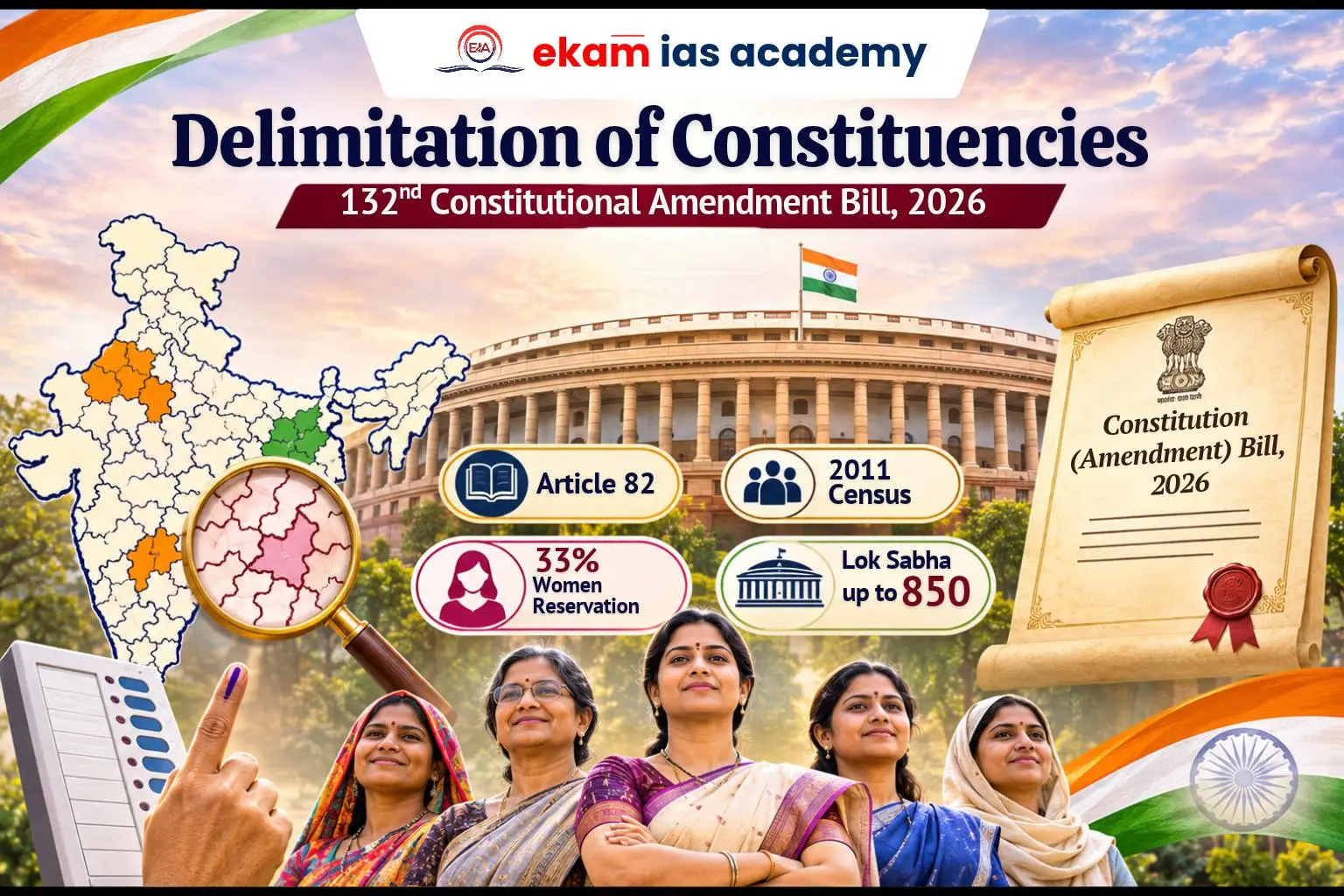
On 27 November 2026, the Union Cabinet reportedly approved the Constitution (132nd Amendment) Bill, 2026, proposing expansion of legislative seats and implementation of women’s reservation through Delimitation of Constituencies in India.
What is Delimitation?
Delimitation involves redrawing territorial constituencies and readjusting legislative seats to ensure equitable political representation based on population changes. The Delimitation Process in India is therefore closely linked with Population-Based Representation, Census and Delimitation in India and Parliamentary Constituencies Delimitation.
Key Provisions of the Proposed Bill
- 50% increase in Lok Sabha seats across every State and Union Territory.
- Increase maximum Lok Sabha strength to 850 seats.
- Increase the maximum strength of State Legislative Assemblies to 650.
- Retain existing interstate seat allocation proportions until the first Census after 2051 is published.
- Use 2011 Census data for redrawing constituencies.
- Facilitate implementation of 33% women’s reservation before the 2029 general elections.
- The proposal is therefore significant for 132nd Constitutional Amendment Bill 2026, Delimitation of Constituencies Bill 2026, Lok Sabha Seat Redistribution and Women’s Reservation and Delimitation.
Constitutional Provisions
| Article | Provision |
|---|---|
| 81 | Composition of Lok Sabha |
| 82 | Readjustment of constituencies after Census |
| 170 | Composition of State Assemblies |
| 330 and 332 | SC/ST reservation |
| 327 | Parliament’s power to regulate elections |
| 329 | Restrictions on judicial interference in electoral matters |
Article 82 Indian Constitution provides the constitutional basis for readjustment of constituencies after a Census, while Article 170 Indian Constitution deals with the composition of State Legislative Assemblies.
Evolution of Delimitation
- 42nd Amendment (1976): Froze seat allocation until 2000.
- 84th Amendment (2001): Extended the freeze until publication of the first Census after 2026.
- 87th Amendment (2003): Permitted constituency readjustment using the 2001 Census without changing interstate seat allocation.
Delimitation Commission
- Independent statutory body constituted by the Central Government.
- Commissions established in 1952, 1963, 1973 and 2002.
- The Delimitation Commission of India plays a central role in implementing the Delimitation Process in India.
Election Commission of India
Composition:
- Retired Supreme Court judge as Chairperson.
- Chief Election Commissioner or nominated Election Commissioner.
- Concerned State Election Commissioner.
- Its final orders have the force of law and are generally protected against judicial challenge.
Challenges
- North–South divide: Southern States fear losing relative representation despite successful population control.
- Representational inequality: Continuing the population-based freeze creates disparities in constituency sizes.
- Federal balance: Expansion must reconcile population-based representation with States’ relative political influence.
- These concerns make Lok Sabha Seat Redistribution, Population-Based Representation and Electoral Reforms in India important dimensions of the debate.
Way Forward
- Ensure interstate consultation and transparent delimitation criteria.
- Balance population representation with demographic performance.
- Safeguard SC/ST representation and geographical accessibility.
- Conduct public consultations before finalising constituency boundaries.
- A balanced approach is essential for effective Electoral Reforms in India and equitable Delimitation of Constituencies in India.
Conclusion
Delimitation must reconcile one person, one vote, one value with cooperative federalism. Electoral restructuring should strengthen representative democracy without penalising successful population stabilisation. The issue is therefore important for Delimitation UPSC, Census and Delimitation in India, Women’s Reservation and Delimitation and broader electoral reforms.