
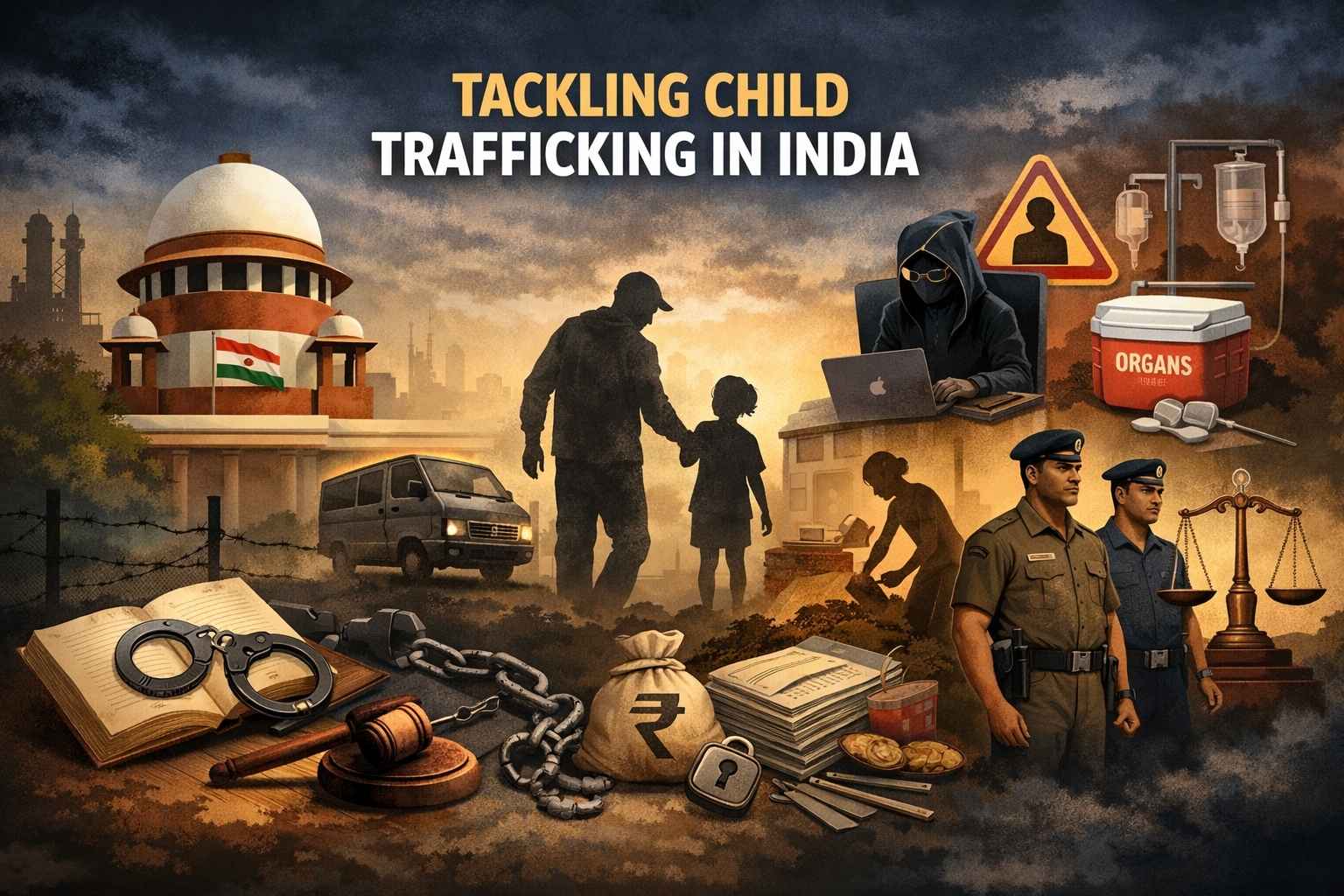
The Supreme Court in K. P. Kiran Kumar vs State recently issued strict directions to curb child trafficking, calling it a grave violation of the fundamental right to life. Such judgments are regularly discussed in GS-II and GS-IV classes at leading IAS coaching in Hyderabad institutes as part of contemporary constitutional issues.
What is Child Trafficking?
International Definition (Palermo Protocol, 2000):
Recruitment, transport, transfer, harbouring, or receipt of a child for exploitation.
Indian Law (BNS, 2023 – Section 143):
Trafficking includes recruitment or transfer through threats, force, fraud, coercion, abuse of power, or inducement for exploitation—an area frequently analysed in polity modules of UPSC online coaching programs.
Scope of Exploitation:
Covers sexual and physical abuse, slavery, servitude, forced labour, and organ removal.
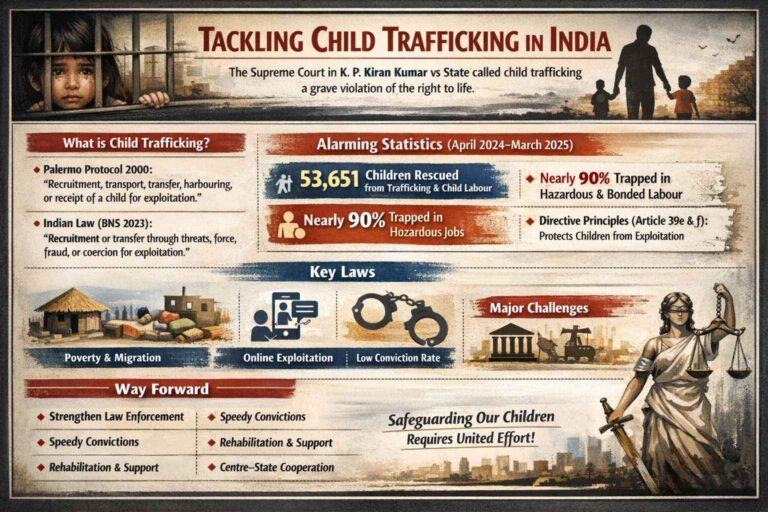
Child trafficking Reports (2025)
- 53,651 children rescued from child labour, trafficking, and kidnapping between April 2024–March 2025.
- Nearly 90% of rescued children were trapped in the worst forms of child labour (e.g., hazardous industries, bonded labour).
- Data compiled by the Centre for Legal Action and Behaviour Change (C-LAB) under India Child Protection.
Constitutional Safeguards
- Article 23: Prohibits trafficking, forced labour, and begar.
- Article 24: Bans child employment in hazardous industries.
- Directive Principles (Article 39 e & f): Mandates protection against exploitation and abandonment; ensures healthy development with dignity.
Legislative Framework
- BNS (Sections 98 & 99): Criminalises selling and buying of minors.
- Immoral Traffic (Prevention) Act, 1956: Targets trafficking for sexual exploitation.
- Juvenile Justice Act, 2015: Provides care, protection, and rehabilitation.
- Criminal Law Amendment Act, 2013: Expands trafficking definition to include slavery, servitude, forced labour, and organ trade.
- POCSO Act, 2012: Gender-neutral law against sexual offences; includes stringent punishments up to life imprisonment and death penalty. 400 fast-track courts set up for speedy disposal of cases.
Judicial Approach
- Vishal Jeet vs Union of India (1990): Recognised trafficking and child prostitution as serious socio-economic issues.
- M. C. Mehta vs State of Tamil Nadu (1996): Issued guidelines against child labour in hazardous industries.
- Bachpan Bachao Andolan vs Union of India (2011): Directed comprehensive measures to combat trafficking and child exploitation.
- These landmark judgments are frequently used as case laws in GS answers by aspirants from top civils coaching in Hyderabad.
Challenges Ahead
- Socio-economic vulnerabilities: Poverty, unemployment, migration, disasters, and family breakdown push children into risk.
- Digital threats: Social media and online platforms increasingly used for recruitment under false pretenses.
- Weak deterrence: Conviction rate between 2018–2022 was only 4.8%.
Way Forward
- Protect children’s social, economic, and political rights through strong institutions.
- Improve conviction rates to create deterrence.
- Strengthen Centre–State cooperation since law and order is a State subject.
- Focus on rehabilitation, awareness, and community vigilance to break trafficking chains.
Conclusion
Child trafficking undermines India’s constitutional promise of dignity and protection for children. A coordinated legal, judicial, and administrative response—backed by strong Union-State collaboration—is essential to safeguard vulnerable children and dismantle trafficking networks.
This topic is available in detail on our main website.