

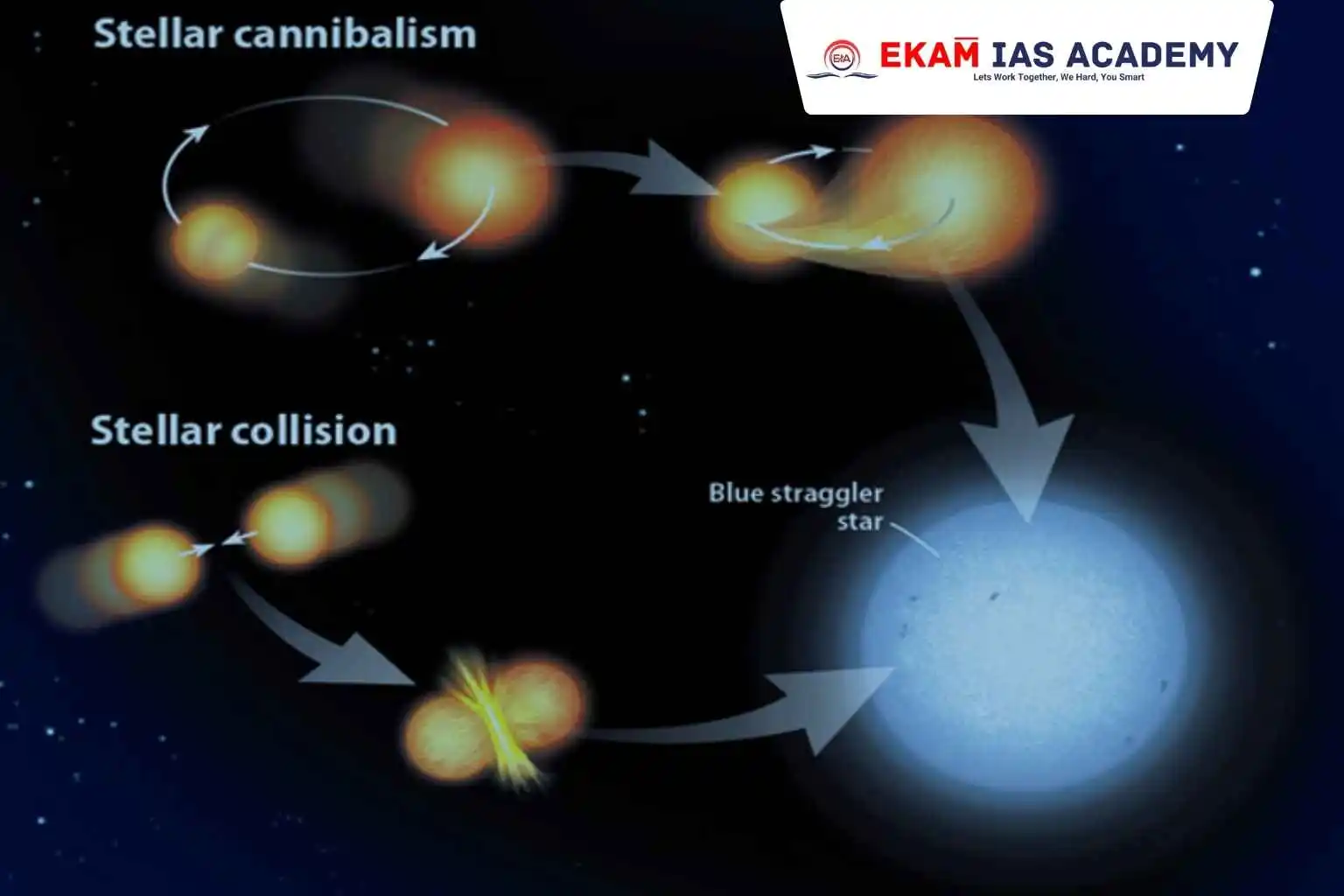
Indian astronomers, along with international collaborators, have recently reported the rare discovery of a Blue Straggler Star (BSS), a unique stellar object that appears younger, hotter, brighter, and more massive than other stars of the same age in old star clusters. This topic is important for aspirants preparing for GS3 Science and Technology through upsc online coaching.
About Blue Straggler Stars
- Found in globular clusters, dwarf galaxies, and dense stellar systems.
- Appear on the main sequence extension in the colour‑magnitude diagram.
- Stand out as bluer and brighter compared to the normal turn‑off stars of the cluster.
- Represent a different evolutionary path than expected for stars of similar age.
How They Differ
- Normally, stars in clusters cool and expand into red giants.
- Blue stragglers instead grow hotter and brighter, showing a blue colour.
- They “lag behind” in evolution compared to their peers, hence termed stragglers.
Possible Explanations
- External Origin: They may not belong to the cluster originally.
- Mass Transfer: A straggler draws matter from a giant companion star → becomes hotter and more massive, while the donor evolves into a white dwarf.
- Triple Star Interaction: A third star may facilitate mass transfer between binary companions, creating the anomaly.
Scientific Significance
- Provide insights into stellar evolution and dynamics in dense clusters.
- Help astronomers understand binary and multiple star interactions.
- Offer clues about mass transfer processes and long‑term stability of star systems.
- Important for studying galactic archaeology, since globular clusters are among the oldest structures in the universe.
Indian Contribution
- Discovery highlights India’s growing role in global astrophysics research.
- Builds on earlier work by Indian observatories in studying stellar populations and cluster dynamics.
Conclusion
cBlue Straggler Stars challenge conventional models of stellar evolution, reminding us that the universe often defies simple rules their study deepens our understanding of stellar life cycles and cosmic mysteries.