
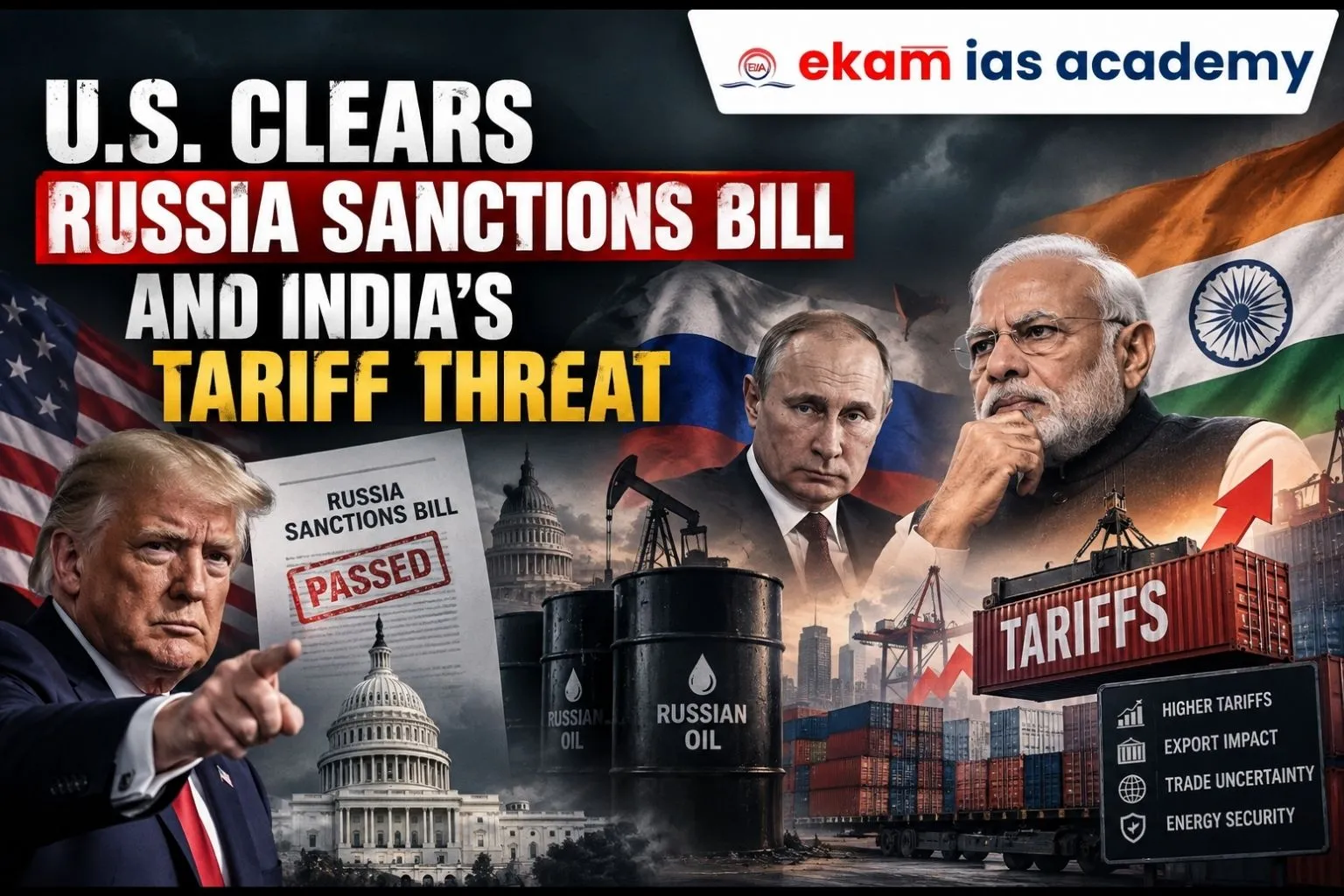
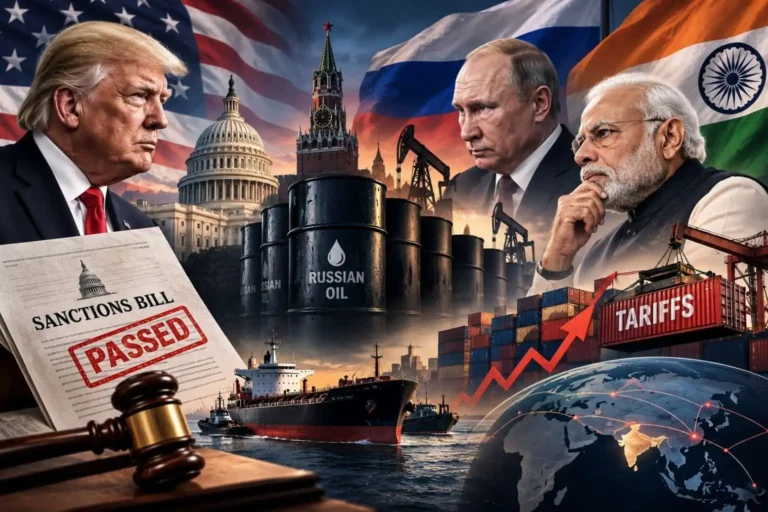
The U.S. House of Representatives has passed an amendment to the Lindsey O. Graham Sanctioning Russia and Iran Act, 2026, relating to the Russia Sanctions Bill 2026, to impose tariffs of up to 100% on countries importing Russian oil and gas. The development has significant implications for India Russia Oil Trade, India Russian Oil Imports, and US India Tariff 2026 relations.
Key Provisions of the Bill
- Targets Russia’s energy sector, individuals, and “shadow fleet” of tankers.
- Authorises tariffs on the top five importers of Russian crude or gas who continue purchases post-enactment.
- Exemptions: Countries reducing Russian gas imports significantly or whose imports are below 15% of Russia’s total gas exports.
- Grants sweeping powers to the U.S. President, including authority to waive sanctions in the national interest.
India’s Position
- Energy Security Priority: India emphasised diversified sourcing to meet the needs of 1.4 billion people.
- Trade Protection: New Delhi pledged to safeguard economic interests while negotiating a preliminary trade deal with Washington.
- Diplomatic Engagement: The issue was raised at high levels with U.S. interlocutors, highlighting implications for bilateral ties.
- Import Trends: Russian crude share fell to a two-year low in December 2025, but imports surged again in April 2026 amid the West Asian conflict.
Implications for India
- Tariff Escalation: India already faces a cumulative 50% tariff (25% existing + 25% additional in 2025). New sanctions could raise this to 100%, severely affecting export competitiveness.
- Economic Costs: Higher tariffs may reduce India’s price advantage in the U.S. market, impacting export-dependent sectors.
- Strategic Dilemma: India must balance affordable Russian energy imports with the risk of strained U.S. relations.
- Global Positioning: India risks being grouped with China and other major importers as potential sanction targets.
Way Forward
- Export Diversification: Strengthen trade ties with the EU, ASEAN and Africa to reduce reliance on the U.S. market.
- Domestic Reforms: Improve logistics, remove non-tariff barriers and enhance product standards.
- Energy Diversification: Expand renewable and alternative energy sources to reduce dependence on Russian crude.
- Diplomatic Strategy: Continue high-level engagement with Washington to seek waivers or phased implementation.
Conclusion
- The US Russia Sanctions Bill poses a significant tariff-related concern for India’s trade and energy security.
- The legislation highlights Washington’s approach towards Russia and countries continuing Russian energy purchases.
- India needs a multi-pronged approach combining export diversification, domestic reforms and energy alternatives.
- Maintaining balanced relations with both the U.S. and Russia remains important for India’s long-term economic resilience.