
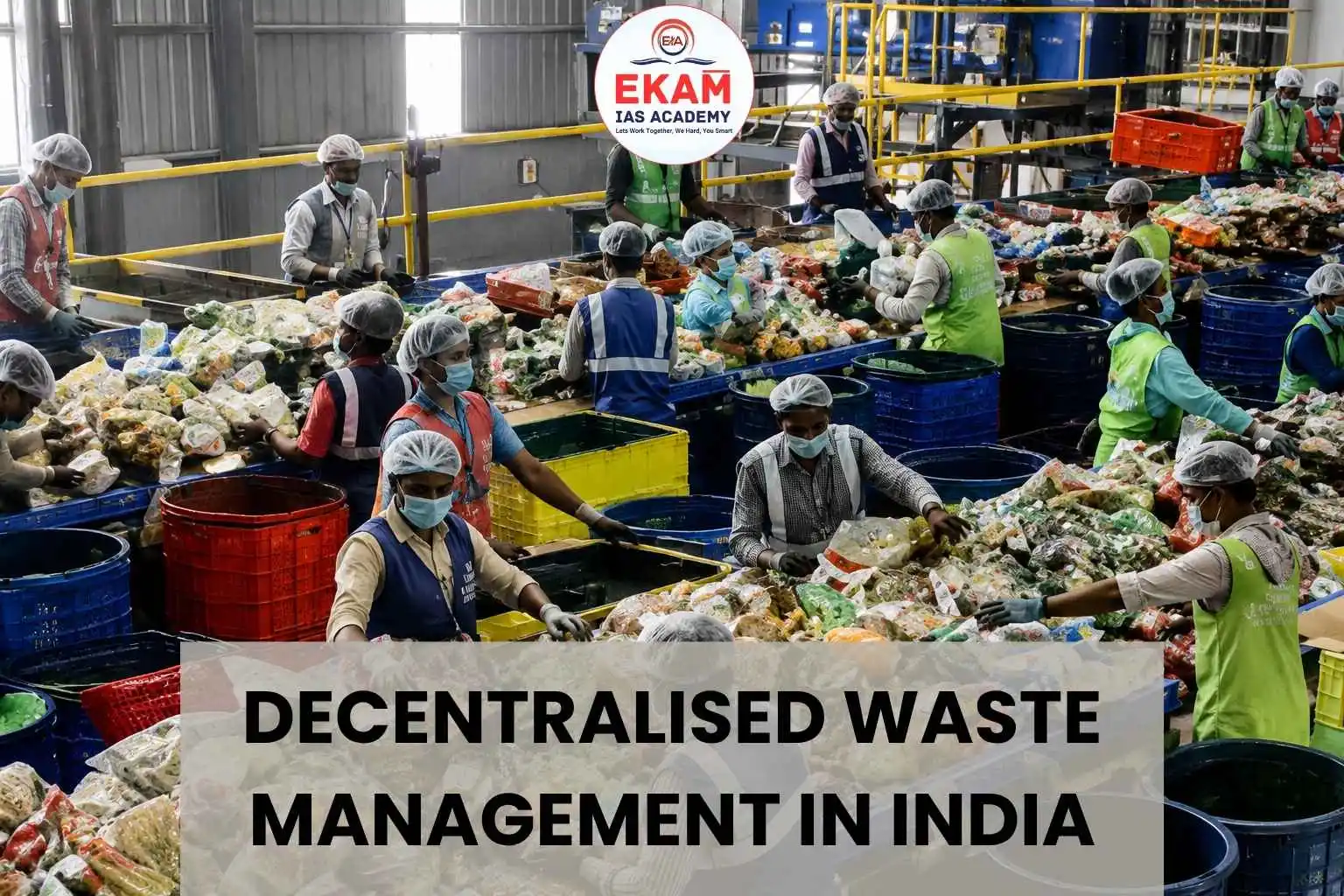
The Solid Waste Management Rules, 2026 have replaced the 2016 framework, aiming to strengthen segregation at source, scientific processing, and reduction of landfill dependence. This topic is important for aspirants preparing through IAS coaching in Hyderabad, UPSC coaching in Hyderabad, and UPSC online coaching.
India’s Waste Challenge
• Massive Waste Generation: India produces about 1.7 lakh tonnes of municipal solid waste every day, much of which is dumped in open landfills without proper treatment.
• Landfill Hazards: Landfills release methane gas, contributing to climate change and causing frequent fires (e.g., Delhi Bhalswa fire 2024, Kochi Brahmapuram fire 2025).
• Urban Flooding from Plastic Waste: Poorly managed plastic waste clogs urban drainage systems, worsening monsoon flooding in cities like Bengaluru and Mumbai.
Constitutional & Legal Context
• Rules framed under the Environment (Protection) Act, 1986, enacted using Article 253 (international obligations like Stockholm Declaration, 1972).
• While national standards are necessary, sanitation and public health are State subjects under the Constitution.
• The 73rd and 74th Amendments assign waste management responsibilities to Panchayats and Municipalities, making it a local governance function.
Principle of Subsidiarity
• Governance at the Local Level: The principle stresses that decision making should happen closest to citizens, with municipalities and gram panchayats leading waste management efforts.
• Need for Local Knowledge: Effective waste solutions depend on understanding local ecology, settlement patterns, and administrative capacity, which only local bodies can provide.
• Limits of Uniform Rules: A single national framework cannot address the diverse realities of megacities, Himalayan towns, coastal regions, and rural villages; decentralisation allows flexibility and innovation.
Challenges
• Compliance Over Outcomes: Centralised rules often prioritise documentation and reporting rather than actual improvements in waste collection, segregation, and processing.
• Administrative and Digital Burden: Heavy reliance on digital monitoring systems can overwhelm local bodies that lack trained staff and technical infrastructure.
• Fiscal Inefficiency: A large share (40–50%) of municipal budgets is consumed by secondary transport of waste to landfills.
Decentralised Waste Management
• Urban Local Bodies (ULBs): Strengthen segregation, recycling, and composting at ward level.
• Gram Panchayats:
• Awareness through Gram Sabhas.
• Promote household/community composting.
• Cluster level waste processing with nearby towns.
• States as Policy Laboratories: Experiment with cooperatives, metropolitan authorities, and tourist waste regulation; successful models can inform national standards.
Solid Waste Management Rules, 2026
• Replaced the 2016 framework from April 1, 2026.
• Key provisions:
• Mandatory segregation of waste at source.
• Regulation of bulk waste generators (institutions, hotels, housing complexes).
• Scientific processing through composting, biomethanation, recycling, and waste-to-energy.
• Legacy dumpsite remediation using bio-mining.
• Digital monitoring via CPCB portal.
Significance
• Promotes sustainable urbanisation and environmental protection.
• Reduces dependence on landfills and lowers methane emissions.
• Encourages circular economy practices through recycling and resource recovery.
• Strengthens local governance and citizen participation in sanitation management.
• Supports India’s climate goals and Swachh Bharat objectives.
Conclusion
Empowering local bodies with predictable financing, trained staff, and citizen participation ensures cleaner cities, healthier rural areas, and sustainable development. A phased rollout starting with megacities and moving to rural areas can balance ambition with practicality. Aspirants preparing through IAS coaching and civils coaching in Hyderabad should focus on its relevance for environmental governance, urbanisation, and sustainable development in GS3.
This topic is available in detail on our main website.