
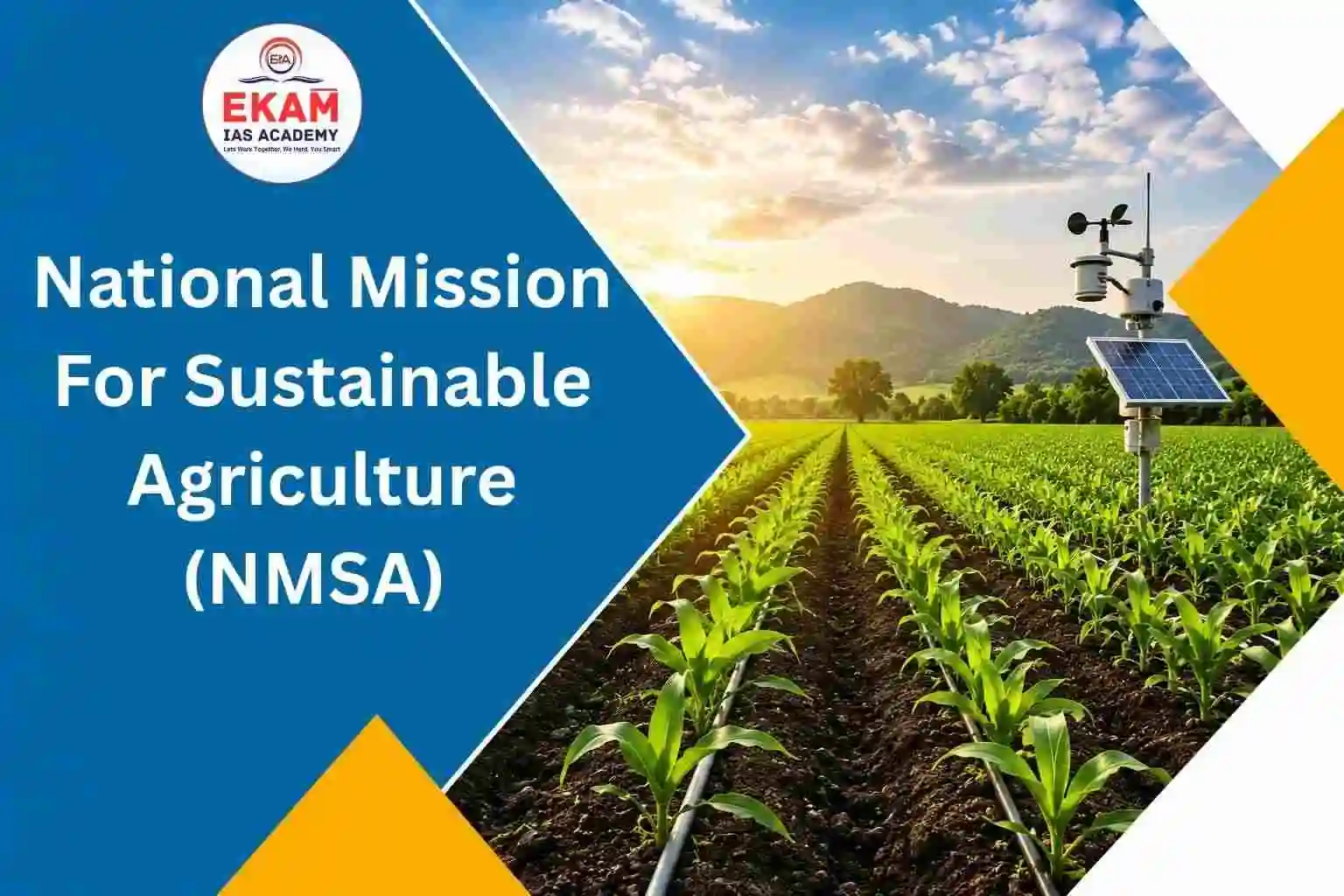
The Government has set a target of covering 100 lakh hectares under micro irrigation between 2025–26 and 2029 as part of the National Mission for Sustainable Agriculture (NMSA), strengthening the “Per Drop More Crop” initiative for water use efficiency. This topic is important for aspirants preparing through IAS coaching in Hyderabad, UPSC coaching in Hyderabad, and UPSC online coaching.
National Mission for Sustainable Agriculture (NMSA)
• Launched in 2014–15 under the National Action Plan on Climate Change (NAPCC).
• Designed to mitigate climate variability impacts on agriculture and ensure long-term food and livelihood security.
• Since 2022–23, it functions under the umbrella of Pradhan Mantri Rashtriya Krishi Vikas Yojana (PMRKVY).
• Nodal Ministry: Ministry of Agriculture and Farmers Welfare.
Objectives
• Promote climate-resilient farming practices.
• Enhance water use efficiency and soil health.
• Strengthen adaptation capacity of farmers against climate shocks.
• Support sustainable agricultural development.
Major Initiatives Under NMSA
Rainfed Area Development (RAD)
• Encourages Integrated Farming Systems (IFS) for diversified and risk-resilient agriculture.
Per Drop More Crop (PDMC)
• Focuses on micro irrigation to improve water efficiency.
• Promotes drip and sprinkler irrigation systems.
Soil Health Management (SHM)
• Linked with the Soil Health Card Scheme.
• Promotes balanced nutrient use and long-term soil fertility.
Climate Change & Sustainable Agriculture: Monitoring, Modeling and Networking (CCSAMMN)
• Facilitates knowledge exchange between farmers and research institutions on climate adaptation.
Significance of NMSA
• Supports climate-resilient agriculture amid rising temperature and erratic rainfall.
• Improves irrigation efficiency and reduces water wastage.
• Enhances farmers’ income through sustainable farming practices.
• Promotes resource conservation and long-term food security.
• Aligns with India’s climate commitments and sustainable development goals.
Challenges
• Limited awareness among small and marginal farmers.
• High initial cost of micro-irrigation systems.
• Regional disparities in implementation and infrastructure.
• Need for stronger extension services and technology adoption.
Conclusion
NMSA is a strategic mission to safeguard agriculture against climate risks while improving productivity and sustainability. Its success depends on effective implementation, farmer awareness, and integration of modern technology for sustainable agricultural growth. Aspirants preparing through IAS coaching and civils coaching in Hyderabad should focus on its relevance for climate change, sustainable agriculture, irrigation, and food security in GS3 Environment and Economy.
This topic is available in detail on our main website.