

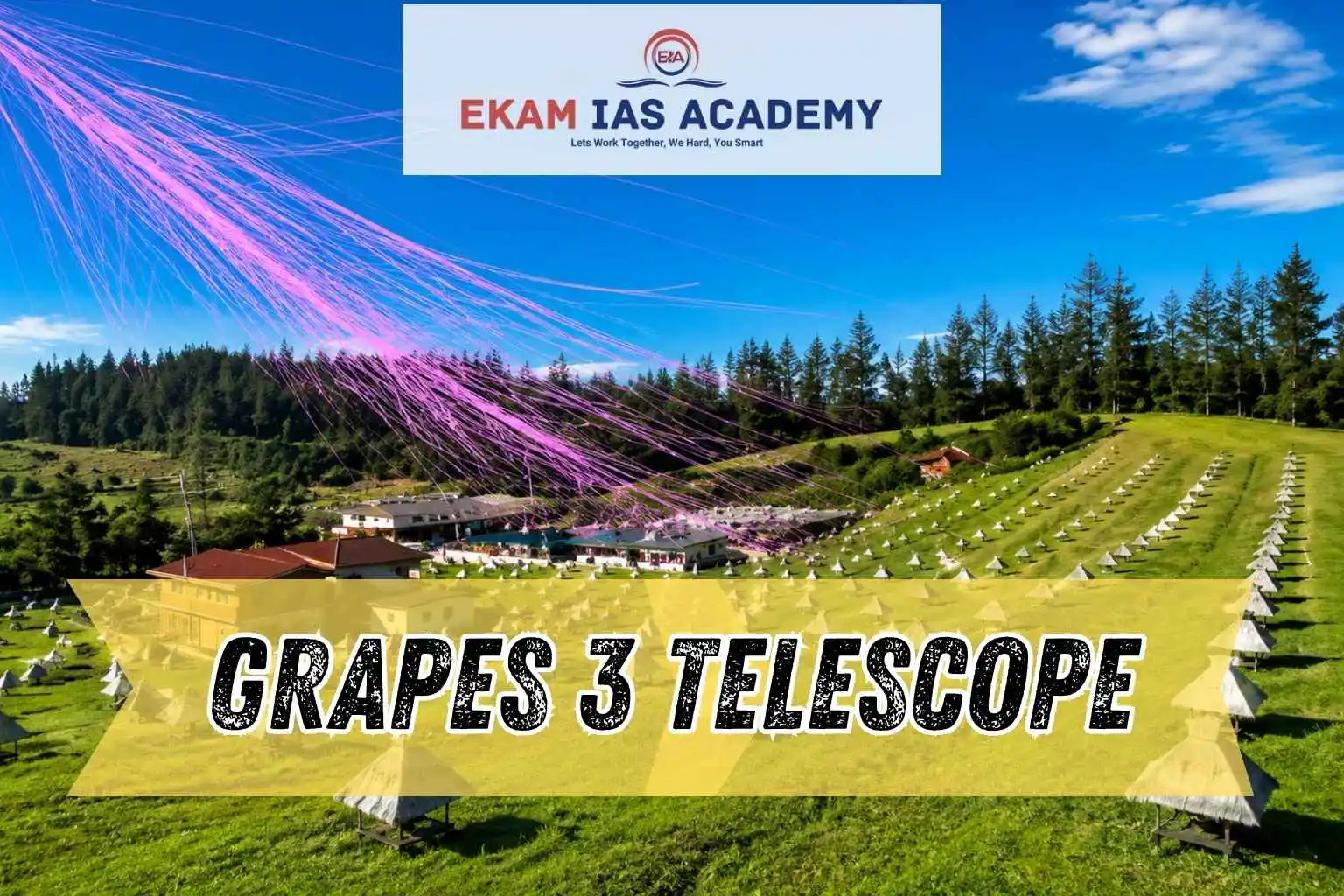
Recently, scientists from Mumbai, Kochi, and Japan used the GRAPES 3 telescope to study how the Earth’s upper atmosphere temperature and the Sun’s magnetic field influence muons reaching the planet. This topic is important for aspirants preparing for GS3 Science and Technology and high energy astrophysics-related issues through IAS coaching in Hyderabad.
GRAPES 3 Telescope
• Full Form: Gamma Ray Astronomy PeV EnergieS phase 3.
• Objective: To investigate the origin, acceleration, and propagation of cosmic rays by measuring extensive air showers.
• Phenomena Studied: Solar activity and thunderstorm effects using muon detection.
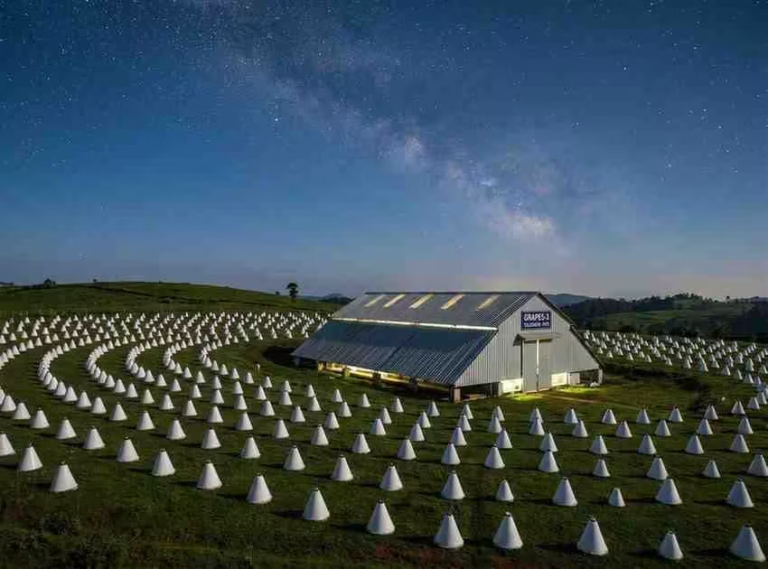
• Technology: Uses an array of plastic scintillator detectors and a large muon detector based on proportional counters.
• Location: Situated in Ooty, Tamil Nadu.
• Institution: Operated by the Tata Institute of Fundamental Research (TIFR).
Cosmic Rays
• Discovery: Identified over 100 years ago; considered the most energetic particles in the universe.
• Characteristics: Earth is constantly bombarded by cosmic rays uniformly from all directions.
• Air Showers: On entering the atmosphere, they produce particle showers including electrons, photons, muons, protons, and neutrons.
• Speed: Travel nearly at the speed of light.
• Energy Range: Observed across a wide energy spectrum, from 10⁸ to 10²⁰ eV.
• Importance: Vital for understanding astrophysics, particle physics, and atmospheric science.
Broader Significance
• Enhances India’s role in global cosmic ray research.
• Provides insights into solar-terrestrial interactions and climate science.
• Supports international collaboration with Japanese institutions.
• Links to India’s broader scientific missions such as ISRO’s space weather studies and neutrino observatories.
Conclusion
GRAPES 3 strengthens India’s position in high energy astrophysics, offering vital clues about cosmic rays and their impact on Earth’s atmosphere.