


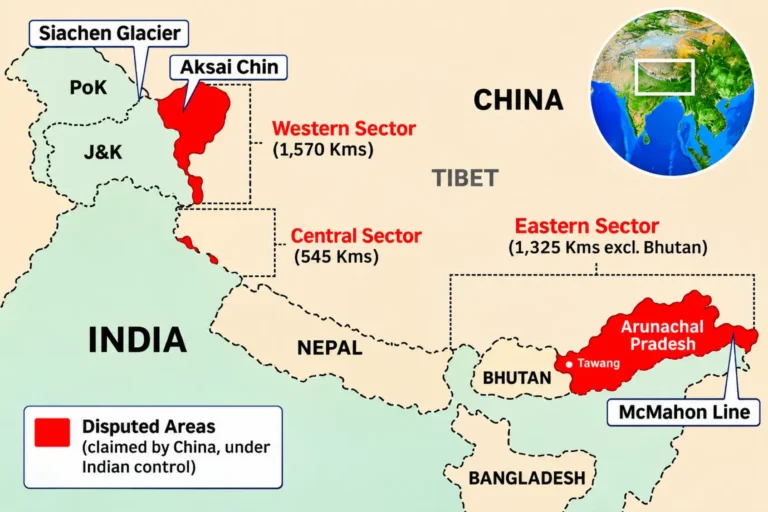
Reports of fresh India-China Border Tensions in Arunachal Pradesh‘s Asaphila, Taksing and Longju areas have raised concerns about border security. The developments are important for understanding the Arunachal Pradesh Border Dispute, India China LAC Dispute and India China Relations 2026.
Background of the India–China Border Dispute
- Line of Actual Control (LAC): The line separating areas under Indian and Chinese control; its alignment is not mutually agreed in several locations.
- McMahon Line (1914): Forms the basis of India’s boundary position in the eastern sector, but China disputes it. The issue remains central to the McMahon Line Dispute.
- China’s claim: Beijing describes Arunachal Pradesh as Zangnan or South Tibet, which India firmly rejects. These claims form an important part of China’s Territorial Claims in Arunachal Pradesh.
- 1959 Line: A historical Chinese proposal for the LAC that India has never accepted.
- The broader India China Border Dispute UPSC topic covers the LAC, territorial claims, boundary agreements and strategic relations between the two countries.
Recent Concerns in Arunachal Pradesh
- Reported face-offs: Asaphila, Taksing and Longju have emerged as areas of concern.
- Patrolling disputes: Reports suggest possible restrictions on Indian patrol access.
- Infrastructure: Allegations of Chinese construction near traditional grazing grounds require verification.
- Salami-slicing: A strategy of making small, gradual territorial advances to change the situation on the ground.
- These developments are relevant to India China Border Conflict, India China Border Infrastructure and India’s Border Security Strategy.
Eastern and Northeastern Border States
| Country | Indian States/UTs Sharing the Border | Principal Border Guarding Force |
|---|---|---|
| China | Arunachal Pradesh, Sikkim, Uttarakhand, Himachal Pradesh and Ladakh (UT) | Indo-Tibetan Border Police (ITBP) |
| Myanmar | Arunachal Pradesh, Nagaland, Manipur and Mizoram | Assam Rifles |
| Nepal | Sikkim, West Bengal, Bihar, Uttar Pradesh and Uttarakhand | Sashastra Seema Bal (SSB) |
| Bhutan | Arunachal Pradesh, Assam, West Bengal and Sikkim | Sashastra Seema Bal (SSB) |
| Bangladesh | West Bengal, Assam, Meghalaya, Tripura and Mizoram | Border Security Force (BSF) |
Major Security Agencies
- Indian Army: Defends the border against external military threats.
- ITBP: Guards the India–China frontier and conducts border patrols.
- Assam Rifles: Guards the Myanmar border and supports counter-insurgency operations.
- SSB: Guards India’s borders with Nepal and Bhutan.
- BSF: Guards the India–Bangladesh border.
- These agencies are central to India’s broader Internal Security UPSC and border-management framework.
Diplomatic Agreements and Mechanisms
- 1993 Agreement: Promotes peace and stability along the LAC.
- 1996 Agreement: Establishes military confidence-building measures.
- 2005 Agreement: Provides political principles for boundary settlement.
- WMCC: Facilitates consultation and coordination on border affairs.
- Special Representatives mechanism: Enables high-level discussions on the boundary question.
- These mechanisms remain important to India China Diplomatic Relations and Indo-China Military Relations.
Challenges
- Border ambiguity: Accelerate mutually agreed clarification of the LAC.
- Infrastructure gaps: Improve roads, communications and surveillance.
- Local participation: Include border communities in development and information-sharing.
- Transparency: Communicate verified major developments without compromising security.
- Diplomacy: Combine military preparedness with sustained political dialogue.
- Managing these challenges is essential for India’s India’s Border Security Strategy and long-term India China Relations 2026.
Conclusion
India’s eastern frontier requires a coordinated strategy combining credible deterrence, diplomatic engagement, border development and transparent governance to protect territorial integrity. A balanced approach to the India China Border Dispute UPSC, India China LAC Dispute, India China Diplomatic Relations, International Relations UPSC and Internal Security UPSC dimensions is essential for safeguarding India’s national interests.