
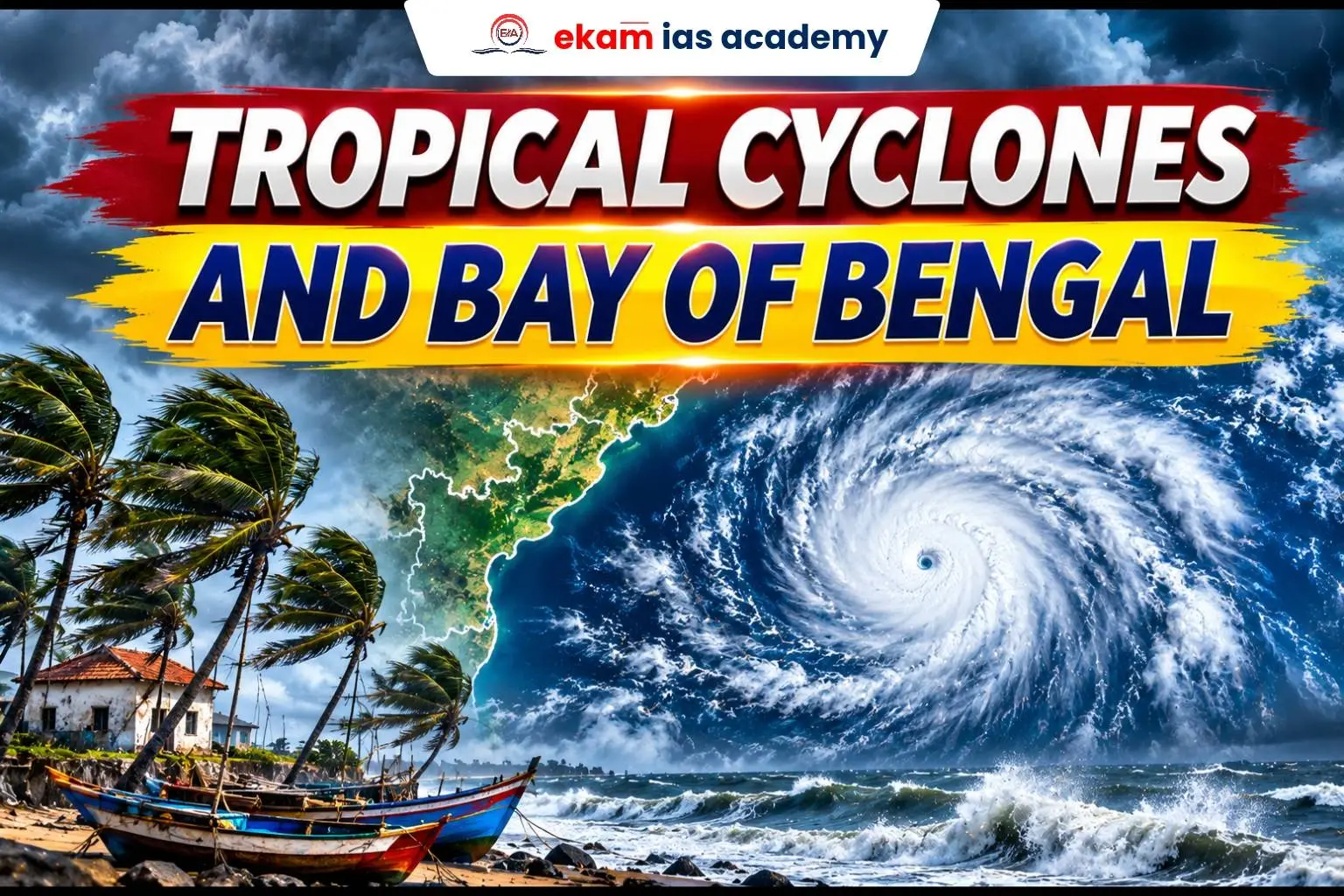
Recently Cyclone Murasu struck coastal Andhra Pradesh, causing deaths, crop damage, displacement and disruption of transport and electricity. The event highlights Tropical Cyclones and Bay of Bengal Vulnerability, Cyclone Risk in Eastern India and the need for stronger coastal resilience.
What Is a Tropical Cyclone?
- A tropical cyclone is an intense low-pressure system developing over warm tropical oceans, accompanied by strong rotating winds and heavy rainfall. Tropical Cyclones UPSC is an important topic under physical geography and disaster management.
- Formation conditions: Sea surface temperature around 26.5°C or higher, moist air, atmospheric instability, low vertical wind shear and sufficient Coriolis force.
- Rotation: Cyclones rotate anticlockwise in the Northern Hemisphere and clockwise in the Southern Hemisphere.
- They rarely form near the Equator because the Coriolis force is very weak.
- These conditions influence Tropical Cyclone Intensity and Frequency across the Indian Ocean region.
How Does the Eye Work?
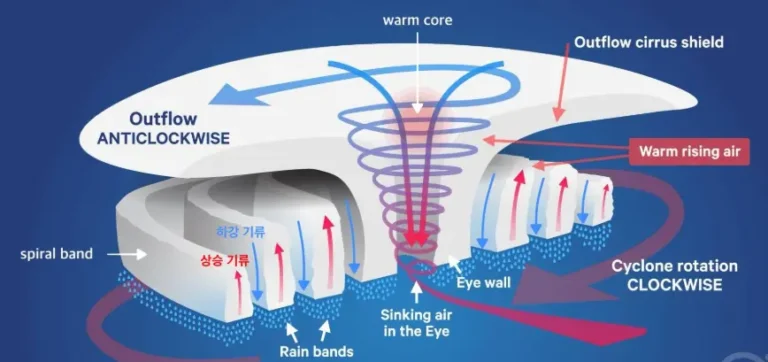
- Eye: The relatively calm central region, where air generally sinks and clouds may clear.
- Eyewall: A ring of powerful thunderstorms surrounding the eye, producing the strongest winds and intense rainfall.
- Rainbands: Curved cloud bands extending outward, bringing showers and gusty winds.
- When the eye passes over an area, conditions may briefly improve before dangerous winds return from another direction.
Northern vs Southern Hemisphere Cyclones
- Northern Hemisphere: Winds spiral anticlockwise around the low-pressure centre.
- Southern Hemisphere: Winds spiral clockwise because the Coriolis force acts in the opposite direction.
- Their basic structure and formation processes remain similar.
- In India, cyclone activity is concentrated around the Bay of Bengal and Arabian Sea, mainly during pre-monsoon and post-monsoon periods, making Indian Ocean Tropical Cyclones important for understanding regional weather hazards.
Why Does the Bay of Bengal Experience More Cyclones?
- Warm waters: High sea temperatures provide energy for cyclone development and contribute to Bay of Bengal Cyclone Formation.
- Freshwater inflow: Major rivers create surface-water stratification, which can limit cooling caused by ocean mixing.
- Atmospheric conditions: Favourable moisture, disturbances and wind patterns support cyclone formation.
- Arabian Sea conditions: Historically, stronger vertical wind shear and cooler water from upwelling have often restricted cyclone development.
- Coastal vulnerability: The Bay’s funnel-shaped northern coastline can amplify storm surges, particularly near low-lying deltas, making Bay of Bengal and Indian Coastline vulnerability a major concern.
- The combination of oceanic and atmospheric conditions makes the region one of the major Cyclone-Prone Regions of India.
Impacts and Disaster Management
- Human: Deaths, displacement, injuries and disease risks.
- Economic: Damage to crops, fisheries, transport and electricity networks.
- Environmental: Coastal erosion, saline-water intrusion and habitat destruction.
- Preparedness: IMD forecasts, evacuation shelters, resilient buildings and coastal shelterbelts. The IMD Cyclone Warning System plays a crucial role in early warning and evacuation.
- Institutions: NDMA, NDRF and State disaster authorities coordinate preparedness and response.
- Effective Cyclone Preparedness and Disaster Management can significantly reduce losses from tropical cyclones.
Conclusion
Reducing cyclone losses requires accurate forecasting, strong community preparedness and climate-resilient coastal development rather than relying on emergency response alone. Understanding Climate Change and Tropical Cyclones, Coastal Vulnerability in India, Tropical Cyclones in Bay of Bengal, Disaster Management UPSC and Geography and Environment UPSC is essential for building long-term resilience.