
India has issued its first ship recycling credit note to Bella Shipping under a new scheme announced in Budget 2025–26, aimed at promoting green ship recycling and linking it with domestic shipbuilding. This topic is important for aspirants preparing for GS3 Economy and maritime industry reforms through IAS coaching in Hyderabad.
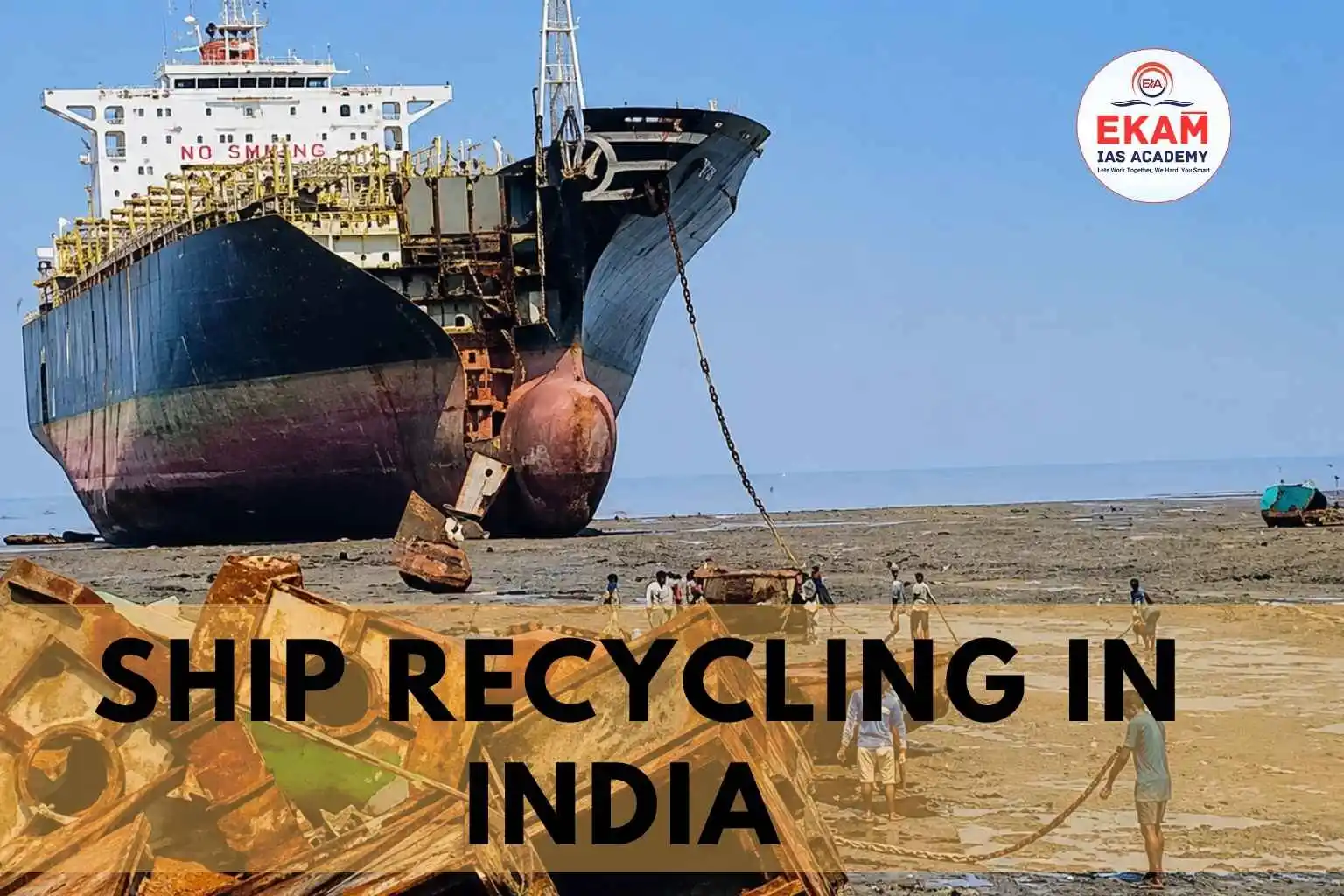
Ship Recycling in India
• Definition: Dismantling end-of-life ships to recover steel, machinery, spare parts, and reusable equipment, while ensuring safe disposal of hazardous waste (asbestos, heavy metals, oils).
• Global Context: Around 16,000 ships (700 million DWT) are expected to be recycled globally in the next decade.
Economic Role
• Steel Recovery: India recycles 4.5 million LDT annually, with plans to expand to 9 million LDT by 2047 under the Maritime Amrit Kaal Vision.
• Energy Savings: Recycled steel requires 60–70% less energy compared to primary steel production, reducing carbon emissions.
• Employment: Provides jobs to thousands in coastal Gujarat, Maharashtra, and Tamil Nadu, supporting ancillary industries such as re-rolling mills, transport, and waste management.
• Import Substitution: Reduces dependence on imported scrap metal, strengthening India’s steel supply security.
Global Position
• Share: India contributes about 33% of global ship recycling tonnage.
• Alang Sosiya Yard (ASSRY), Gujarat: Largest ship recycling hub globally, handling 97% of India’s recycling activity with 120 operational plots, many HKC compliant.
• EU Whitelist Compliance: India is increasingly aligning with the EU Ship Recycling Regulation, enabling recycling of EU-flagged vessels.
Legal & Environmental Framework
• Governing Law: Recycling of Ships Act, 2019, aligned with the Hong Kong International Convention (HKC).
• HKC Status: Entered into force globally in June 2025; India ratified it in 2019.
• Focus Areas: Safe handling of asbestos, heavy metals, toxic oils; worker safety; emergency preparedness; pollution control; coastal protection.
Economic Importance
• Recovery of steel for domestic industries.
• Employment generation in coastal regions.
• Growth of ancillary maritime industries.
• Supports Maritime India Vision 2030 and the Blue Economy framework.
How the Scheme Works
• Credit Note Value: Ship owners receive 40% of the scrap value of a dismantled vessel as a credit note.
• Redemption: The credit can be used to cover up to 5% of the cost of a new ship built in an Indian shipyard.
• Eligibility: Only HKC-compliant yards qualify, ensuring environmental and safety standards.
• Objective: Strengthen the circular economy, link recycling with domestic shipbuilding, and enhance competitiveness of Indian shipyards.
Challenges
• India processed only ~13% of global recycled tonnage, relying on dismantling smaller ships rather than large carriers.
• Limited shipbuilding capacity restricts full utilization of the scheme.
• Faster rollout of digital credit note platforms and simplified approval processes needed.
• Expansion of a skilled maritime workforce is essential.
• Greater investment in shipyards and ancillary industries is required to match global standards.
Conclusion
India’s new green ship recycling initiative is a strategic step linking sustainability with industrial growth, positioning the country as a global hub for eco-friendly ship recycling and shipbuilding.