
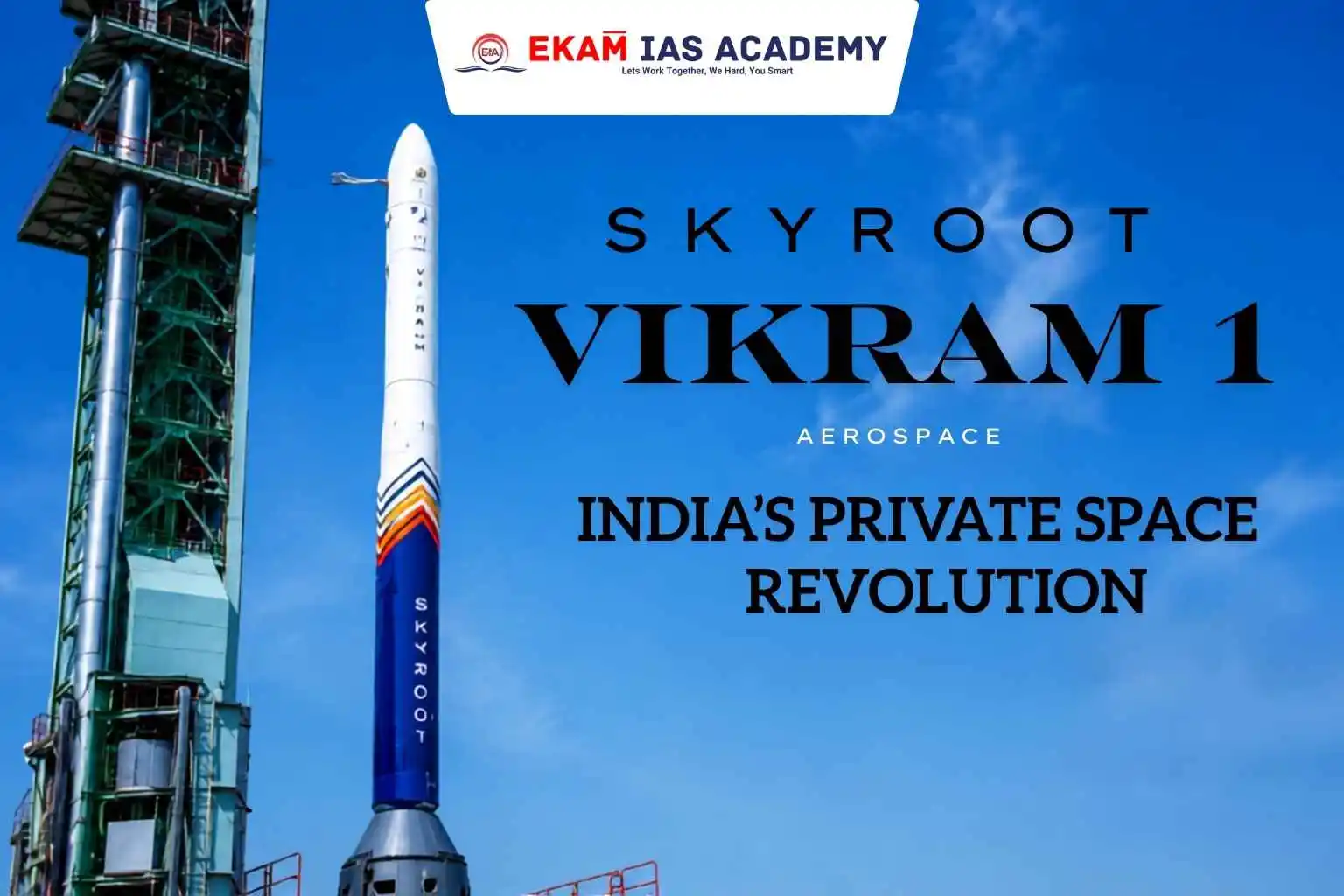
Skyroot Aerospace successfully launched its Vikram 1 rocket, marking a major milestone in India’s private space sector. This topic is important for aspirants preparing for GS3 Science & Technology through ias coaching in Hyderabad.
Key Highlights of the Launch
• Vikram 1 Targets Low Earth Orbit (LEO): Crucial for small satellites and commercial applications.
• Start-Up Ecosystem: India has 400+ space start-ups working across the value chain – from launch vehicles to downstream applications.
• Sector Valuation: ₹70,000 crore, expected to grow 4–5 times in the next decade.
• Collaboration: ISRO continues to work with private firms, ensuring synergy in missions like Chandrayaan and Gaganyaan.
Significance for India’s Space Economy
• Diversification: Private players reduce dependence on ISRO and expand commercial opportunities.
• Global Competitiveness: India aims to capture a larger share of the $440 billion global space economy.
• Innovation: Start-ups bring agility, cost-effective solutions, and new technologies (e.g., reusable rockets, space grade electronics).
• Employment: Expanding sector generates high-skill jobs in engineering, data analytics, and AI.
Policy and Institutional Support
• IN SPACe: Facilitates private participation.
• Space Policy 2023: Allows private firms to build, launch, and operate satellites independently.
• Government Encouragement: FDI in space technology and partnerships with global firms.
• Global Example: Skyroot’s success mirrors ventures like SpaceX (USA) and Rocket Lab (New Zealand).
Challenges Ahead
• Funding: Start-ups need sustained investment; venture capital in India’s space sector is still limited.
• Regulation: Balancing innovation with national security concerns.
• Technology Transfer: Dependence on ISRO for advanced tech must gradually reduce.
• Global Competition: Competing with giants like SpaceX requires scale and innovation.
Way Forward
• Strengthen public-private partnerships in satellite launches and deep space missions.
• Promote research collaborations with IITs and IISc for advanced propulsion and AI-based space systems.
• Expand international cooperation under initiatives like Artemis Accords.
• Encourage start-up incubation and funding through schemes like Startup India and Digital India.
Conclusion
The Vikram 1 launch by Skyroot marks the dawn of a new space age in India, where private innovation complements ISRO’s legacy to propel the nation into global leadership.