

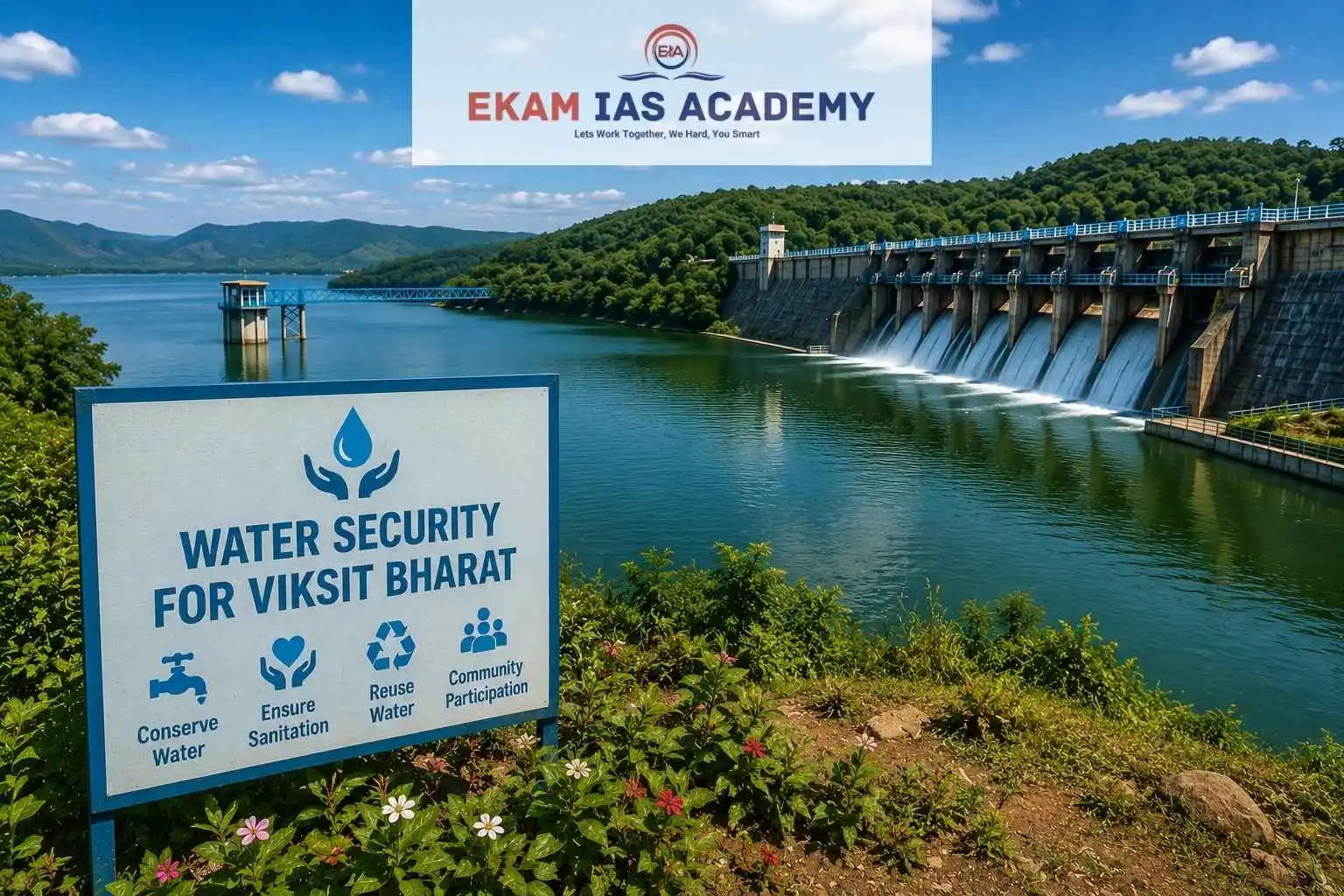
The Union Jal Shakti Minister highlighted that flagship schemes are transforming India’s water and sanitation landscape, making water security a cornerstone for achieving Viksit Bharat. This topic is important for aspirants preparing for GS1 Geography and water resource management issues through IAS coaching in Hyderabad.
What is Water Security?
• Defined by the UN as the capacity of a population to safeguard sustainable water supply, protect against water hazards, and preserve ecosystems.
• Includes protection against water-related risks such as floods, droughts, and pollution.
Transformation in Water Sector
Jal Jeevan Mission
• World’s largest rural drinking water programme.
• In 2019, only 17% of rural households (3.23 crore) had tap water.
• By 2026, 15.8 crore households (81%) have access; target is 100% by 2028.
• Saves 5.5 crore person-hours daily, empowering women and reducing waterborne diseases.
Swachh Bharat Mission
• World’s largest rural sanitation movement.
• WHO estimates 3 lakh diarrhoea deaths averted (2014–2019) due to SBM Grameen.
• SBM 2.0 focuses on solid & liquid waste management for sustainable villages.
• Improved toilets enhanced dignity, privacy, and safety for rural women.
Water Conservation & River Projects
Groundwater Recharge:
• Under Jal Sanchay Jan Bhagidari, 1.55 crore rainwater harvesting structures built till May 2026.
• Reduced over-exploited groundwater units, showing positive trends.
River Linking & Namami Gange:
• Ken–Betwa Project: India’s first major river interlinking, bringing water to Bundelkhand.
Namami Gange Programme:
- Sewage treatment capacity expanded to 4,260 MLD.
- Biochemical Oxygen Demand reduced from 26 TPD (2017) to 10.75 TPD (2024).
- Effluent discharge reduced from 349 MLD to 265.56 MLD.
- Water quality now meets bathing standards at monitored sites.
Broader Picture
• Population–Resource Imbalance: India has 18% of global population but only 4% of freshwater resources (FAO, 2025).
• Climate & Urbanisation Pressure: Changing rainfall patterns, rising temperatures, and rapid urban growth intensify water demand in agriculture, industry, and cities.
• Integrated Approach Needed: Drinking water, sanitation, irrigation efficiency, conservation, wastewater reuse, and climate resilience must be treated as one connected ecosystem.
• Global Lessons: Israel (water recycling) and Singapore (NEWater project) demonstrate that community participation combined with political will can reverse environmental stress.
Road Ahead
• Improve Efficiency: Agriculture consumes nearly 80% of India’s freshwater; micro-irrigation coverage must expand beyond current 11.7 million hectares (MoA, 2025).
• Promote Recycling: India generates 72,000 MLD of wastewater, but only 30% is treated (CPCB, 2024); scaling reuse can ease urban water stress.
• Strengthen Governance: Establish National Water Informatics Centre and enforce accountability in schemes like Atal Bhujal Yojana for groundwater management.
• Citizen Participation: Jal Sanchay Jan Bhagidari’s success (1.55 crore recharge structures) shows local communities are key to sustainable outcomes.
UN MEASURES & GLOBAL PRACTICES
- UN SDG‑6 (Clean Water & Sanitation): Calls for universal access to safe water by 2030.
- World Bank “Water Forward” Strategy: Aims to improve water security for 400 million people globally by 2030, with India as a key focus .
- Global Techniques:
- Israel: Recycles 85% of wastewater for agriculture.
- Singapore’s NEWater Project: Produces ultra‑clean water from treated wastewater, meeting 40% of demand.
China’s Sponge Cities: Urban design absorbs rainwater to reduce flooding and recharge aquifers.
Conclusion
Water security is not just a utility goal but the foundation of a resilient and developed India, essential for achieving Viksit Bharat.