

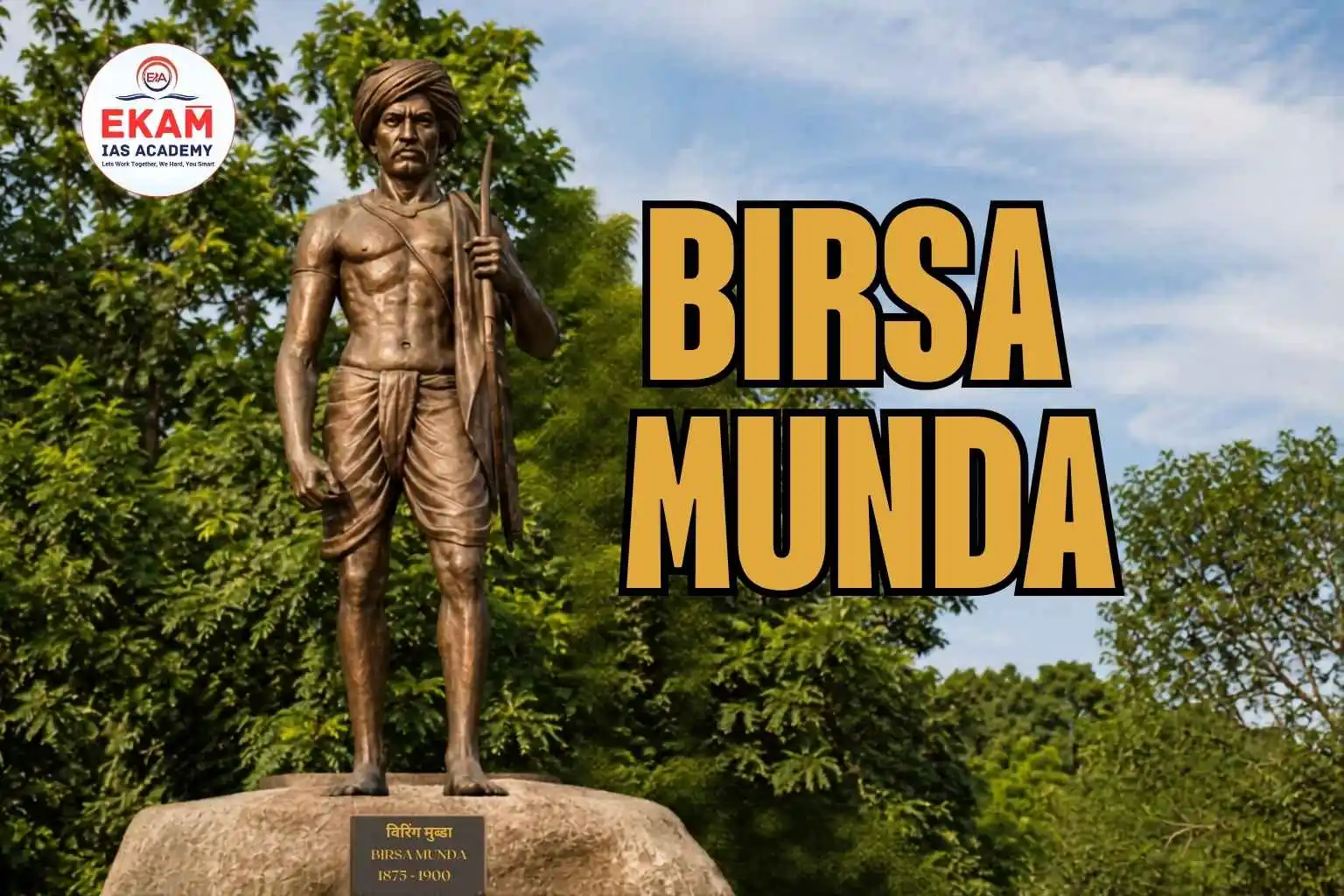
The legacy of Birsa Munda, the revolutionary tribal leader from Jharkhand, has gained renewed attention for his role in shaping Adivasi identity, tribal empowerment, and land protection laws. This topic is important for aspirants preparing for GS1 Modern History and tribal movements-related issues through IAS coaching.
Early Life and Background
• Birth and Origin: Birsa Munda was born in 1875 in Ulihatu village in present day Jharkhand.
• He belonged to the Munda tribe, known for its deep connection with forests, land, and community life.
• Colonial Context: British policies disrupted tribal land systems through the Zamindari system, displacing Adivasis and enabling exploitation by moneylenders and landlords.
• Cultural Awakening: Birsa initiated a socio religious movement promoting tribal unity, indigenous faith, and resistance to forced conversions.
ULGULAN MOVEMENT
The movement arose in the Chotanagpur plateau, where British land policies replaced the traditional Khuntkatti system (community ownership) with Zamindari, dispossessing tribal farmers.
- Leadership and Mobilization: Birsa Munda united various tribal groups — Mundas, Oraons, and Kharias — under a common banner of resistance, emphasizing “Abua Raj” (self‑rule).
- Timeline:
- Began around 1899 in Ranchi and Khunti regions.
- Reached its peak in 1900, when British forces suppressed the rebellion and arrested Birsa Munda.
- Nature of Revolt: It was both socio‑religious and political, combining spiritual revival with armed resistance against colonial exploitation.
- British Response: The British deployed military forces to crush the uprising, but the movement forced them to reconsider tribal land laws.
- Legal Outcome: The Chotanagpur Tenancy Act (1908) was enacted later, ensuring that tribal lands could not be transferred to non‑tribals — a direct legacy of Ulgulan.
- Religious Dimension: Birsa’s spiritual message rejected missionary dominance and revived indigenous faith, known as Birsaite Dharma, emphasizing purity and unity.
- Socio‑economic Impact:
- Strengthened tribal solidarity and identity.
- Inspired later tribal movements like Tana Bhagat Movement (1914–1920) and Jharkhand statehood movement.
Symbolism: “Ulgulan” became a metaphor for tribal assertion and dignity, influencing India’s later discourse on indigenous rights and environmental justice.
Birsa Munda’s Ideological Legacy
• Tribal Identity: Birsa redefined Adivasi identity as one rooted in land, forest, and community autonomy.
• Religious Reform: He advocated worship of a single god, moral discipline, and rejection of exploitative practices.
• Political Symbolism: His struggle inspired later tribal movements and the demand for Jharkhand statehood, achieved in 2000.
• National Recognition: The Government of India observes Birsa Munda Jayanti on November 15 as Janjatiya Gaurav Diwas.
Contemporary Relevance
• Policy Linkages: His ideals resonate in modern laws and schemes such as Van Dhan Yojana, PESA Act, 1996, and Forest Rights Act, 2006.
• Cultural Revival: Tribal art, language, and heritage are being revived through government initiatives and recognition efforts.
• Environmental Dimension: His emphasis on harmony with nature aligns with sustainable development goals and forest conservation policies.
• Rights Based Governance: His legacy continues to influence debates on land rights, forest rights, and tribal self governance.
Conclusion
Birsa Munda’s life stands as a powerful symbol of indigenous resistance, dignity, and empowerment. His legacy reminds India that true progress lies in protecting tribal heritage, ensuring land justice, and empowering communities rooted in forests and local traditions.