
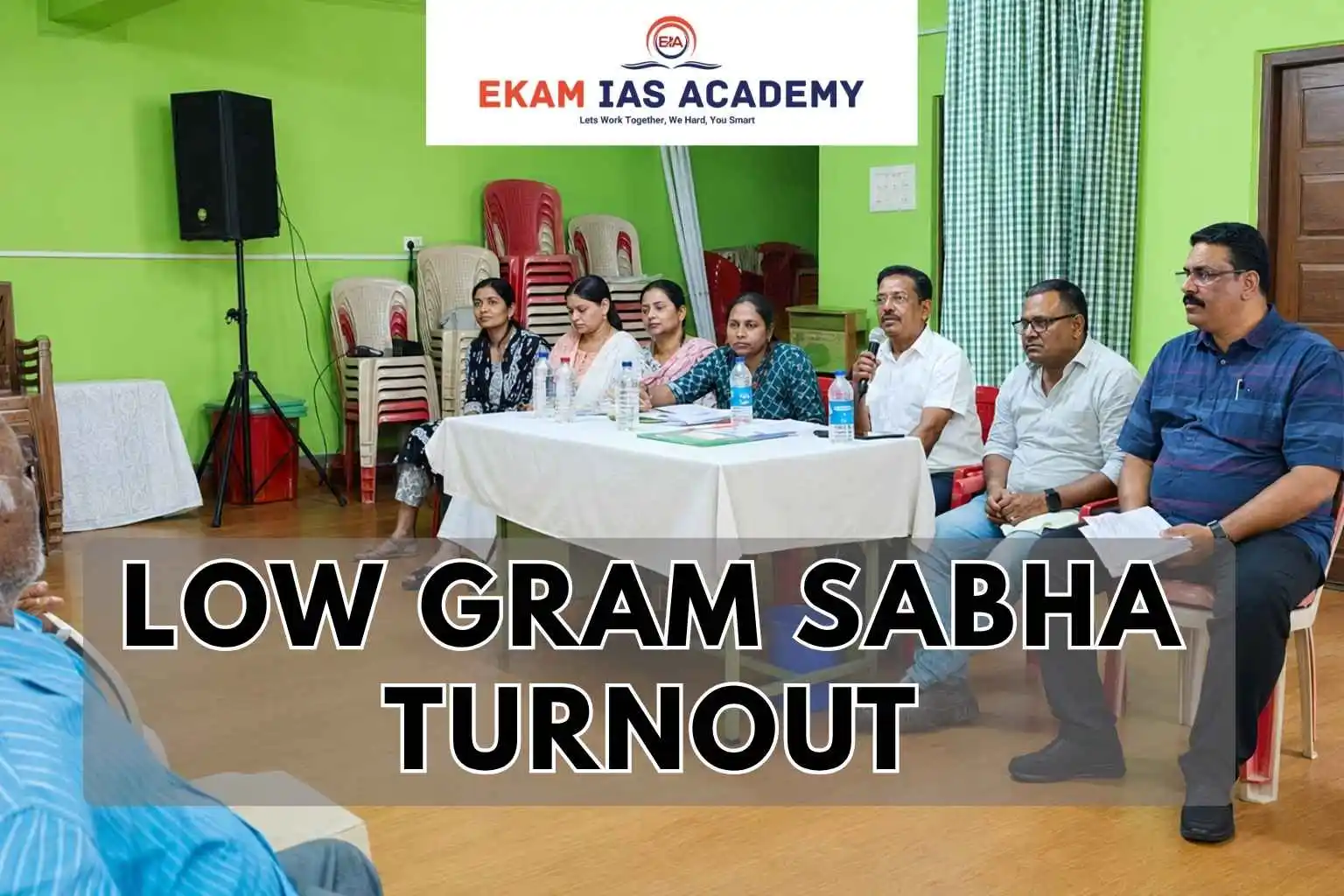
A Union government commissioned study by NIRDPR (Hyderabad) revealed that livelihood pressures and “participation fatigue” are the main reasons for low attendance in gram sabhas. This topic is important for aspirants preparing for GS2 Polity and local governance issues through IAS coaching in Hyderabad.
Gram Panchayat
• Definition: A Gram Panchayat is a village council and the foundation of rural self-governance in India, operating under the 73rd Constitutional Amendment Act, 1992, which gave constitutional status to Panchayati Raj Institutions (PRIs).
Structure
- Composed of Ward Members (Panchs) elected directly by villagers.
- Headed by a Sarpanch/Pradhan, elected either directly by villagers or indirectly by ward members (varies by state).
- Assisted by a Secretary, appointed by the state government, who handles records and administration.
- Term of elected representatives: 5 years.
Findings on Gram Sabha Participation
Awareness Levels:
- 94% respondents knew about gram sabha meetings.
- 83% were aware of their participation rights.
- Only 59% understood quorum and procedures, showing awareness does not always mean informed participation.
Attendance Trends:
- 47% attended only 1–2 meetings in the past year, reflecting low engagement.
- Daily wage labourers and migrant workers were most likely to miss meetings due to livelihood pressures, highlighting the clash between economic survival and civic participation.
Challenges
• Livelihood Constraints: Over 55% cited work commitments as the main barrier. Daily wagers lose income if they attend meetings.
• Participation Fatigue: Repeated meetings without visible outcomes reduce interest and dilute the significance of gram sabha processes.
• Transparency Concerns: 45% respondents felt decision-making lacked openness; weak grievance resolution eroded trust.
• Limited Outcomes: 42% cited absence of tangible results; 33% noted repetitive or formal meetings with little substance.
• Political Interference: 28% reported political dominance affecting discussions, undermining the participatory spirit envisioned in the 73rd Constitutional Amendment.
Way Forward
• Flexible Meeting Timings: Schedule meetings outside peak working hours to enable participation of daily wage earners and migrant workers.
• Transparency through Digital Records: Use online portals and public dashboards to record and disclose decisions, addressing concerns over openness.
• Strengthen Grievance Redressal: Establish clear mechanisms at the panchayat level to ensure grievances are not only heard but resolved.
• Capacity Building & Awareness: Conduct training and awareness campaigns to improve understanding of quorum and procedures; only 59% respondents currently know the rules.
Conclusion
Revitalising gram sabhas requires tackling livelihood barriers, ensuring transparency, and delivering visible outcomes. Only then can they serve as the true foundation of participatory democracy in rural India.