

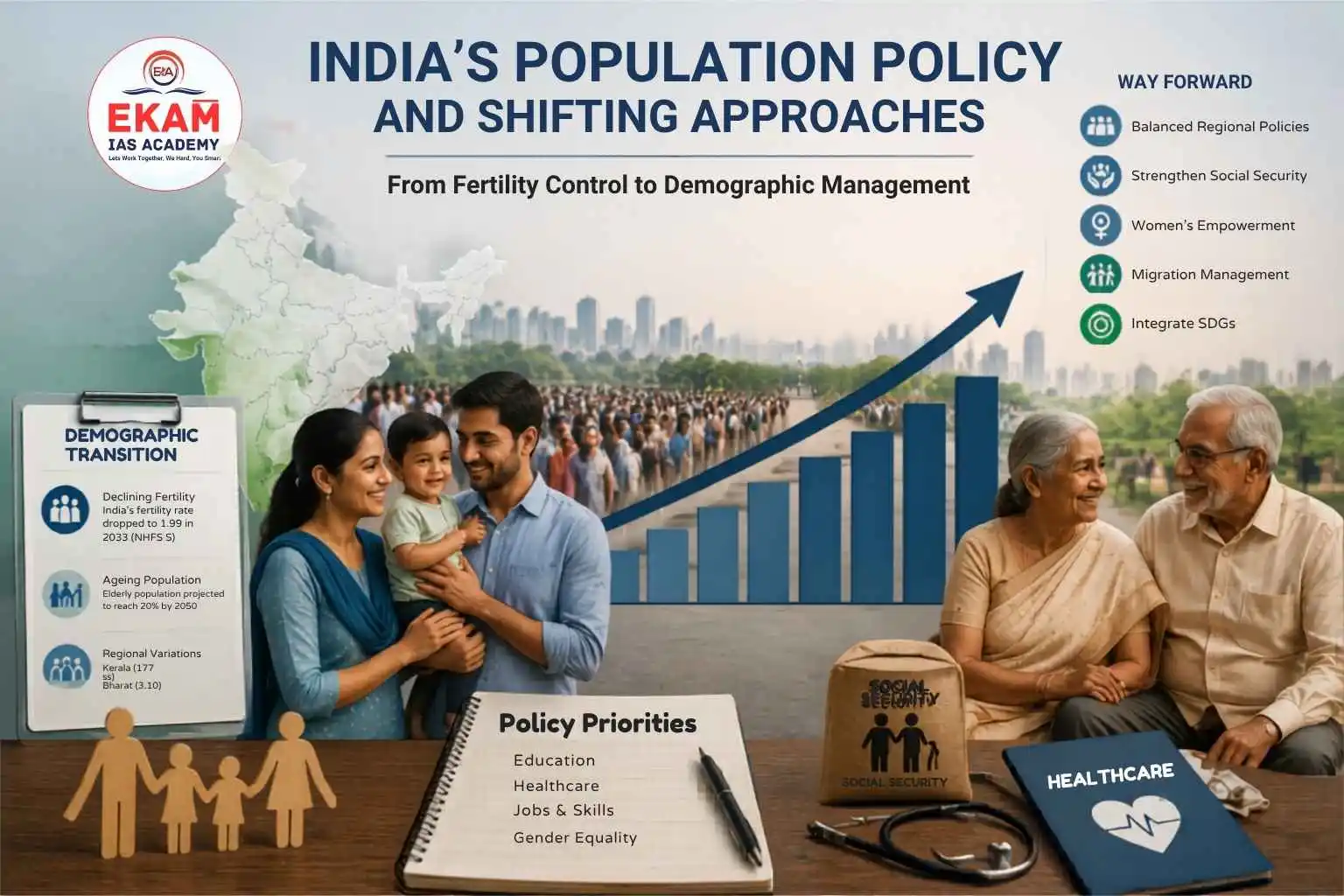
India’s policymakers are revisiting population control strategies as fertility rates decline, raising concerns about ageing and the need for balanced demographic planning. This topic is important for aspirants preparing for GS2 Polity and demographic studies-related issues through UPSC coaching in Hyderabad.
India’s Demographic Transition
• Declining Fertility Trends: India’s fertility rate has dropped to 1.99 in 2023 (NFHS 5), below the replacement level of 2.1. States like Kerala (1.7) and Tamil Nadu (1.6) show very low fertility, while Bihar (3.0) and Uttar Pradesh (2.7) remain higher.
• Policy Evolution: Earlier policies focused on reducing fertility through family planning. Today, the challenge is sustaining workforce size and addressing the ageing population, projected to reach 20% of the total population by 2050 (UN Population Division).
• Global Experience: Countries like Japan (fertility 1.3) and South Korea (fertility 0.7) struggle with ageing despite incentives like childcare subsidies and tax breaks. Their experience highlights the difficulty of reversing fertility decline once it sets in.
• Economic & Social Implications: India’s demographic dividend window (2020–2040) risks narrowing if job creation and social security do not keep pace. By 2036, India will have 315 million elderly citizens, creating pressure on pensions, healthcare, and welfare systems.
International Experience
• Japan: Despite incentives like childcare support, fertility remains low.
• China: Shifted from one-child policy to pro-natalist measures, but ageing continues.
• Europe: Countries like France offer family benefits, yet demographic transition persists.
India’s Demographic Studies
• Longitudinal Ageing Study in India (LASI): Found that 75 million elderly (60+) in 2020 will rise to 315 million by 2050, with high prevalence of chronic illnesses like hypertension (~45%) and diabetes (~20%).
• NITI Aayog Reports: Stress balanced demographic planning; note that 90% of India’s workforce is informal, requiring stronger social security and skill development.
• UN Population Projections: India will remain the most populous country till 2060, but growth is slowing — fertility rate has dropped to 1.99 (NFHS 5, 2023).
Implications
• Economic: Shrinking workforce — India’s working-age population share will peak at 59% by 2041, then decline, affecting productivity and GDP growth.
• Social: Rising demand for elderly care — by 2036, 140 million elderly will need pensions, healthcare, and social security.
• Political: Interstate migration reshapes demographics; e.g., Kerala and Tamil Nadu rely on migrant labour from Bihar and Uttar Pradesh, altering resource allocation.
• Health: Non-communicable diseases dominate — WHO estimates 60% of deaths in India are NCD-related, burdening healthcare systems.
Way Forward
• Balanced Regional Policies: Address fertility variations — Bihar (3.0) vs Kerala (1.7) — through tailored interventions.
• Strengthen Social Security: Expand pension and healthcare coverage; currently only 28% of elderly receive pensions (LASI 2020).
• Women’s Empowerment: Increase female labour force participation, which is just 25.7% in urban areas (PLFS 2025), to sustain workforce size.
• Migration Management: Develop policies to integrate migrant workers into low-fertility states, ensuring balanced workforce distribution.
• Integrate SDGs: Align demographic planning with SDG 3 (Health) and SDG 8 (Decent Work) to ensure inclusive growth.
Conclusion
India’s demographic shift demands a move from fertility control to holistic population management, ensuring both workforce sustainability and dignity for the ageing population.