
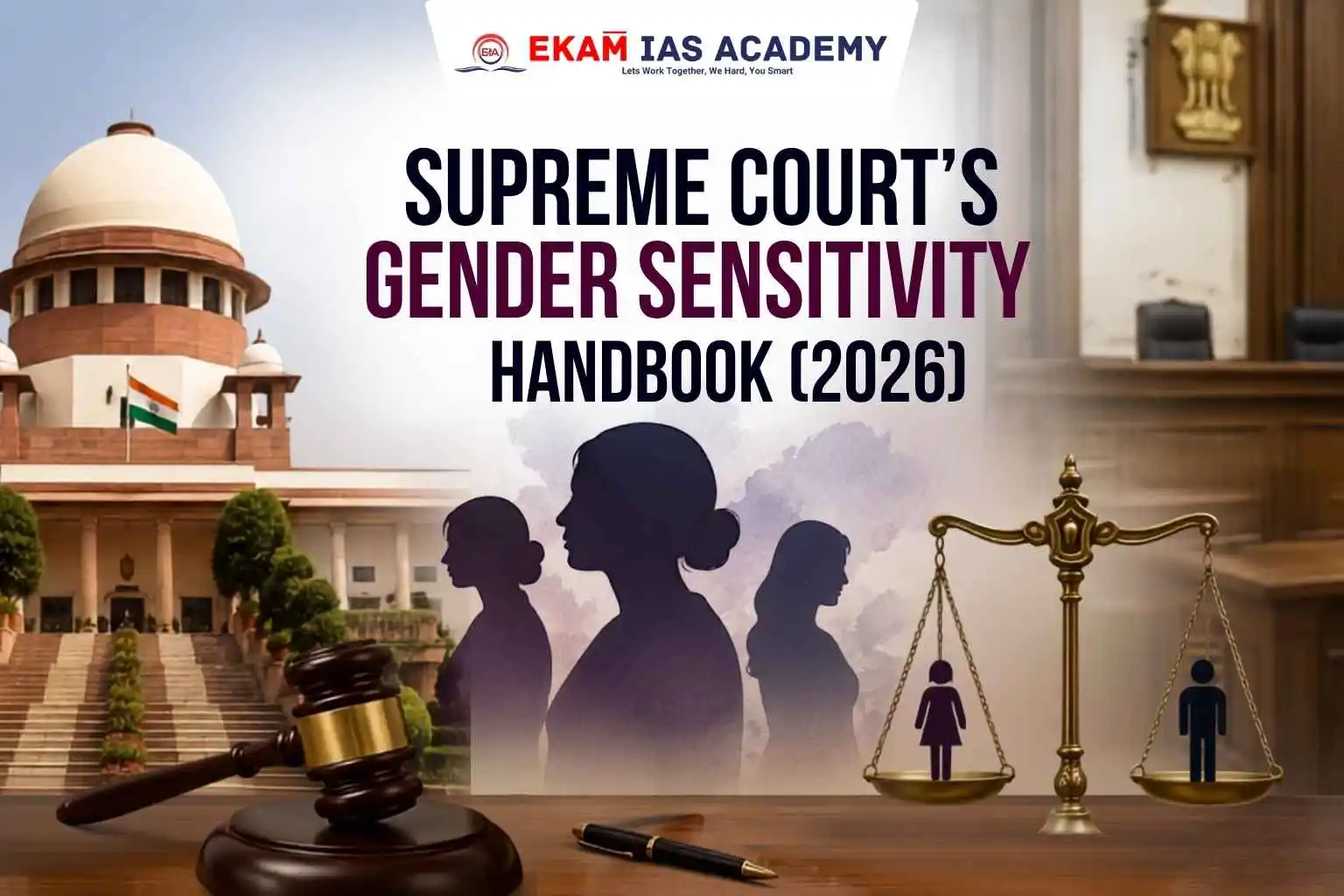
The Supreme Court’s Gender Sensitivity Handbook, 2026 titled “Judgments and Gender: Sensitivity and Compassion in Writing Judgments” aims to promote dignity, empathy, and fairness in judicial proceedings. Replacing the 2023 Handbook on Combating Gender Stereotypes, the new framework expands focus from courtroom language to victim support, witness protection, privacy, and inclusive judicial practices. This topic is important for aspirants preparing for GS2 Polity and Governance through IAS Preparation Institute in Hyderabad.
Combating Gender Stereotypes
- The judiciary plays a crucial role in ensuring justice not only through its decisions but also through the manner in which victims and witnesses are treated.
- Recognising the need for a more humane justice system, the Supreme Court has introduced the Gender Sensitivity Handbook, 2026.
- The report aims to promote empathy, dignity, and fairness in judicial proceedings, particularly in cases involving women, children, and vulnerable groups.
Background
- The report was prepared following the Supreme Court’s suo motu intervention in a 2025 Allahabad High Court judgment, which was criticised for its insensitive interpretation of an attempted rape case.
- During the hearing, Chief Justice Surya Kant observed that the 2023 handbook had limited practical impact and stressed the need for guidelines based on Indian realities.
- Consequently, the National Judicial Academy (NJA) constituted an expert committee under Justice Aniruddha Bose to prepare practical recommendations.
Major Features of the Handbook
Victim-Centric Justice
- Encourages courts to adopt a compassionate approach while dealing with victims and witnesses.
- Emphasises that judges should combine legal knowledge with empathy during trials.
- Seeks to prevent secondary victimisation caused by insensitive courtroom practices.
Compassionate Court Practices
- Witnesses should be treated with respect and dignity to encourage truthful testimony.
- Courts should ensure that victims receive legal aid and support persons at the earliest stage.
- Recommends pre-trial counselling to reduce fear and emotional stress.
- Advises courts to provide a comfortable environment by offering basic facilities such as seating and drinking water.
Fair Trial Procedures
- Judges should actively prevent humiliating or irrelevant cross-examination, especially regarding a survivor’s personal or sexual history.
- Supports in-camera proceedings, use of video conferencing, and protection of victims’ identities through initials or pseudonyms.
- Highlights the effective implementation of the Witness Protection Scheme, 2018 and Victim Compensation Scheme, 2018.
Language and Judicial Writing
- Recommends replacing emotional, moralistic, or stereotypical expressions with neutral and respectful language.
- Discourages the use of religious or cultural references while delivering judgments.
- Advises judges to avoid offensive expressions in regional languages as well.
Inclusive Approach
- Promotes the use of gender-neutral and inclusive terminology.
- Introduces the SOGIESC framework (Sexual Orientation, Gender Identity and Expression, and Sex Characteristics) to ensure respectful treatment of LGBTQIA+ persons.
- Recognises the experiences of transgender and gender-diverse individuals within the justice system.
How It Differs from the 2023 Handbook
- The 2023 handbook mainly focused on removing gender stereotypes from judicial language.
- The 2026 report expands its scope to include courtroom behaviour, victim support, privacy, witness protection, and judicial conduct.
- Unlike the earlier handbook, it is based on field studies, trial court judgments, and stakeholder feedback, making its recommendations more practical.
Significance
- Promotes a victim-friendly justice system.
- Strengthens access to justice for women, children, and vulnerable communities.
- Encourages gender-sensitive and inclusive judicial practices.
- Enhances public confidence in the judicial process through dignity and fairness.
Conclusion
By combining legal fairness with compassion, it seeks to improve the experience of victims and witnesses without compromising judicial independence. Its effective implementation can strengthen public trust and promote a more sensitive and accessible justice delivery system.