


The Taxation and Other Laws (Amendment) Bill, 2026 has proposed changes allowing banks and payment service providers to levy Merchant Discount Rate (MDR) on selected UPI and RuPay debit card transactions. The move aims to create a sustainable digital payment ecosystem while balancing merchant interests, financial viability, and global trade concerns. This topic is important for aspirants preparing for GS3 Economy through UPSC Economy Coaching in Hyderabad.
Introduction
- India’s Unified Payments Interface (UPI) has transformed the country’s digital payment ecosystem by enabling fast, secure, and low-cost transactions.
- Since 2020, merchants have not been charged any Merchant Discount Rate (MDR) on UPI payments, encouraging widespread adoption.
- However, with the rapid growth of digital transactions and increasing infrastructure costs, the government is considering a limited reintroduction of MDR while balancing financial sustainability and trade commitments.
What is Merchant Discount Rate (MDR)?
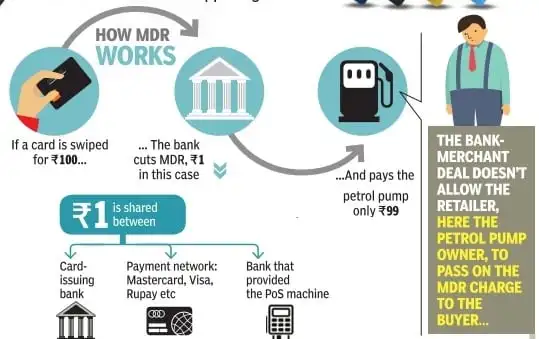
MDR is the fee paid by a merchant to banks or payment service providers for processing digital payments.
It helps cover expenses related to:
- Payment infrastructure and technology.
- Settlement and processing of transactions.
- Cybersecurity and fraud prevention.
- Maintenance of the digital payment network.
- Importantly, MDR is charged to merchants and not directly to customers.
Key Provisions of the Proposed Bill
- Permit the levy of MDR on UPI and RuPay debit card transactions.
- Apply the fee only to transactions above ₹2,000.
- Restrict the levy to large merchants crossing a specified turnover threshold.
- Continue free UPI services for small businesses and person-to-person (P2P) transactions.
- Thus, the proposal is not a tax on UPI users, but a fee on eligible merchants.
Why is MDR Being Considered Again?
- Since January 2020, the government has prohibited MDR on UPI transactions and compensated banks through subsidies.
- However UPI transactions have grown exponentially, increasing operational costs.
- Banks and payment providers incur expenses for servers, security, fraud detection, and settlement systems.
- Government reimbursement has not kept pace with the expanding digital payment ecosystem.
- The proposal aims to create a financially sustainable payment infrastructure.
Key Issues
- The US Trade Representative (USTR) has argued that India’s digital payment policies favour domestic platforms.
- It has expressed concerns regarding: Promotion of RuPay, The zero-MDR policy, Regulatory measures affecting foreign payment networks.
- Some believe that introducing MDR could partially address concerns regarding competitive neutrality.
Significance of the Proposal
- For the Digital Payment Ecosystem: Creates a sustainable revenue model for banks and payment providers. Supports continued investment in technology and cybersecurity.
- For Merchants: Large businesses may incur additional transaction costs. Small merchants continue to enjoy free digital payment acceptance.
- For India’s Economy: Reinforces confidence in the rapidly growing digital payment system. Balances financial sustainability with continued promotion of digital transactions.
Concerns
- Additional costs may discourage some large merchants from accepting digital payments.
- There is a need to ensure that the burden is not indirectly passed on to consumers.
- Policy decisions should protect India’s digital payment sovereignty while remaining consistent with global trade commitments.
Way Forward
- Adopt a balanced MDR structure that does not affect small businesses.
- Continue government support for promoting financial inclusion.
- Ensure transparent consultation with banks, payment companies, merchants, and consumer groups.
- Strengthen UPI infrastructure, cybersecurity, and fraud management to maintain public confidence.
- Align payment regulations with both domestic priorities and international trade obligations.
Conclusion
India’s proposal to introduce a limited Merchant Discount Rate reflects the need to make the digital payment ecosystem financially sustainable as transaction volumes continue to rise. A carefully designed framework can strengthen India’s digital economy while preserving the global success of UPI as a model of inclusive digital innovation.