
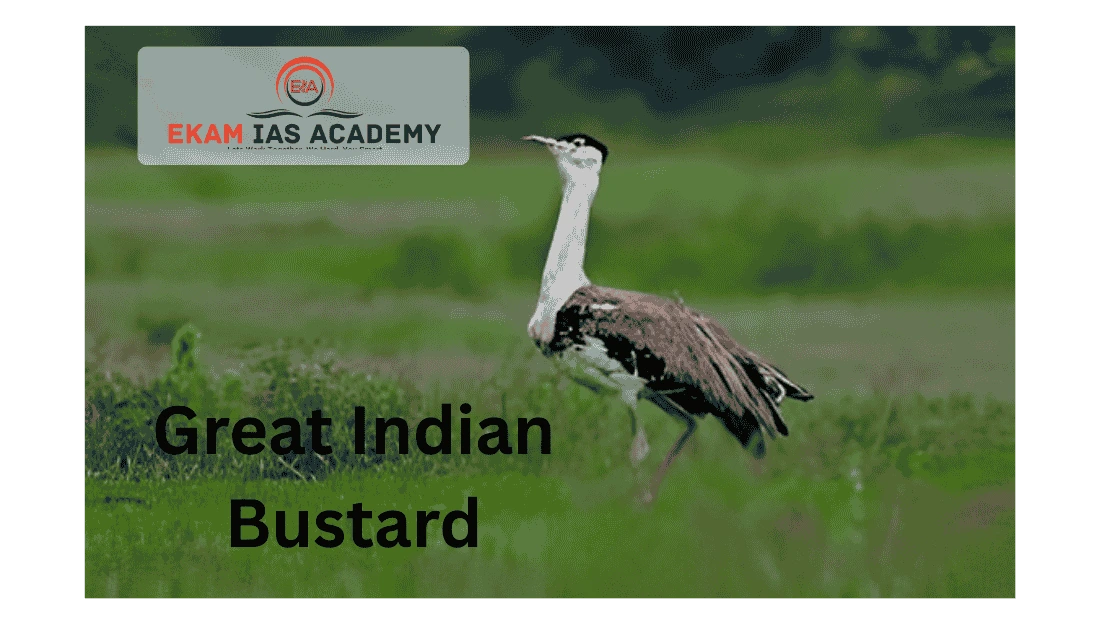
The Union Environment Minister recently informed Parliament that Project Great Indian Bustard has entered its fourth year of captive breeding, aiming to save this critically endangered bird from extinction. Such biodiversity conservation topics are highly relevant for aspirants preparing through IAS coaching in Hyderabad, UPSC online coaching, and other civil services preparation programs.
Great Indian Bustard
• Large terrestrial bird endemic to the Indian subcontinent.
• Habitat: Dry grasslands and scrublands, now shrinking due to agriculture and development.
• Distribution: Core population in the Thar Desert, mainly Jaisalmer and Barmer (Rajasthan).
Understanding species conservation and habitat protection is important for students preparing through UPSC coaching in Hyderabad and Hyderabad IAS coaching institutes, where environmental ecology forms a major part of the UPSC syllabus.
Characteristics
• Among the heaviest flying birds in the world (up to 15 kg).
• Horizontal body posture, long bare legs, resembles an ostrich.
• Lifespan: 12–15 years.
• Diet: Opportunistic feeders – grass seeds, insects (grasshoppers, beetles), small rodents, and reptiles.
These ecological characteristics are often covered in environmental modules taught in IAS coaching and civils coaching in Hyderabad, helping aspirants prepare for both UPSC Prelims and GS Paper 3.
Conservation Status
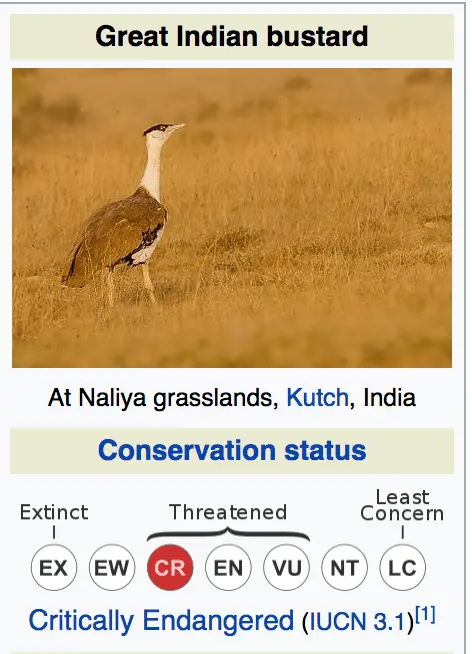
• IUCN Red List: Critically Endangered.
• CITES: Appendix I.
• Wildlife (Protection) Act, 1972: Schedule I (highest protection).
Knowledge of conservation status under international and national frameworks is crucial for aspirants enrolled in UPSC online coaching and structured UPSC coaching in Hyderabad programs.
Threats
• Habitat loss due to farming, mining, and infrastructure projects.
• Collision with power lines in desert regions.
• Low breeding rate and small population size.
• Poaching in some areas.
Such environmental threats are frequently analysed in Hyderabad IAS coaching classes to help aspirants understand the link between development and biodiversity conservation.
Conservation Efforts
• Project GIB: Captive breeding programme started in 2021, now in its fourth year.
• Supreme Court directive: Power lines in critical habitats to be undergrounded.
• Protected areas: Desert National Park (Rajasthan) is a key habitat.
• Community involvement: Awareness campaigns among local villagers and farmers.
These conservation initiatives are important case studies often discussed in IAS coaching and civils coaching in Hyderabad to strengthen answers in environment-related UPSC questions.
Conclusion
The Great Indian Bustard is a symbol of India’s grassland ecosystem but faces imminent extinction. Effective captive breeding, habitat protection, and strict enforcement of conservation measures are vital to ensure its survival. For aspirants preparing through IAS coaching in Hyderabad, UPSC coaching in Hyderabad, and UPSC online coaching, such environmental case studies are essential for understanding biodiversity conservation in India.
This topic is available in detail on our main website.