
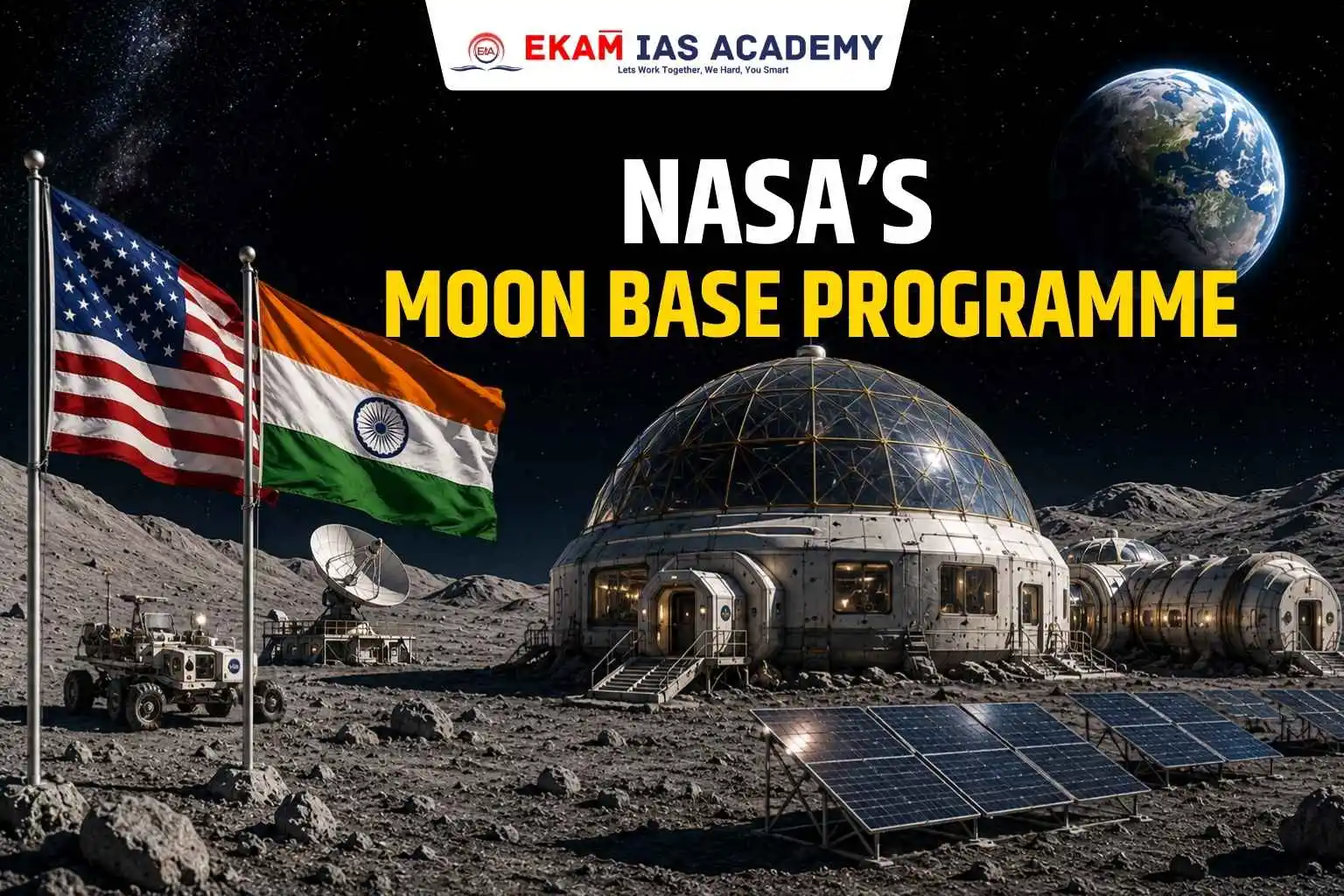
NASA’s proposed Moon Base Programme represents a major step towards establishing a long-term human presence on the Moon. The initiative focuses on creating a sustainable lunar outpost near the Moon’s South Pole, where resources like water ice can support future exploration. This topic is important for aspirants preparing for GS3 Science and Technology through Best IAS Coaching.
About the Programme
- Objective: Create humanity’s first lunar outpost for sustained habitation, research, and exploration.
- Location Significance: The South Pole is rich in water ice, vital for fuel, life support, and scientific study.
- Phased Approach: Step‑by‑step infrastructure development through robotic and crewed missions.
- Global Context: Builds on India’s Chandrayaan‑3 success (2023), which first accessed the South Pole region.
Phases of Development
Phase I (Now–2029)
- Robotic missions to test technologies.
- Identify suitable sites for infrastructure.
- Reduce risks before human arrival.
Phase II (2029–2032)
- Deploy initial infrastructure: power systems, logistics, communications.
- Expand operations for complex missions.
Phase III (2032 onwards)
- Establish permanent habitats.
- Enable astronauts to live and work for extended durations.
- Prepare for Mars exploration.
Strategic Dimensions
- Scientific Value: Unlocks new discoveries in planetary geology and resource utilization.
- Technological Leap: Advances in robotics, energy systems, and space logistics.
- Geopolitical Angle: Strengthens India’s role in global space governance, aligning with Artemis Accords.
- Economic Potential: Lunar resources (helium‑3, rare earths) could support future industries.
- Security & Diplomacy: Collaboration enhances India’s strategic partnerships with the U.S. and other spacefaring nations.
Conclusion
The Moon Base Programme marks a turning point in human space exploration, where India’s participation can elevate its global standing in science, technology, and diplomacy.