
The Ministry of Statistics and Programme Implementation (MoSPI) and the Ministry of Women and Child Development (MoWCD) have collaborated to launch the National Child Survey under Mission Vatsalya to create India’s first Child Well-being Index. The initiative aims to strengthen data-driven child welfare governance by assessing children’s health, education, protection, and social inclusion outcomes across States. This topic is important for aspirants preparing for GS2 Governance through UPSC Preparation.
Policy Framework for Child Welfare
- The initiative stems from the need for data-driven child welfare policies.
- India has multiple schemes for children. Mission Vatsalya, Poshan Abhiyaan, Saksham Anganwadi, and PM CARES for Children, but lacks a unified national database.
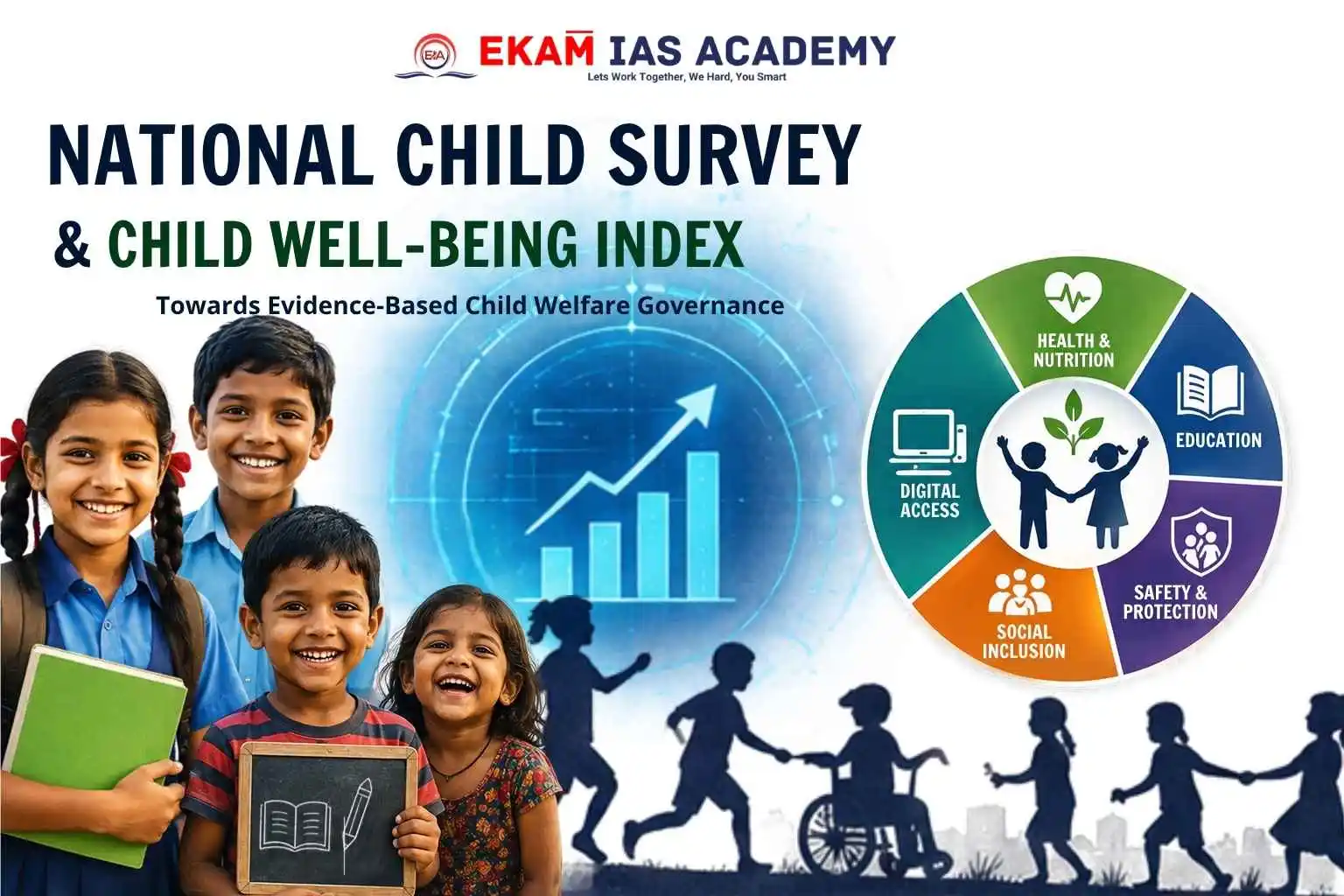
- The survey will cover health, nutrition, education, safety, and social inclusion indicators.
- It aligns with UNICEF’s global child development frameworks and India’s National Policy for Children (2013).
Objectives of the National Child Survey
- Data Integration: Combine child-related data from different ministries for a holistic view.
- Child Index Creation: Develop a composite index ranking states on child welfare parameters.
- Policy Support: Help design targeted interventions under Mission Vatsalya.
- Monitoring Progress: Track outcomes of schemes like Poshan 2.0 and Samagra Shiksha.
Mission Vatsalya
- Implemented by MoWCD, Mission Vatsalya focuses on child protection and welfare.
- It supports Child Care Institutions (CCIs), adoption agencies, and juvenile justice systems.
- The new survey will strengthen its evidence base for better resource allocation.
Dimensions of the Child Index
- Health & Nutrition: Immunization, malnutrition rates, access to healthcare.
- Education: Enrollment, learning outcomes, dropout rates.
- Safety & Protection: Child labour, trafficking, abuse prevention mechanisms.
- Social Inclusion: Access for children with disabilities and marginalized groups.
- Digital Access: Use of technology in education and protection services.
Significance
- Policy Alignment: Supports India’s SDG commitments (Goal 3, 4, 5, and 10).
- Inter-Ministerial Coordination: Encourages collaboration between MoWCD, MoSPI, and NITI Aayog.
- State Ranking: Promotes competition among states to improve child welfare outcomes.
- Evidence-based Governance: Strengthens accountability and transparency in child-related schemes.
Challenges
- Data Accessibility: Collecting reliable information from remote villages and informal urban settlements remains difficult due to poor connectivity and lack of records.
- Human Resource Capacity: Requires well‑trained enumerators and uniform survey methods to ensure accuracy and comparability across states.
- Digital Integration: Harmonising data systems across multiple ministries is a challenge, as platforms often work in silos without interoperability.
- Data Privacy: Safeguarding children’s personal information is critical; ethical use of data must be ensured to prevent misuse or breaches.
CHILD LABOUR
Child labour refers to the employment of children below the legal age in work that harms their physical, mental, or moral development.
Constitutional Safeguards:
- Article 24: Prohibits employment of children below 14 years in factories, mines, or hazardous occupations.
- Article 39(e) & (f): Directs the State to ensure children are not abused and receive opportunities for healthy development.
Statutory Framework:
- The Child Labour (Prohibition and Regulation) Amendment Act, 2016 bans child labour under 14 years and regulates adolescent work (14–18 years) in non‑hazardous sectors.
- Linked with Right to Education Act, 2009, ensuring compulsory schooling for children aged 6–14.
Institutional Mechanisms:
- National Child Labour Project (NCLP) provides rehabilitation and education for rescued children.
Mission Vatsalya integrates protection and rehabilitation through district child protection units.
Conclusion
The National Child Survey and Child Index under Mission Vatsalya mark a transformative step toward evidence-based child welfare governance, ensuring every child’s well-being is measured, monitored, and improved.