
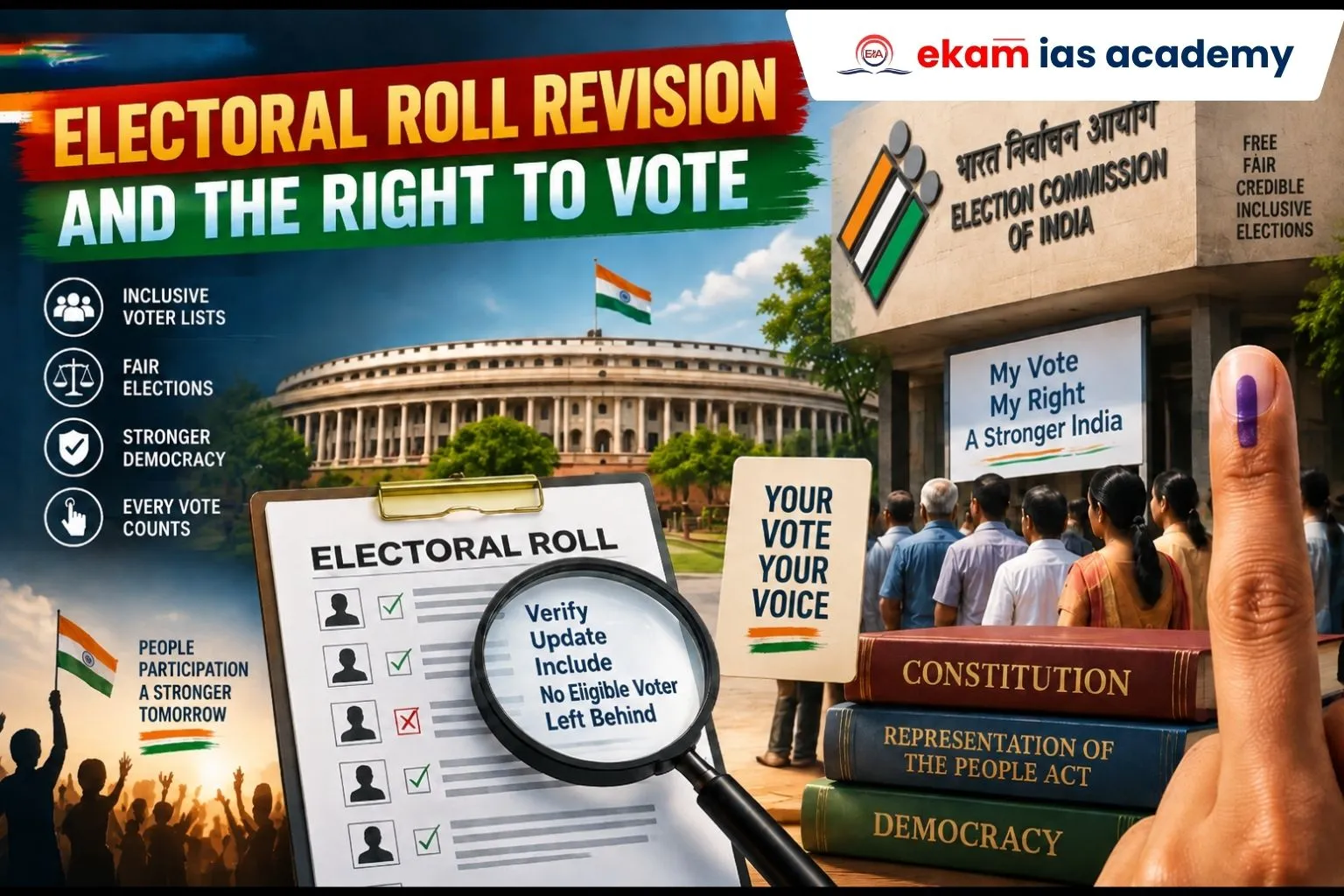
The ongoing Special Intensive Revision SIR 2026 of electoral rolls has raised concerns over wrongful exclusion of eligible voters, particularly in West Bengal and Delhi. The process of Electoral Roll Revision India plays an important role in maintaining accurate voter lists while protecting the Right to Vote in India.
Constitutional provisions
- Article 324: Gives the Election Commission of India (ECI) superintendence, direction and control over elections and Election Commission Electoral Roll preparation and management.
- Article 326: Provides for elections based on adult suffrage, subject to constitutional and statutory qualifications.
- The Representation of the People Act, 1950 and Registration of Electors Rules, 1960 provide the legal framework for Electoral Roll Revision and Voter List Revision India.
- ECI states that an eligible elector must generally be an Indian citizen, 18 years or above and ordinarily resident in the concerned constituency.
- The framework of Voter Registration India ensures eligible citizens are included while preventing duplicate and invalid entries.
Challenges
- Risk of wrongful exclusion: Large-scale deletion or non-inclusion during Electoral Roll Deletion and Inclusion processes can affect genuine voters if verification mechanisms are inadequate.
- Burden on citizens: Where discrepancies require individual clarification, elderly persons, migrants, poor households and persons with limited digital access may face greater difficulties.
- Verification capacity: A high number of claims and appeals can overwhelm appellate authorities, delaying restoration of eligible names.
- Documentation challenge: Linking present voters with older electoral records may create difficulties where names, addresses or spellings have changed.
- Urban migration: Cities such as Delhi have highly mobile populations, making residence verification particularly complex during SIR Electoral Rolls India exercises.
Broader Democratic Implications
- Universal adult franchise: Electoral rolls must balance two objectives—excluding ineligible entries while ensuring eligible citizens are not denied participation under the principle of Right to Vote in India.
- Public trust: Transparent criteria, accessible appeals and timely correction strengthen confidence in elections.
- Administrative neutrality: Verification should rely on objective evidence rather than assumptions based merely on database mismatches.
- The Supreme Court, during the Bihar SIR proceedings, emphasised facilitating voters in filing claims and objections, including through recognised political parties’ Booth Level Agents.
- Effective Electoral Reforms in India require balancing electoral integrity with citizen accessibility.
Way Forward
- Adopt a “verify before deletion” approach wherever feasible.
- Provide clear reasons and adequate notice before removing a voter.
- Strengthen EROs, appellate authorities and Booth Level Officers to manage claims rapidly.
- Use technology for verification while retaining human review and offline assistance.
- Maintain accessible digital services for search, registration and appeals; ECI currently provides these through its Voters’ Services Portal.
- Strengthen Election Commission of India UPSC topics related to electoral administration, transparency and democratic participation.
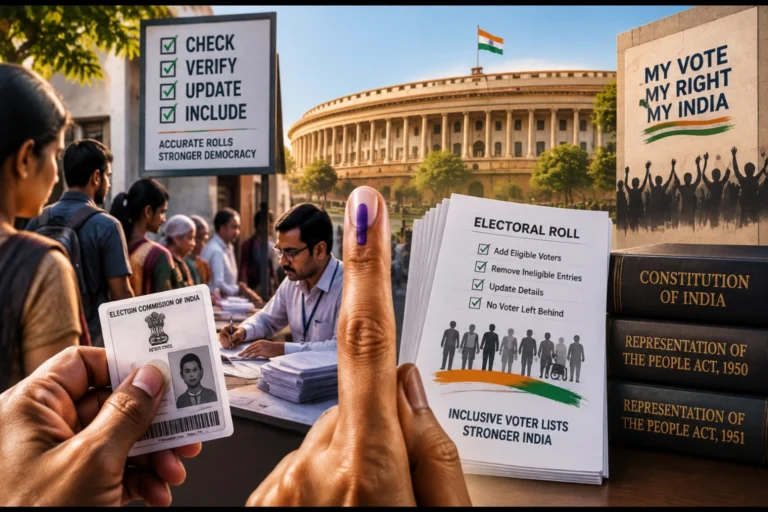
RIGHT TO VOTE
The Right to Vote in India means the legal right of an eligible citizen to participate in elections by casting their vote and choosing their representatives. It is an important aspect of democratic governance and a key area under Right to Vote UPSC preparation.
Constitutional Basis
- Article 326 provides for elections to the Lok Sabha and State Legislative Assemblies on the basis of adult suffrage.
- Every Indian citizen who is 18 years or above is eligible to be registered as a voter, subject to legal conditions.
- The voting age was reduced from 21 to 18 years by the 61st Constitutional Amendment Act, 1988.
- The process of inclusion through Electoral Roll Revision ensures eligible citizens can exercise their voting rights.
Is the Right to Vote a Fundamental Right?
No.
The right to vote is not a Fundamental Right under Part III of the Constitution.
It is primarily a constitutional/statutory right, governed by:
- Article 326 of the Constitution
- Representation of the People Act, 1950
- Representation of the People Act, 1951
Conclusion
Electoral Roll Revision and Right to Vote are closely connected with democratic participation. Electoral-roll purification must protect both electoral integrity and universal adult franchise, ensuring that genuine voters are not excluded through procedural or technological errors. Effective Electoral Roll UPSC understanding requires analysing voter inclusion, Election Commission powers and broader electoral reforms in India.