

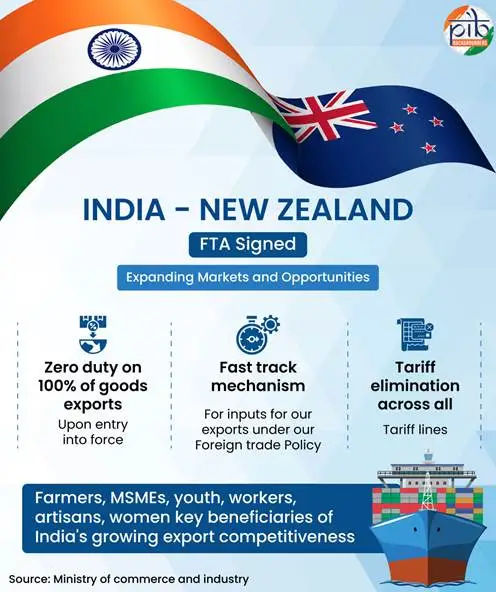
The India New Zealand Free Trade Agreement (India New Zealand FTA) will enter into force on 20 October 2026 after both countries completed their domestic approval processes. The India New Zealand Free Trade Agreement 2026 marks an important step in strengthening India New Zealand Trade Relations and expanding India New Zealand Bilateral Trade.
What is an FTA?
- A Free Trade Agreement is a pact through which countries reduce or remove trade barriers such as customs duties and improve market access.
- It may also cover services, investment, intellectual property, customs procedures, professional mobility and cooperation.
- Free Trade Agreements India UPSC topics are important as FTAs influence India’s trade policy, exports and economic diplomacy.
Key Features of India New Zealand FTA
- Duty-free exports: New Zealand will provide 100% duty-free access for Indian exports from day one under the India New Zealand Trade Deal.
- India’s market access: India has offered tariff concessions on 70.03% of tariff lines, covering about 95% of bilateral trade value. The remaining 29.97% are largely sensitive products.
- Investment: New Zealand has committed to facilitate US$20 billion of investment in India over 15 years, strengthening India New Zealand Economic Relations.
- Services: Greater opportunities for Indian IT, professional, tourism, education and other service-sector providers.
- Skilled mobility: A dedicated quota of 5,000 temporary employment visas for skilled Indians and 1,000 working-holiday visas annually for young Indians.
- Students: The agreement expands post-study work opportunities, including up to three years for STEM graduates and four years for doctoral scholars.
Protection of Sensitive Indian Sectors
- India has kept dairy, several agricultural products, sugar and edible oils outside tariff concessions under the India New Zealand FTA Negotiations framework.
- Selected products such as apples, kiwifruit and Manuka honey will receive calibrated access through Tariff Rate Quotas (TRQs), Minimum Import Prices and seasonal restrictions.
- This approach seeks to combine trade liberalisation with protection of vulnerable domestic producers while balancing India New Zealand FTA Benefits and domestic interests.
Significance for India
- Exports: Zero-duty access can improve the competitiveness of Indian textiles, leather, footwear, engineering goods, pharmaceuticals and processed foods under the India New Zealand Export Import framework.
- Employment: Expansion of labour-intensive exports can support employment, particularly for MSMEs and women workers.
- Investment: New Zealand capital can contribute to agriculture, manufacturing, infrastructure and start-ups.
- Agriculture: Cooperation in horticulture can improve productivity, post-harvest management and supply chains.
- Services and human capital: Easier mobility can expand opportunities for Indian professionals and students.
- Indo-Pacific partnership: The FTA complements the broader India New Zealand Relations UPSC perspective and Strategic Partnership and Roadmap to 2030.
Challenges
- Indian firms must improve quality, productivity and global standards to fully utilise market access.
- MSMEs may face difficulties in meeting certification, logistics and rules-of-origin requirements.
- Greater imports in selected sectors could create adjustment pressures for some domestic producers.
- Benefits will depend on effective implementation, awareness and utilisation by exporters.
- Successful implementation will determine the long-term impact of the India New Zealand Trade Agreement UPSC topic.
Way Forward
- Strengthen export infrastructure, testing facilities and trade-finance support for MSMEs.
- Build awareness about FTA concessions, rules of origin and certification requirements.
- Use the agreement to deepen cooperation in technology, skills, agriculture and innovation.
- Regularly monitor trade outcomes and provide targeted support to vulnerable domestic sectors.
- Strengthen India’s broader India FTA Policy to maximise benefits from future trade agreements.
Conclusion
The India New Zealand FTA can turn market access into wider gains in exports, investment, employment and technology while balancing domestic sensitivities. The agreement represents a significant milestone in India New Zealand Current Affairs and highlights India’s evolving approach towards global trade partnerships.