
Around 20 Trinamool Congress MPs have sought to merge with the Nationalist Citizens Party of India (NCPI), raising questions about the interpretation of the Tenth Schedule on party mergers and defections. This topic is important for aspirants preparing for GS2 Polity and constitutional law-related issues through IAS coaching in Hyderabad.
Origin of the Tenth Schedule
• Introduction: Enacted through the 52nd Constitutional Amendment (1985) to curb political instability caused by frequent defections in the 1960s–70s.
• Disqualification: Legislators who voluntarily give up party membership or vote against party directions can be disqualified.
• Distinction: Differentiates between the political party (entire organisation) and the legislature party (members in a House).
Merger Provisions
Original Exceptions:
- Paragraph 3: One-third of members splitting to form a separate group.
- Paragraph 4: Merger of a political party with another, approved by two-thirds of its legislature party.
• 91st Amendment (2003): Deleted Paragraph 3 to strengthen anti-defection law.
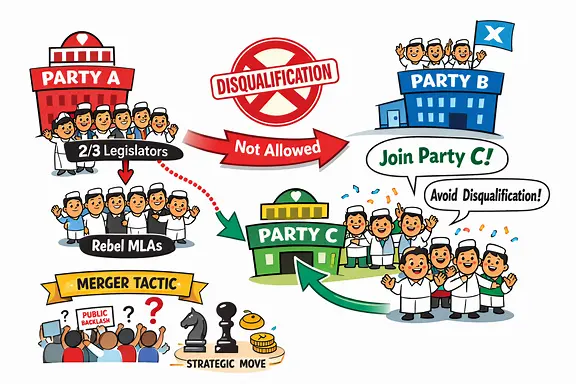
• Current Provision: Only merger of the original political party with another party is exempt from disqualification if two-thirds of its legislature party agrees.
Misuse After Deletion of Paragraph 3
• Legislators claim to be the “original political party” to escape disqualification.
• Examples:
- Shiv Sena (2022) and NCP (2023) splits.
- Rajasthan BSP MLAs (2019) merged with Congress.
- Goa Congress MLAs (2022) merged with BJP; upheld by Bombay High Court.
- AAP Rajya Sabha MPs (2026) merged with BJP.
• Current Bengal Case: 20 of 28 Trinamool MPs claim merger with NCPI under Paragraph 4.
Challenges
• Ambiguity in Merger: Unclear if two-thirds of legislature party alone can merge without parent party approval.
• Bias of Presiding Officers: Speakers/Chairmen often act in favour of ruling parties, undermining impartiality.
• Judicial Delays: Appeals pending in Supreme Court create uncertainty.
• Undermining Mandate: Frequent mergers dilute voter trust and weaken party discipline.
Way Forward
• Independent Tribunal: Supreme Court (K.M. Singh case, 2020) suggested transferring disqualification powers to a tribunal headed by judges.
• Law Commission Recommendation (1999): Deletion of Paragraph 4 advised to prevent misuse of merger provisions.
• Stronger Anti-Defection Law: Ensure any action against parent party leads to disqualification to maintain accountability.
• Transparency and Judicial Review: Speaker’s rulings must be transparent, with time-bound judicial oversight.
Tenth Schedule
Authority to Disqualify
- Presiding Officer:
- The Speaker of Lok Sabha/State Assembly or the Chairman of Rajya Sabha/Legislative Council decides on disqualification petitions under the Tenth Schedule.
- Their decision is considered final within the House, but subject to judicial review.
Judicial Remedy
- Judicial Review:
- Supreme Court in Kihoto Hollohan case (1992) upheld the constitutional validity of the Tenth Schedule but allowed judicial review of Speaker/Chairman’s decisions.
- Courts can intervene if the decision is mala fide, biased, or unconstitutional.
Supreme Court Recommendation (K.M. Singh case, 2020):
- Suggested creation of an independent tribunal headed by judges to decide disqualification cases, reducing political bias.
Law Commission Report (1999):
- Recommended deletion of Paragraph 4 (merger provision) to prevent misuse and ensure stricter anti‑defection law.
Conclusion
The misuse of merger provisions under the Tenth Schedule highlights the need for clearer constitutional safeguards and impartial adjudication to protect the sanctity of the voter’s mandate.