
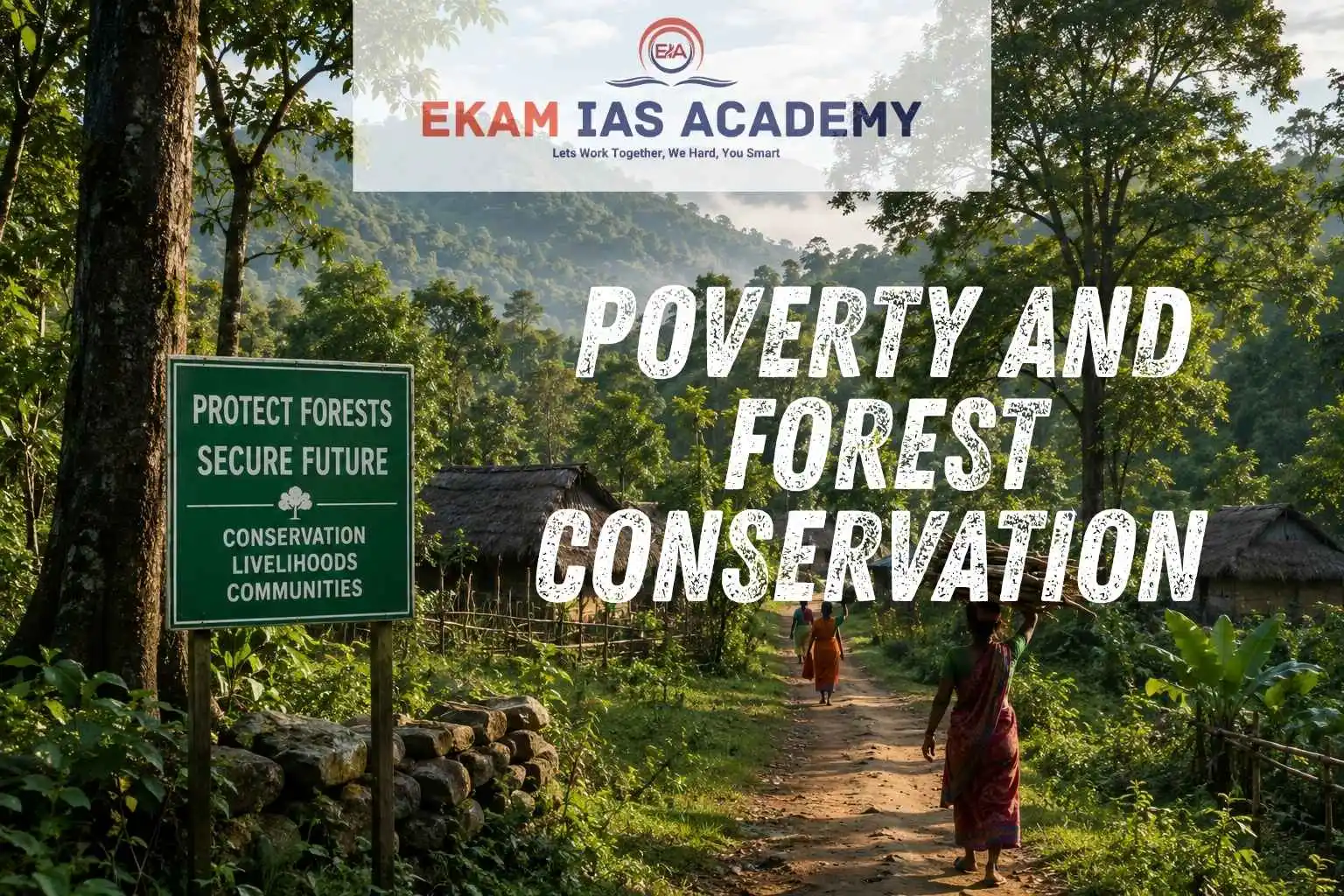
A new international study published in Nature Sustainability shows that alleviating poverty and providing alternative livelihoods can directly improve forest biodiversity. This topic is important for aspirants preparing for GS3 Environment and sustainable development-related issues through IAS coaching in Hyderabad.
Forest-Linked Livelihoods in India
• Dependence: Around 300 million people rely on forests for fuelwood, fodder, grazing, medicinal plants, and non-timber forest products (NTFPs) such as lac, tendu leaves, and bamboo.
• Tribal Communities: Forests are crucial for Scheduled Tribes, forming nearly 8.6% of India’s population, with many living in forest-fringe villages.
• Livestock Grazing: Forests provide grazing for ~30% of India’s livestock population, linking rural economy directly to forest health.
Findings of the Study
• Livelihood Link: Forests with higher poverty and dependence on fuelwood showed lower tree species diversity.
• Alternative Livelihoods: Communities with access to farming or other income sources had more diverse forests.
• Tree Diversity: Greater species richness supports wildlife, ecological stability, and resilience to climate change.
• Human Pressure: Poverty itself is not the cause; lack of livelihood options forces heavy reliance on forests.
Challenges
• Fortress Model Limitations: Protected areas managed by restricting human access have isolated forests, creating ecological stress.
• High Dependence: Around 275 million Indians rely on forests for daily needs, increasing extraction pressure.
• Implementation Gaps: Subsidised LPG and efficient stoves reduce fuelwood use but face inconsistent funding and weak community participation.
• Equity in Benefits: Wildlife tourism generates revenue, yet only a small fraction reaches forest-dependent communities.
Way Forward
• Inclusive Conservation: Empower local communities with rights, incentives, and roles in managing forests (Madhav Gadgil’s approach).
• Wildlife Corridors: Strengthen ecological links between protected areas to improve species richness and resilience.
• Community Partnerships: Expand initiatives like hornbill nest adoption (Arunachal Pradesh), mangrove co-management (Maharashtra), and snow leopard homestays (Ladakh).
• Livelihood Diversification: Promote farming, ecotourism, and sustainable aquaculture to reduce dependence on fuelwood.
• Revenue Sharing: Ensure greater share of tourism and conservation funds reach local communities.
• Policy Integration: Align forest conservation with poverty alleviation schemes like MGNREGA, National Rural Livelihood Mission, and Green India Mission.
India’s Forest Area (ISFR 2023)
- Total Forest Cover: 7,13,789 sq km (21.71% of India’s geographical area).
- Tree Cover: 95,003 sq km outside recorded forest areas.
- Carbon Stock: Forests store ~7,320 million tonnes of carbon, acting as a major sink.
- Global Position: India ranks 9th globally in forest area and 3rd in net annual forest area gain (FAO GFRA 2025).
UNCBD and Livelihood Promotion
- Kunming‑Montreal Global Biodiversity Framework (2022):
- Targets 30% of land and sea under conservation by 2030.
- Emphasises community participation and equitable benefit‑sharing from biodiversity use.
- Forest Ecosystem Restoration Initiative (FERI): Supports countries (including India) in restoring degraded forests and building livelihood opportunities.
- Collaborative Partnership on Forests: UNCBD works with FAO, UNFF, and UNCCD to integrate poverty alleviation with forest conservation, ensuring sustainable harvesting and market access for NTFPs.
Livelihood Focus: Encourages eco‑tourism, community forestry, and payments for ecosystem services, ensuring local communities benefit financially from conservation.
Conclusion
India can secure its forests not by excluding people, but by integrating poverty alleviation with conservation, ensuring that communities become partners in protecting biodiversity and enhancing ecological sustainability.