

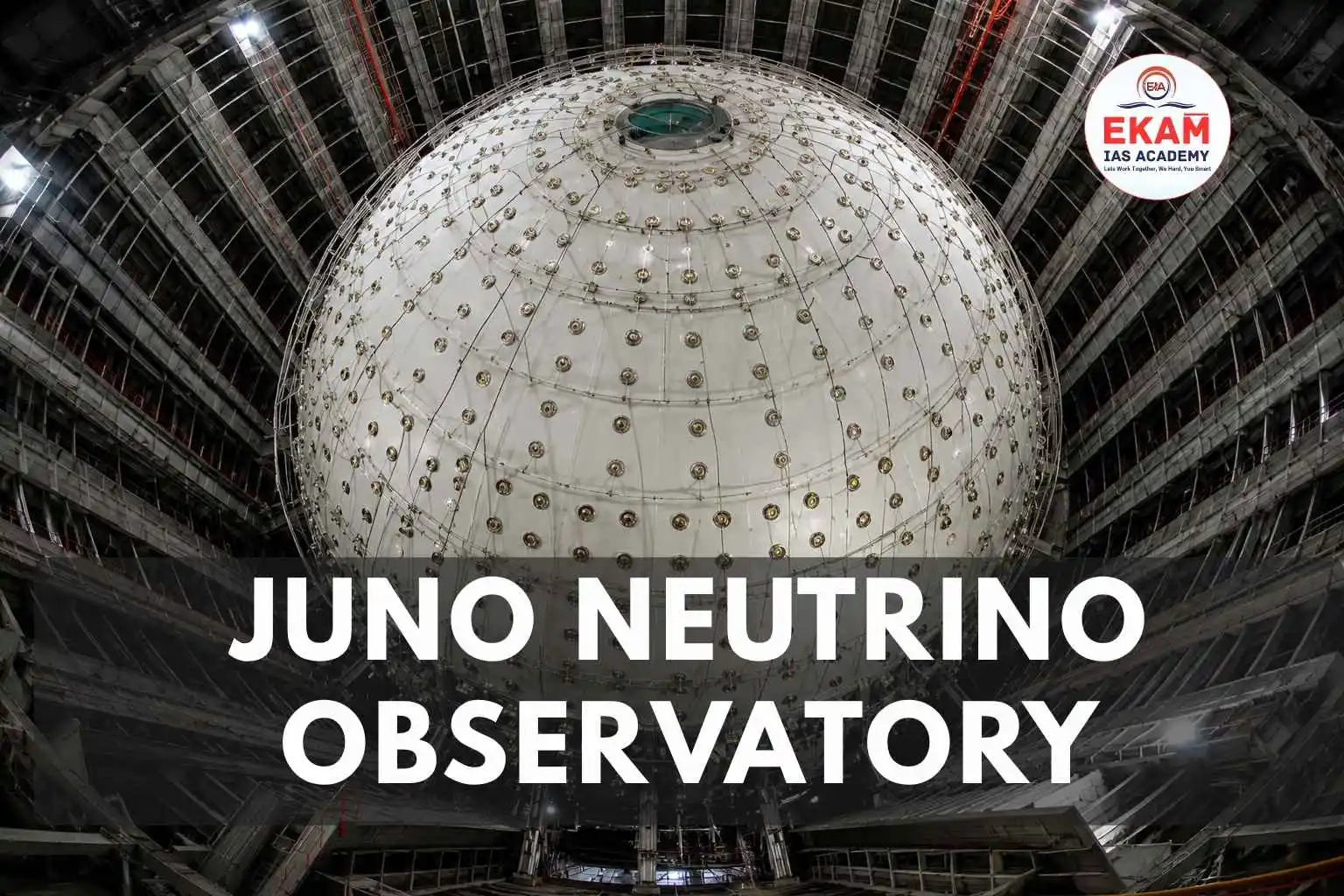
China’s Jiangmen Underground Neutrino Observatory (JUNO) recently released its first scientific results, measuring how neutrinos from nuclear reactors change their flavour while travelling. This topic is important for aspirants preparing for GS3 Science and Technology and particle physics-related issues through UPSC coaching in Hyderabad.
About JUNO
• Location: Situated near Kaiping city, Guangdong province, approximately 53 km from the Taishan and Yangjiang nuclear plants.
• Collaborating Institutions: Involves 74 institutions across Asia, Europe, and America, with around 700 scientists participating.
• Leadership: Led by the Chinese Academy of Sciences (CAS) via the Institute of High Energy Physics.
• Scale: World’s largest liquid scintillator detector — a 35 m radius sphere containing 20,000 tonnes of liquid scintillator.
• Design: Built underground at a depth of 700 m, designed for a 30-year scientific lifespan.
Scientific Goals
• Neutrino Mass Ordering: Primary aim is to determine the hierarchy of neutrino masses.
• Oscillation Studies: Measures oscillation patterns of electron antineutrinos from nuclear reactors.
• Precision: Offers higher accuracy than earlier experiments such as Daya Bay.
• Global Context: Part of next generation neutrino projects alongside Hyper-Kamiokande (Japan) and DUNE (USA).
What are Neutrinos?
• Ghost Particles: Elementary particles with no electric charge, extremely small mass (< one millionth of the electron mass), moving nearly at the speed of light.
• Interactions: Interact only via gravity and weak nuclear force, making detection extremely difficult.
• Sources: Produced in nuclear reactions, stellar processes, and particle decays.
• Scale: Most abundant particles in the universe; roughly 100 trillion neutrinos pass through the human body every second harmlessly.
• Significance: Crucial for particle physics, stellar physics, black hole studies, and Big Bang cosmology.
Broader Significance
• Advances fundamental physics by clarifying neutrino properties.
• Strengthens international scientific collaboration.
• Supports cosmology and astrophysics research, linking particle physics with the evolution of the universe.
• Provides insights relevant to India’s own neutrino projects, such as the India-based Neutrino Observatory (INO) in Tamil Nadu.
Conclusion
JUNO represents a milestone in global neutrino research, deepening our understanding of the universe’s most elusive particles and their role in fundamental physics.